Performance of different genotypes of pummelo (Citrus grandis L.) for softwood grafting success and growth parameters
DOI:
https://doi.org/10.31783/elsr.2023.912732Keywords:
pummelo, rootstock, softwood grafting, success, survivabilityAbstract
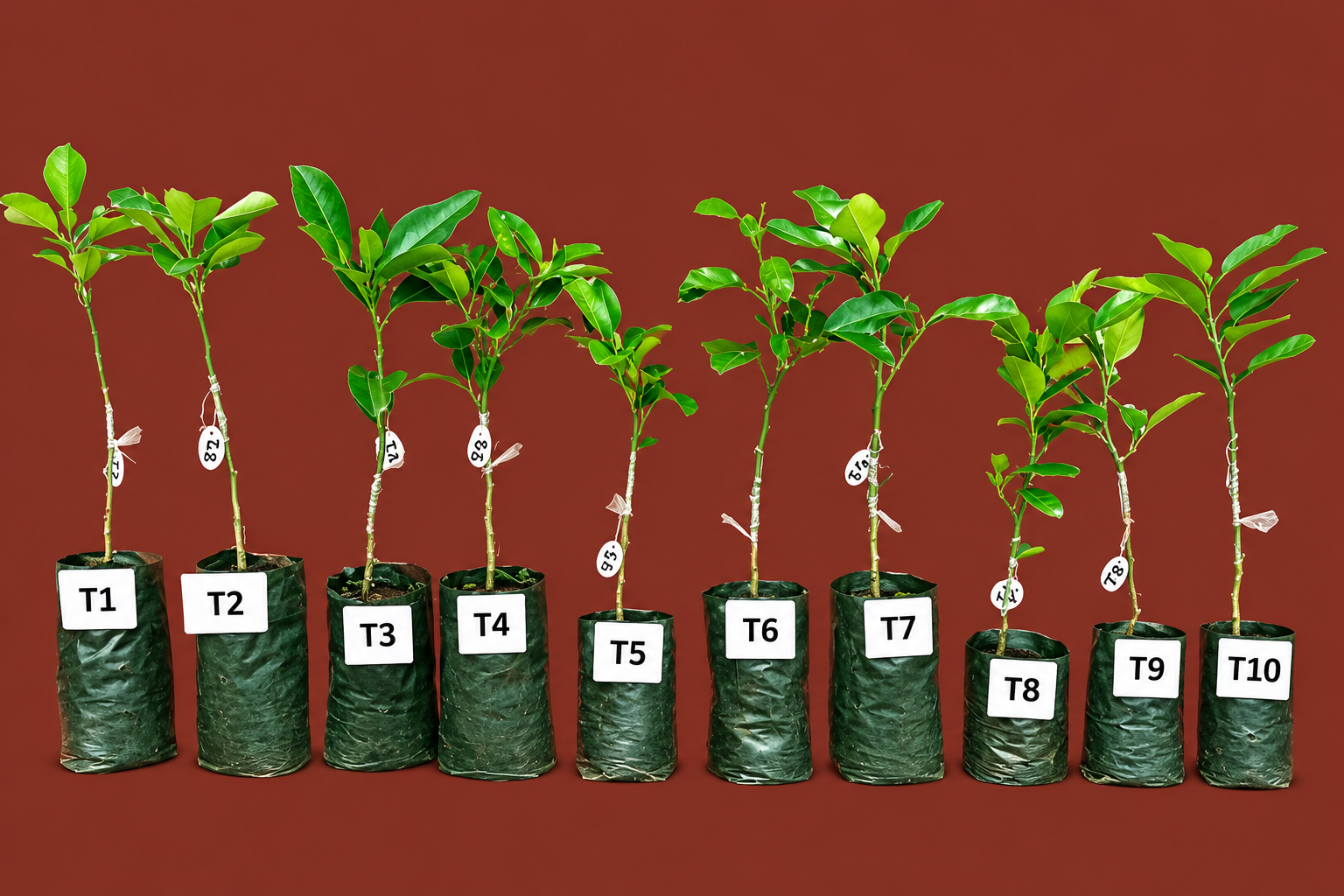
Pummelo (Citrus grandis L.) is one of the important tropical fruit crops among the citrus group. Since pummelo is a monoembryonic and cross-pollinated crop, vegetative propagation is critical for obtaining true-to-type plants. A study entitled “Performance of different genotypes of pummelo (Citrus grandis L.) for softwood grafting success and growth parameters” was carried out in the Department of Fruit Science, College of Horticulture Bengaluru in 2022. The experiment was laid out in a completely randomised design (CRD) with ten genotypes in three replications to know the response of softwood grafting success on locally gathered scions of elite Devanahalli pummelo genotypes was assessed. In February, they were grafted onto six-month-old rangpur lime rootstock. The results revealed that the genotype DSP-8 had recorded the significant minimum days (13) for bud breaking, the maximum graft success (96.67 %) and survivability (100.00 %). The genotype DSP-12 had a significantly maximum graft height at 30, 60, 90 and 120 days after grafting (DAG) (11.60, 14.73, 17.07 and 19.91 cm, respectively) and graft girth at 30, 60, 90 and 120 DAG (3.16, 3.95, 4.95, and 6.01 mm, respectively). Whereas the DSP-5 genotype had recorded significant maximum sprouts at 60, 90 and 120 DAG (3.67, 4.34 and 4.34, respectively) and the DSP-8 genotype had recorded the maximum number of leaves at 30, 60 and 120 DAG i.e., 7.67, 11.67 and 20.34. Among the different genotypes DSP-8 and DSP-12 recorded higher graft success, and these genotypes can be exploited for commercial production.
References
[1] A. Verdi (1988). Application of recent taxonomical approaches and new techniques to citrus breeding. In Proceeding of the 6th International Citrus Congress, Tel Aviv, Israel, March (6-11). Balaban Publishers, pp303-318.
[2] A. F. Ona, M. K. R. Bhuiyan, M. A. Emteas, M. Rakibuzzaman and A. F. M. J Uddin (2018). Influence of different rootstocks on survival of mandarin, sweet orange and pummelo grafting. Int. J. Bus. Soc. Sci. Res., 6: 36-39.
[3] S. D. Patil, P. L. Deshmukh and A. B. Purane (2017). Standardization of grafting time in custard apple (Annona squamosa L) cv. Balanagar. Trends in Biosci., 10: 2505-2506.
[4] W. S. Dilip, D. Singh, D. Moharana, S. Rout and S. S. Patra (2017). Effect of gibberellic acid (GA) different concentrations at different time intervals on seed germination and seedling growth of Rangpur Lime. J. Agroecol. Nat. Resour. Manag., 4: 157-165.
[5] H. T. Hartmann, D. E. Kester, F. T. Davies and R. L. Geneve (1997). Plant propagation: principal and practices. Prentice Hall, Upper Saddle River, NJ, USA, pp770.
[6] N. Akter, M. A. Rahim, and M. S. Alam (2017). Stionic relationship among three citrus species using cleft grafting. Int. J. Nat. Soc. Sci., 4: 38-45.
[7] M. M. Islam (2014). Effect of scion wood maturity and time of grafting on the success survivability and growth in cleft grafting of pummelo. Bangladesh Agricultural University, Bangladesh.
[8] M. H. Zimmerman (1958). Translocation of organic substances in trees. III. The removal of sugars from the sieve tubes in the white ash Fraxinus americana L. Plant Physiol., 33: 213-217.
[9] Y. Wang and R. Kollmann (1996). Vascular differentiation in the graft union of in vitro grafts with different compatibility- structural and functional aspects. J. Plant Physiol., 147: 521-33.
[10] N. A. Deshmukh, R. K. Patel, R. Krishnappa, B. C. Verma, H. Rymbai, S. R. Assumi, P. Lyngdoh et al., (2017). Influence of rootstock age and propagation methods on scion physiology and root morphology of Khasi mandarin (Citrus reticulata). Indian J. Agric. Sci., 87: 203-209.
[11] R. K. Patel, K. D. Babu, A. Singh, D. S. Yadav and L. C. De (2010). Soft wood grafting in Mandarin (C. reticulata Blanco): A novel vegetative propagation technique. Int. J. Fruit Sci., 10: 54-64.
[12] Z. Hussain, F. Khadija, A. Aziz, M. N. Khan, M. R. Salik and R. Anwar (2017). Evaluation of different grafting methods to citrus cultivars. Citrus R T., 38: 198-203.
[13] N. Bhandari, M. Basnet and S. Khanal (2021). Standardization of grafting time of mandarin (Citrus reticulata Blanco) in central mid hill of Nepal. Int. J. Fruit Sci., 21: 599-608.
[14] M. M. Rob, A. K. Singha, S. Basak, U. Habiba, M. F. Mondal and S. S. Nasreen (2016). Success of cleft grafting as affected by the number of scion nodes of Pummelo. Bangladesh J. Agriculturist, 9: 9-14.
[15] D. S. Skene, H. R. Shepherd and B. H. Howard (1983). Characteristic anatomy of union formation in T-and chip-budded fruit and ornamental trees. J. Hortic. Sci., 58: 295-299.
[16] B. Chalise, K. P. Paudyal and S. P. Srivastava (2013). Effect of grafting height on success and subsequent growth of acid Lime (Citrus aurantifolia Swingle) saplings. Nepal J. Sci. Technol., 14: 25-32.
[17] E. Widaryanto, A. Humaidah, A. Saitama and A. H. Zaini (2019). Techniques for accelerating of scion growth in Pummelo grafting (Citrus maxima L.). Asian J. Plant Sci., 18: 46-51.
[18] M. A. H. Talukder, M. M. Rahman, M. M. Hossain, M. A. K. Mian and M. Q. A. Khatiq (2014). Effect of rootstock and grafting methods on the graft success in mandarin. Ann. Bangladesh Agric., 19: 43-50.
Downloads
Published
Issue
Section
License
Copyright (c) 2023 Author (s)

This work is licensed under a Creative Commons Attribution-NonCommercial-NoDerivatives 4.0 International License.
Copyright © The Author(s). Effective from 1 July 2026, articles published in Emergent Life Sciences Research (ELSR) are distributed under the Creative Commons Attribution 4.0 International License (CC BY 4.0), which permits use, sharing, distribution, reproduction, and adaptation in any medium or format, provided that appropriate credit is given to the original author(s) and the source, a link to the license is provided, and any changes made are indicated.
Articles published before 1 July 2026 remain subject to the license applicable at the time of their original publication, including the Creative Commons Attribution-NonCommercial-NoDerivatives 4.0 International License (CC BY-NC-ND 4.0), where applicable.