
Geostatistical analysis of arsenic contamination in soil and comparison of interpolation techniques in Nadia district of Bengal, India
DOI:
https://doi.org/10.31783/elsr.2023.918390Keywords:
extractable arsenic, GIS, interpolationAbstract
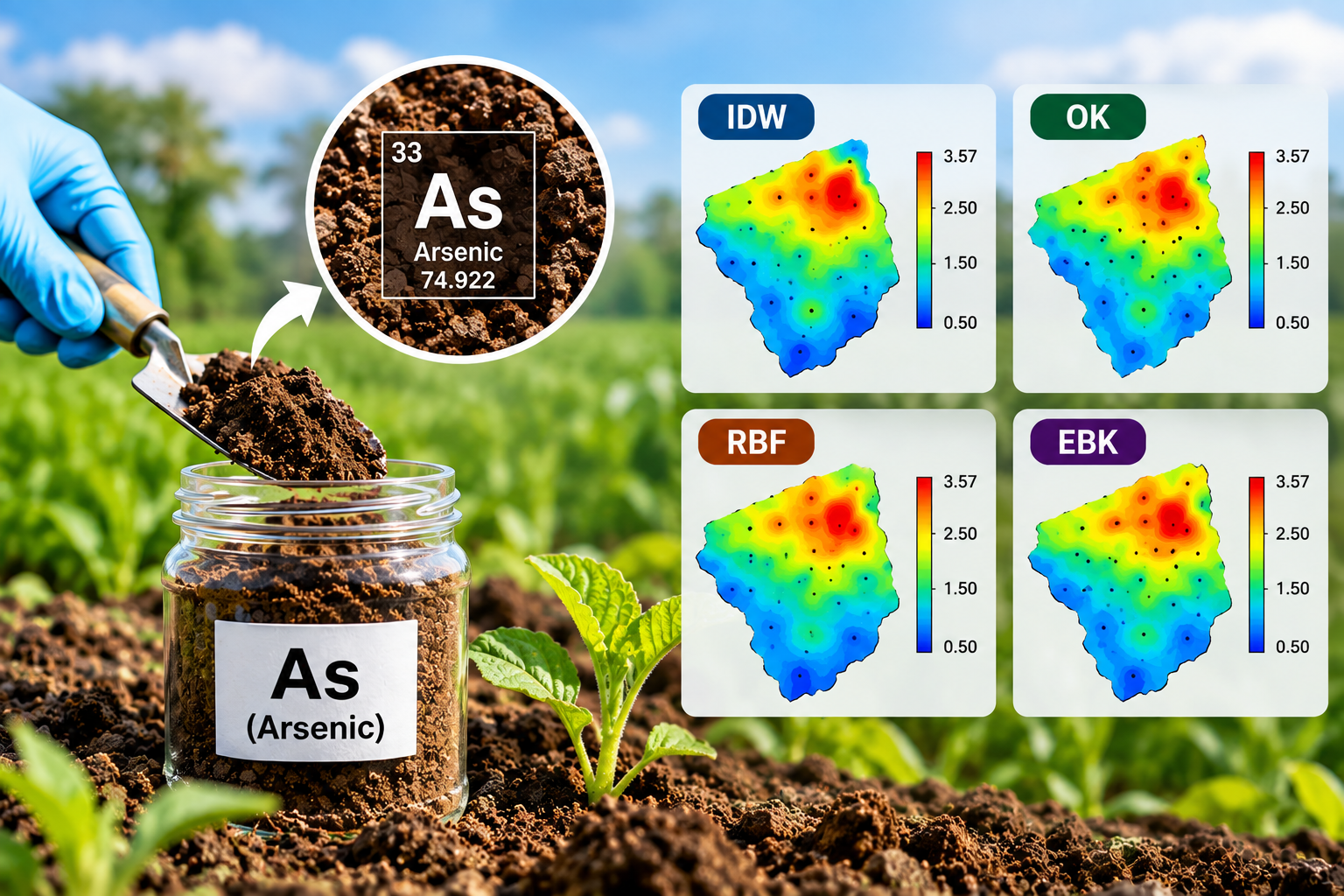
The contamination of soil and water with arsenic directly or indirectly affects millions of people, particularly in Southeast Asia. Efficiently managing contaminated sites cost-effectively requires an understanding of the spatial distribution of contamination in soil. In this study, different interpolation methods, including Ordinary Kriging (OK), Inverse Distance Weighted (IDW), Radial Basis Function (RBF), and Empirical Bayesian Kriging (EBK), were evaluated in the Bengal region to determine their effectiveness in predicting the Olsen extractable as content in the soil. The study found that the mean Olsen extractable content in soil was 1.45 mg kg-1, with a range of 0.48 to 3.57 mg kg-1. Geostatistical analysis showed that the northern side of Nadia had relatively high contamination, while the southern side had relatively lower contamination. The Root Mean Square Error (RMSE) values of the different interpolation methods ranged from 0.52 to 0.54, with corresponding mean cross-validation (CV) values ranging from -0.005 to 0.008. The predicted minimum and maximum values of as-in soil were in close agreement with the measured values for IDW interpolation, followed by OK, RBF, and EBK. The study found that IDW consistently provided the most precise predictions of pollution in the soil throughout space. These findings have significant implications for managing contamination in the Nadia West Bengal and other regions facing similar challenges.
References
[1] IARC International Agency for Research on Cancer (2012). IARC A review of human carcinogens. c. metals, arsenic, fibres and dusts. International agency for research on Cancer: Monographs on the evaluation of carcinogenic risks to humans.
[2] A. Ahmad and P. Bhattacharya (2019). Arsenic in Drinking Water: Is 10 μg/L a Safe Limit?, Curr. Pollut. Rep., 5: 1-3.
[3] X. Y. Xu, S. P. McGrath, A. A. Meharg and F. J. Zhao (2008). Growing Rice Aerobically Markedly Decreases Arsenic Accumulation, Environ. Sci. Technol., 42: 5574–5579.
[4] A. Kumar, M. S. Rahman, M. A. Iqubal, M. Ali, P. K. Niraj, G. Anand, P. Kumar and A. K. G. Abhinav (2016). Ground water arsenic contamination: a local survey in India, Int J Prev Med., 7: 100. doi: 10.4103/2008-7802.188085.
[5] M. K. Upadhyay, A. Shukla, P. Yadav and S. Srivastava (2019). A review of arsenic in crops, vegetables, animals and food products, Food Chem., 276: 608-618.
[6] M. K. Upadhyay, A. Majumdar, A. Barla, S. Bose and S. Srivastava (2019). An assessment of arsenic hazard in groundwater–soil–rice system in two villages of Nadia district, West Bengal, India. Environ. Geochem. Health., 41: 2381-2395.
[7] S. Rahaman, A.C. Sinha, R. Pati and D. Mukhopadhyay (2013). Arsenic contamination: a potential hazard to the affected areas of West Bengal, India. Environ Geochem Health., 35: 119-132.
[8] A. J. Signes-Pastor, J. Vioque, E. M. Navarrete-Muñoz, M. Carey, M. García de la Hera, J. Sunyer, M. Casas et al., (2017). Concentrations of urinary arsenic species in relation to rice and seafood consumption among children living in Spain. Environ. Res., 159: 69-75.
[9] Y. Xie, T.-b. Chen, M. Lei, J. Yang, Q. Guo, B. Song and X.-y. Zhou (2011). Spatial distribution of soil heavy metal pollution estimated by different interpolation methods: Accuracy and uncertainty analysis, Chemosphere, 82: 468-476.
[10] K. L. Hu, F. R. Zhang, H. Li, F. Huang and B. G. Li (2006). Spatial patterns of soil heavy metals in urban–rural transition zone of Beijing. Pedosphere, 16: 690-698.
[11] R. Abdulmanov, I. Miftakhov, M. Ishbulatov, E. Galeev and E. Shafeeva (2021). Comparison of the effectiveness of GIS-based interpolation methods for estimating the spatial distribution of agrochemical soil properties, Environ. Technol. Innov., 24: 101970. doi: 10.1016/j.eti.2021.101970.
[12] T. Panagopoulos, J. Jesus, M.D.C. Antunes and J. Beltrão (2006). Analysis of spatial interpolation for optimising management of a salinized field cultivated with lettuce. Eur. J. Agron., 24: 1-10.
[13] F. J. Aguilar, F. Agüera, M. A. Aguilar and F. Carvajal (2005). Effects of terrain morphology, sampling density, and interpolation methods on grid DEM accuracy. Photogramm Eng. Remote Sens., 71: 805-816.
[14] C. A. Gotway, R. B. Ferguson, G. W. Hergert and T. A. Peterson (1996). Comparison of Kriging and Inverse-Distance Methods for Mapping Soil Parameters. Soil Sci. Am. J., 60: 1237-1247.
[15] G. S. Bhunia, P. K. Shit and R. Maiti (2018). Comparison of GIS-based interpolation methods for spatial distribution of soil organic carbon (SOC). J. Saudi Soc. Agric. Sci., 17: 114-126.
[16] A. Saha, B. S. Gupta, S. Patidar and N. Martínez-Villegas (2022). Spatial distribution based on optimal interpolation techniques and assessment of contamination risk for toxic metals in the surface soil. J. S. Am. Earth Sci., 115: 103763. doi: 10.1016/j.jsames.2022.103763.
[17] S. R. Olsen, C. V. Cole, F. S. Watanabe and L. A. Dean (1954). Estimation of available phosphorus in soils by extraction with sodium bicarbonate, Washington, D.C., USA: U.S. Department of Agriculture
[18] R. Mirzaei and M. Sakizadeh (2016). Comparison of interpolation methods for the estimation of groundwater contamination in Andimeshk-Shush Plain, Southwest of Iran, Environ Sci Pollut Res., 23: 2758-2769.
[19] S. A. S. (2011). Institute, SAS/IML 9.3 user’s guide, Sas Institute.
[20] P. Bhattacharya, A. C. Samal, J. Majumdar and S. C. Santra (2010). Accumulation of arsenic and its distribution in rice plant (Oryza sativa L.) in Gangetic West Bengal, India, Paddy Water Environ., 8: 63-70.
[21] T. Roychowdhury, T. Uchino and H. Tokunaga (2008). Effect of arsenic on soil, plant and foodstuffs by using irrigated groundwater and pond water from Nadia district, West Bengal. Int. J. Environ. Pollut., 33: 218-234.
[22] A. Kabata-Pendias and B. Szteke (2015). Trace elements in abiotic and biotic environments, Taylor & Francis.
[23] D. Golui, D. N. G. Mazumder, S. K. Sanyal, S. P. Datta, P. Ray, P. K. Patra and S. Sarkar et al., (2017). Safe limit of arsenic in soil in relation to dietary exposure of arsenicosis patients from Malda district, West Bengal- A case study. Ecotoxicol. Environ. Saf., 144: 227-235.
[24] C. B. Manjarrez-Domínguez, J. A. Prieto-Amparán, M. C. Valles-Aragón, M. D. R. Delgado-Caballero, M. T. Alarcón-Herrera, M. C. Nevarez-Rodríguez and G. Vázquez-Quintero et al., (2019). Arsenic Distribution Assessment in a Residential Area Polluted with Mining Residues, Int. J. Environ. Res. Public Health., 16: 375. doi:10.3390/ijerph16030375.
[25] N. S. Magesh and L. Elango (2019). Spatio-Temporal Variations of Fluoride in the Groundwater of Dindigul District, Tamil Nadu, India: A Comparative Assessment Using Two Interpolation Techniques. GIS Geostat Techn Groundwater Sci, 283-296.
[26] P. Singh and P. Verma (2019). A comparative study of spatial interpolation technique (IDW and Kriging) for determining groundwater quality. GIS and Geostatistical Techniques for Groundwater Science. pp43-56. doi: 10.1016/b978-0-12-815413-7.00005-5.
Downloads
Published
Issue
Section
License
Copyright (c) 2023 Author (s)

This work is licensed under a Creative Commons Attribution-NonCommercial-NoDerivatives 4.0 International License.
Copyright © The Author(s). Effective from 1 July 2026, articles published in Emergent Life Sciences Research (ELSR) are distributed under the Creative Commons Attribution 4.0 International License (CC BY 4.0), which permits use, sharing, distribution, reproduction, and adaptation in any medium or format, provided that appropriate credit is given to the original author(s) and the source, a link to the license is provided, and any changes made are indicated.
Articles published before 1 July 2026 remain subject to the license applicable at the time of their original publication, including the Creative Commons Attribution-NonCommercial-NoDerivatives 4.0 International License (CC BY-NC-ND 4.0), where applicable.