Potentiality of nano minerals to combat ill effect of rice gruel feeding in ruminants
DOI:
https://doi.org/10.31783/elsr.2023.91103107Keywords:
gas production, In vitro gas production technique, pH, volatile fatty acidAbstract
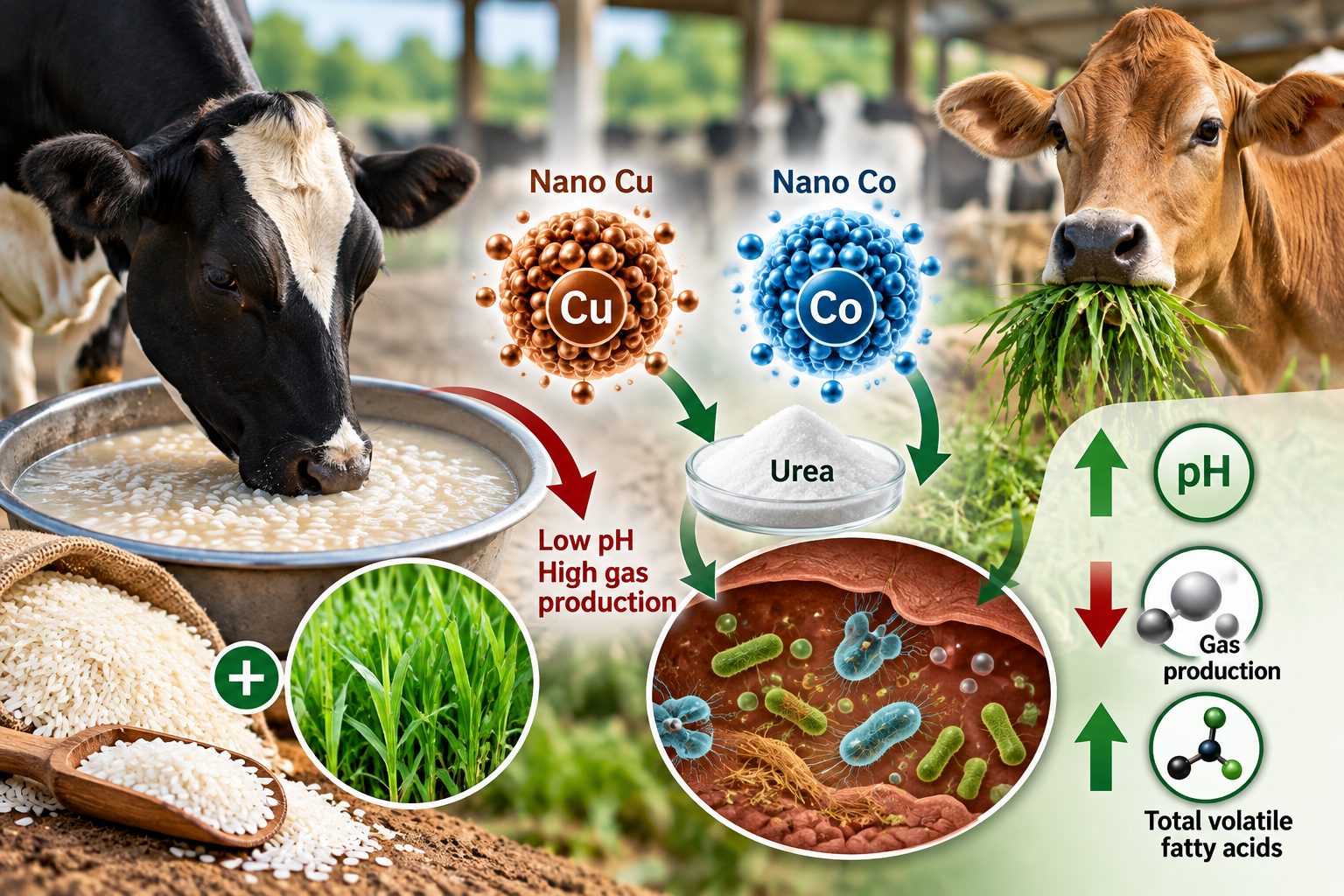
The study was carried out to assess the potentiality of nano minerals to prevent the negative impact of the rice gruel diet on the ruminants by conducting two experiments. In the first experiment, the pH and gas production of rice gruel was determined on the graded level of rice gruel gas production technique. In the second experiment, the level showing the lowest pH and highest gas production was selected for the demonstration of the effect of supplementing nano minerals (nano copper and nano cobalt) along with urea on pH, gas production and total volatile fatty acid. In the first experiment, it was found that the pH was lowest (p<0.05) and gas production was highest (p<0.05) for 80% rice gruel + 20% green grass, which was selected as basal diet in the second experiment. In the second experiment, the nano minerals at 12.22 mg/kg of copper and 0.25 mg/kg of cobalt and 7.5 mg / 100 g of urea were found to resist (p<0.05) the pH change, decreased (0.05) gas production and improved (p<0.05) total volatile fatty acid production. From this study, it can be inferred that the negative impact of the rice gruel-based diet can be reduced by supplementing the nano forms of copper and cobalt along with the urea.
References
[1] R. Suresh, V. Balakrishnan and P. Vasan (2018). Evolving safe and strategic supplementation to ruminants fed with rice gruel. Int. J. Curr. Microbiol. App. Sci., 7: 3260-3268
[2] R. Murugeswari, C. Valli, R. Karunakaran, V. Leela and A. S. S. Pandian (2018). Prevalence and magnitude of acidosis sequelae to rice-based feeding regimen followed in Tamil Nadu, India. Vet. World, 11: 464-468
[3] M. Alam, B. C. Das, M. M. Hassan, M. Ahaduzzaman, M. S. A. Faruk and M. Hasanuzzaman (2014). Ruminal acidosis- A case compilation study in SAQ Teaching Veterinary Hospital, Bangladesh, Vet. World, 7: 38-43.
[4] J. C. Plaizier, D. O. Krause, G. N. Gozho and B. W. McBride (2008). Subacute ruminal acidosis in dairy cows: The physiological causes, incidence and consequences. Vet. J., 176: 21-31
[5] K. M. Krause and G. R. Oetzel (2005). Inducing subacute ruminal acidosis in lactating dairy cows. J. Dairy Sci., 88: 3633-3639
[6] W. C. Stone (1999). The effect of subclinical acidosis on milk components. In: Cornell Nutrition Conference for Feed Manufacturers. Cornell Univ., Ithaca, NY, pp40-46
[7] R. Murugeswari, C. Valli, R. Karunakaran, V. Leela and A. S. S. Pandian (2020). Nutritional composition of cooked rice fed to dairy cattle of Tamil Nadu. Int. J. Livestock Res., 10: 81-89
[8] M. Riaz and G. Muhammad (2018). Copper deficiency in ruminants in Pakistan. Matrix Sci Medica, 2: 18-21.
[9] D. V. Reddy (2018). Principles of animal nutrition and feed technology, 3rd Edn. Oxford and IBH Publishing Co. Pvt. Ltd., New Delhi.
[10] K. K. Saxena and S. K. Ranjhan (1980). Effect of cobalt and copper supplementation on the ruminal pH, total nitrogen, ammonia and TVFA concentration in Hariana [Haryana] calves. Indian J. Anim. Sci., 50: 21-25.
[11] R. Rodriguez, A. Sosa and Y. Rodriguez (2007). Microbial protein synthesis in rumen and its importance to ruminants. Cuban. J. Agric. Sci., 41: 287-294.
[12] S. A. Abdelnour, M. Alagawany, N. M. Hashem, M. R. Farag, E. S. Alghamdi, F. U. Hassan and R. M. Bilal et al., (2021). Nanominerals: Fabrication methods, benefits and hazards, and their applications in ruminants with special reference to selenium and zinc nanoparticles, Animals, 11: 1916. doi: 10.3390/ani11071916.
[13] M. Blummel, H. P. S. Makkar and K. Becker (1997). In vitro gas production: A technique. J. Anim. Physiol. Anim. Nutr., 77: 24-34
[14] F. Li, Y. Cao, N. Liu, X. Yang, J. Yao and D. Yan (2014). Subacute ruminal acidosis challenge changed in situ degradability of feedstuff in dairy goats. J. Dairy Sci., 97: 5101-5109.
[15] G. W. C. Snedecor and G. William (1989). statistical methods/George w. Snedecor and William g. Cochran (No. QA276. 12. S6313 1989).
[16] Mir, S. A., M. A. Shah and S. J. D. Bosco (2017). Variations in brown rice quality among cultivars. In A. Manickavasagan, C. Santhakumar, & N. Venkatachalapathy (Eds.), Brown Rice. Springer, pp25-44.
[17] Ran, T., L. Jin, R. Abeynayake, A. M. Saleem, X. Zhang, D. Niu and L. Chen et al., (2021). Effects of brewers’ spent grain protein hydrolysates on gas production, ruminal fermentation characteristics, microbial protein synthesis and microbial community in an artificial rumen fed a high grain diet. J. Anim. Sci. Biotechnol., 12: doi: 10.1186/s40104-020-00531-5.
[18] Yabuuchi, Y., Y. Matsushita, H. Otsuka, K. Fukamachi and Y. Kobayashi (2006). Effects of supplemental lauric acid-rich oils in high-grain diet on in vitro rumen fermentation. Anim. Sci. J., 77: 300-307
[19] D. E. Axe, K. K. Bolsen, D. L. Harmon, R. W. Lee, G. A. Milliken and T. B. Avery (1987). Effect of wheat and high-moisture sorghum grain fed singly and in combination on ruminal fermentation, solid and liquid flow, site and extent of digestion and feeding performance of cattle. J. Anim. Sci., 64: 897-906.
[20] M. E. Tiffany, V. Fellner and J. W. Spears (2006). Influence of cobalt concentration on vitamin B12 production and fermentation of mixed ruminal microorganisms grown in continuous culture flow-through fermentors. J. Anim. Sci., 84: 635-640.
[21] M. R. Cameron, T. H. Klusmeyer, G. L. Lynch, J. H. Clark and D.R. Nelson (1991). Effects of urea and starch on rumen fermentation, nutrient passage to the duodenum, and performance of cows. J. Dairy Sci., 74: 1321-1336
[22] T. Ampapon and M. Wanapat (2021). Mitigating rumen methane and enhancing fermentation using rambutan fruit peel powder and urea in lactating dairy cows. J. Anim. Physiol. Anim. Nutr., 105: 1014-1023.
[23] L. R. Rebelo, I. C. Luna, J. D. Messana, R. C. Araujo, T. A. Simioni, Y. T. Granja-Salcedo and E. S. Vito et al., (2019). Effect of replacing soybean meal with urea or encapsulated nitrate with or without elemental sulfur on nitrogen digestion and methane emissions in feedlot cattle. Anim. Feed Sci. Technol., 257: 114293. Doi: 10.1016/j.anifeedsci.2019.114293.
[24] Q. Wu, S. K. La, C. Wang, J. Zhang, Q. Liu, G. Guo and W. J. Huo et al., (2021). Effects of coated copper sulphate and coated folic acid supplementation on growth, rumen fermentation and urinary excretion of purine derivatives in Holstein bulls. Anim. Feed Sci. Technol., 276: 114921. doi: 10.1016/j.anifeedsci.2021.114921.
[25] S. Kišidayová, P. Sviatko, P. Siroka, and D. Jalč (2001). Effect of elevated cobalt intake on fermentative parameters and protozoan population in RUSITEC. Anim. Feed Sci. Technol., 91: 223-232.
[26] D. J. Schingoethe, H. H. Voelker, G. L. Beardsley and J. G. Parsons (1976). Rumen volatile fatty acids and milk composition from cows fed hay, haylage, or urea-treated corn silage. J. Dairy Sci., 59: 894-901.
Downloads
Published
Issue
Section
License
Copyright (c) 2023 Author (s)

This work is licensed under a Creative Commons Attribution-NonCommercial-NoDerivatives 4.0 International License.
Copyright © The Author(s). Effective from 1 July 2026, articles published in Emergent Life Sciences Research (ELSR) are distributed under the Creative Commons Attribution 4.0 International License (CC BY 4.0), which permits use, sharing, distribution, reproduction, and adaptation in any medium or format, provided that appropriate credit is given to the original author(s) and the source, a link to the license is provided, and any changes made are indicated.
Articles published before 1 July 2026 remain subject to the license applicable at the time of their original publication, including the Creative Commons Attribution-NonCommercial-NoDerivatives 4.0 International License (CC BY-NC-ND 4.0), where applicable.