A review to investigate the nutrient profile of the nutrient-dense seed Lepidium sativum L.
DOI:
https://doi.org/10.31783/elsr.2023.91108113Keywords:
antioxidant, garden cress, malnutrition, nutritional composition, proximate compositionAbstract
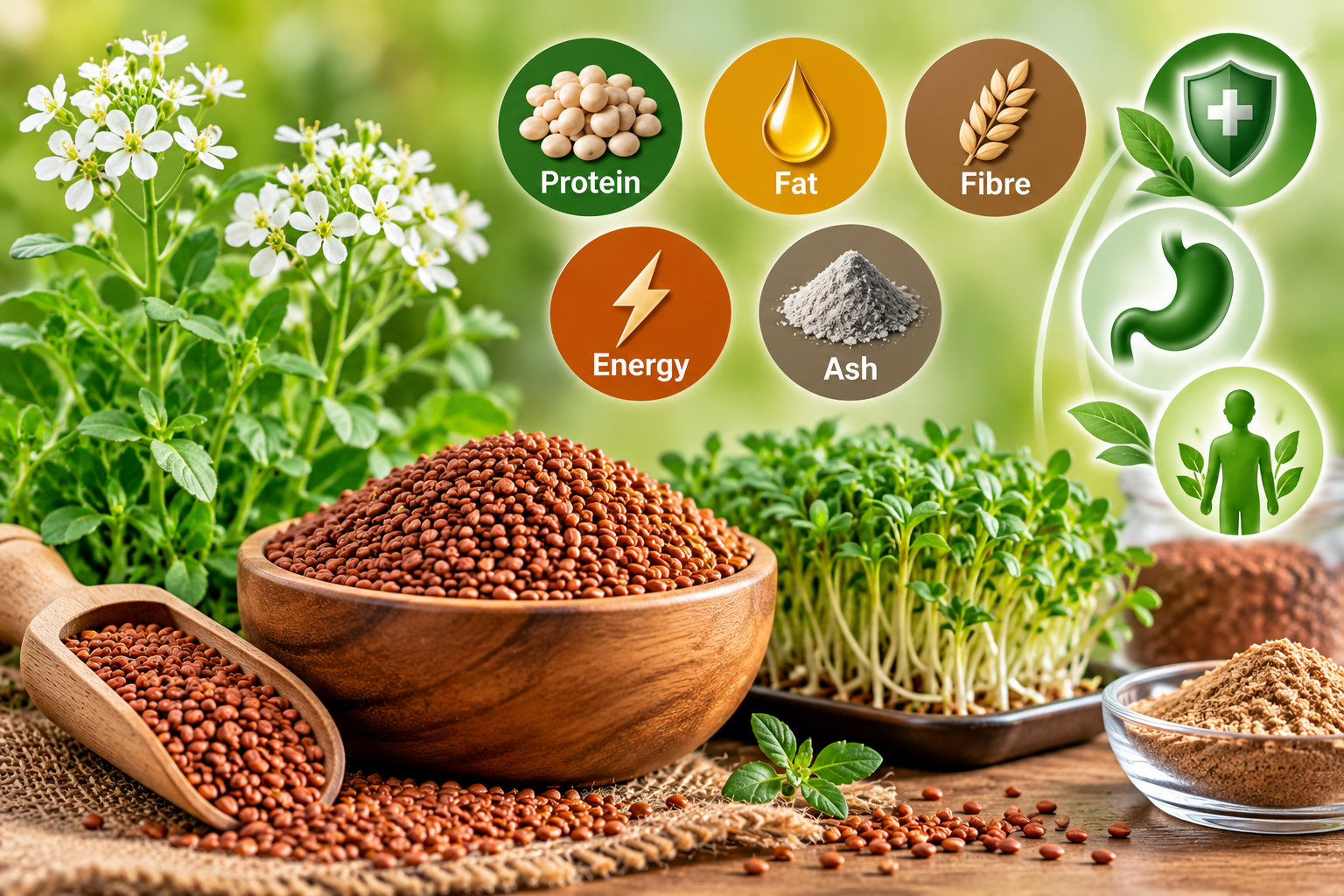
Lepidium sativum is an annual, underutilized herb that belongs to the Brassicaceae family and has similar basic properties like mustard and water cress. Garden cress is grown throughout the Middle East, Europe, and the United States. Garden cress seeds are known throughout history for their medicinal properties and are cultivated for a variety of culinary purposes. Seeds have been used to treat many disorders such as asthma, uterine tumours, ulcers, colds, wounds, skin problems, irregular menstrual cycles, ischias, and ethmoidal polyps because of their nutritional and antioxidant activity. Besides showing strong medicinal properties, garden cress seeds have a rich proximate profile with high concentrations of energy, protein, ash, fat, and fibre compared to the common staple cereals and millets. Various parts of garden cress plants like leaves and seeds are consumed in many forms such as salad, sprouts and spices. The seeds are bitter in taste, thus to improve taste and quality, different processing techniques like roasting, germination, soaking and boiling etc. are used. Malnutrition is currently a major concern in all segments of society and garden cress seeds being rich in protein and energy can be utilized to combat malnutrition. The objective of this review is to enhance community health by consolidating a scientific understanding of the nutritional composition of L. sativum.
References
[1] H. Karazhiyan, S. M. A. Razavi, G. O. Phillips, Y. Fang, S. Al-Assaf, K. Nishinari and R. Farhoosh (2009). Rheological properties of Lepidium sativum seed extract as a function of concentration, temperature and time. Food Hydrocoll., 23: 2062-2068.
[2] F. Shabbir , M. Eddouks , F. Nadeem and M. W. Azeem (2018). A brief review on bioactivities and therapeutic potential of garden cress (Lepidium sativum L.). Int. J. Chem. Biochem. Sci., 13: 36-45.
[3] Ö. Tuncay , D. Esiyok , B. Yagmur and B. B. Okur (2011).Yield and quality of garden cress affected by nitrogen sources and growing period. Afr. J. Agric. Res., 6: 608-617.
[4] S. Mathews, R. S. Singhal and P. R. Kulkarni (1993). Some physicochemical properties of Lepidium sativum (Haliv) seeds. Die Nahrung., 37: 69-71.
[5] R. W. Bussmann, K. Batsatsashvili, Z. Kikvidze, N. Y. Paniagua-Zambrana, M. Khutsishvili, I. Maisaia and S. Sikharulidze et al., (2020). Ethnobotany of the mountain regions of far eastern Europe,
Springer, Ural, Northern Caucasus, Turkey, and Iran. Springer, Switzerland, pp1-6.
[6] H. M. Yahya, and H. I. Hadi (2017). Uses of gas chromatography-mass spectrometry (GC-MS) technique for analysis of bioactive chemical compounds of Lepidium sativum: a review. Res. J. Pharm. Techno., 10: 4039-4042.
[7] S. O. Arinola and K. Adesina (2014). Effect of thermal processing on the nutritional, antinutritional, and antioxidant properties of tetracarpidium conophorum (African walnut). J. Food Process., 6: 1-4.
[8] Y. C. Yadav, D. N. Srivastav, A. K. Seth, V. Saini, R. Balaraman and T. K. Ghelani (2010). In vivo antioxidant potential of Lepidium sativum L. seeds in albino rats using cisplatin induced nephrotoxicity. Int. J. Phytomedicine., 2: 292-298.
[9] N. Agarwal and S. Sharma (2013). Appraisal of garden cress (Lepidium sativum L.) and product development as an all pervasive and nutrition worthy food stuff. Ann. Food Sci. Technol., 14: 77-84.
[10] K. H. A. El-Salam, A. O. Toliba, G. A. El-Shourbagy and Sh. E. El-Nemr (2019). Chemical and functional properties of garden cress (Lepidium sativum L.) seeds powder. Zagazig J. Agric. Res., 46: 1517-1528.
[11] S. Doke and M. Guha (2014). Garden cress (Lepidium sativum L.) seeds - an important medicinal source. J. Nat. Prod. Plant Resour., 4: 69-80.
[12] Hanan, M. A. AL-Sayed., Nahla, S. Zidan and M. A. Abdelaleem (2019). Utilization of garden cress seeds (Lepidium sativum L.) as natural source of protein and dietary fiber in noodles. Int. J. Pharm. Res. Allied Sci., 8: 17-28.
[13] Manju and N. Dobhal (2022). Nutritional composition of raw and roasted garden cress seed flour (Lepidium sativum L.) flour. Int. J. Curr. Sci. Res. Rev., 5: 141-146.
[14] V. S. Rajshri and A. Haripriya (2018). Effect of processing on selected nutrient profile of garden cress seeds and development of garden cress seed based muffin. Int. J. Acad. Res. Dev., 2: 1542-1547.
[15] M. R. Prajapati and P. H. Dave (2018). Therapeutic and nutritional importance of garden cress seed. J. Pharmacogn. Phytochem., 7: 140-143.
[16] S. S. Gokavi, N. G. Malleshi and M. Guo (2004). Chemical composition of garden cress (Lepidium sativum) seeds and its fractions and use of bran as a functional ingredient. Plant Foods Hum. Nutr., 56: 105-111.
[17] B. R. Moser, S. N. Shah, J. K. Winkler-Moser, S. F. Vaughn and R. L. Evangelista (2009). Composition and physical properties of cress (Lepidium sativum L.) and field pennycress (Thlaspi arvense L.) oils. Ind. Crops Prod., 30: 199-205.
[18] C. Gopalan, B. V. Ramasastri and S.C. Balasubramanian (2007). Nutritive value of Indian foods. National institute of nutrition, Hydarabad, India.
[19] M. Zia-Ul-Haq, S. Ahmad, L. Calani, T. Mazzeo, D. D. Rio, N. Pellegrini and V. D. Feo (2012). Compositional study and antioxidant potential of Ipomoea hederacea Jacq. and Lepidium sativum L. seeds. Molecules, 17: 10306-10321.
[20] P. Chaudhary and R. Gupta (2017). Formulation and sensory evaluation of iron rich recipes using garden cress seeds (Lepidium sativum). Int. J. Food Sci. Nutr., 6: 25-33.
[21] M. Mulla, J. Ahmed and T. Al-Sharrah (2018). Effect of hot oven and microwave roasting on garden cress (Lepidium sativum) seed flour quality and fatty acid composition, thermal and dielectric properties of extracted oil. Int. J. Food Sci. Technol., 53: 2770-2776.
[22] H. Falana, W. Nofal and H. Nakhleh (2014). A Review Article Lepidium sativum (Garden cress). Pharm-D Program, College Of Nursing, Pharmacy and Health Professions. Birzeit University.
[23] M. Angel and K. P. V. Devi (2014). Effect of garden cress seeds incorporated health mix among selected anaemic adolescent girls (12-15 years) in Dindigul district, Tamil Nadu, India. Int. J. Sci. Res., 3: 64-66.
[24] T. Jain, K. Grover and G. Kaur (2016). Effect of processing on nutrients and fatty acid composition of garden cress (Lepidium sativam) seeds. Food Chem., 213: 806-812.
[25] G. A. Alshehry (2019). Technological and sensory characteristics of biscuits fortified with garden cress (Lepidium sativum) seeds. Life Sci. J., 16: 28-35.
[26] A. Toliba and A. S. Mohamed (2019). The effect of garden cress seeds addition on rheological properties of wheat flour and chocolate flavored cupcake. Egypt. J. Food. Sci., 47: 187-199.
[27] B. Lahiri and R. Rani (2020). Garden Cress Seeds: chemistry, medicinal properties, application in dairy and food industry: A Review. Emer. Life Sci. Res., 6: 1-4.
[28] N. Agarwal and S. Sharma (2013). Garden cress (Lepidium sativum L.) - A non conventional traditional plant item for food product. Indian J. Tradit. Knowl., 12: 699-706.
[29] M. A. M. Hassan and A. M. Abdel-Rahman (2019). The influence of dry roasting process on chemical and nutritional properties of garden cress seeds flour. Int. Adv. Res. J. Sci. Eng. Technol., 6: 73-82.
Downloads
Published
Issue
Section
License
Copyright (c) 2023 Author (s)

This work is licensed under a Creative Commons Attribution-NonCommercial-NoDerivatives 4.0 International License.
Copyright © The Author(s). Effective from 1 July 2026, articles published in Emergent Life Sciences Research (ELSR) are distributed under the Creative Commons Attribution 4.0 International License (CC BY 4.0), which permits use, sharing, distribution, reproduction, and adaptation in any medium or format, provided that appropriate credit is given to the original author(s) and the source, a link to the license is provided, and any changes made are indicated.
Articles published before 1 July 2026 remain subject to the license applicable at the time of their original publication, including the Creative Commons Attribution-NonCommercial-NoDerivatives 4.0 International License (CC BY-NC-ND 4.0), where applicable.