Evaluation of non-chemical methods in the management of garlic mite complex
DOI:
https://doi.org/10.31783/elsr.2024.1011018Keywords:
garlic, mites, NSKE 5%, pongamia, teepolAbstract
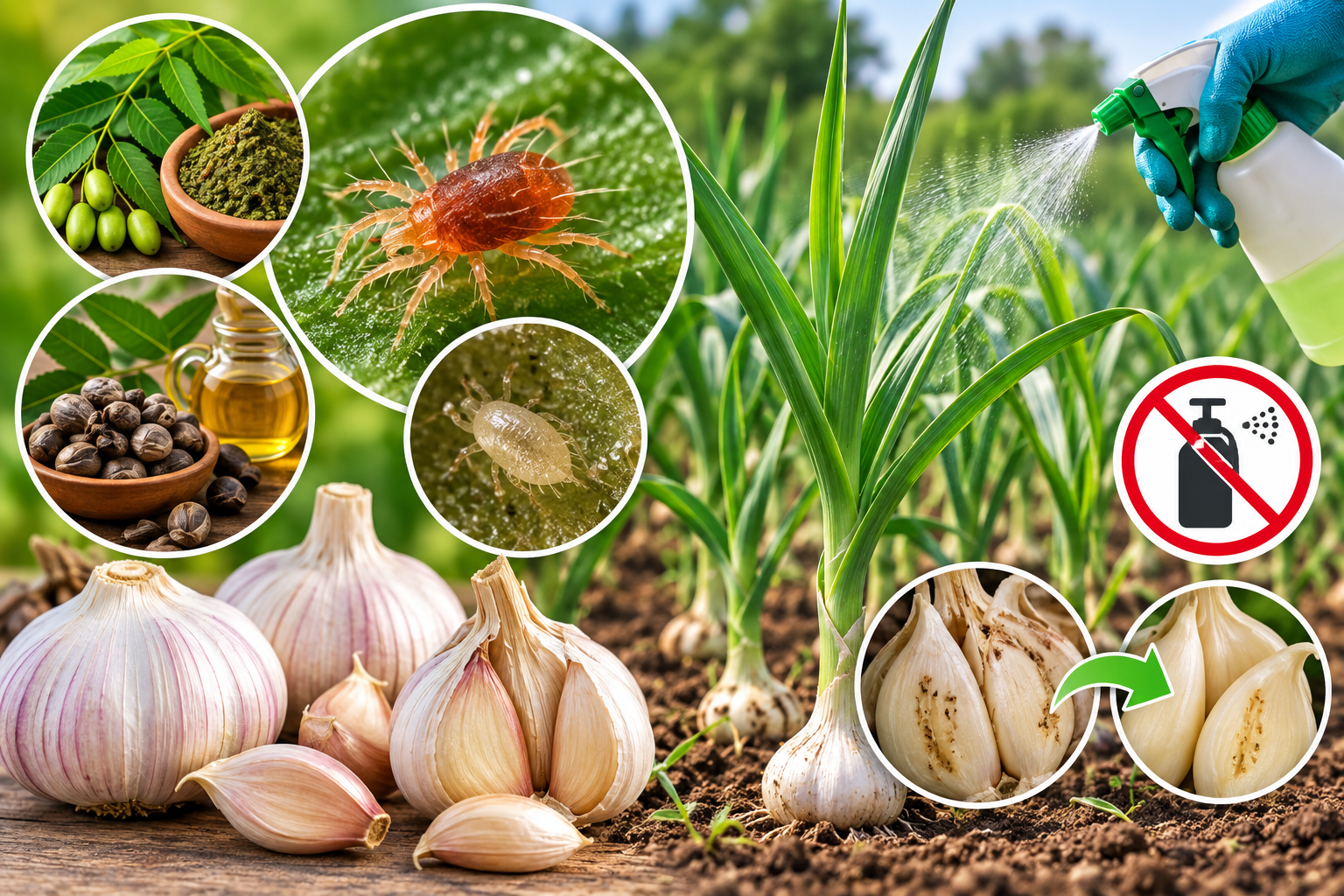
Mites are noxious pests infesting the garlic crop leading to significant yield loss. Several synthetic chemicals have been used over several decades; however, the extensive use of the chemicals has deleterious effects on both human health and the environment. Hence, a field experiment was conducted at the College of Horticulture, Bidar to evaluate the different non-chemical traditional methods against the garlic mite complex during 2020-21. Among the different treatments, sequential water spray –NSKE 5% at an interval of 24 hrs registered the lowest mean carmine spider mite population after the first spray (16.57/sq. cm of leaf) and second spray (15.82/ sq. cm of leaf). Further, it also recorded the highest mite population reduction over control to an extent of 64.90% and 65.98%, after the first and second spray, respectively. The sequential water spray -Pongamia seed extract 3% was next best with 61.99 and 63.01 percent reduction over control after the first and second spray, respectively. Similar results were obtained during 2021-22. The sequential water spray – NSKE 5% also proved to be best against bulb mites as it recorded the lowest lacerations on the garlic cloves (25.36 and 27.15%) with the highest reduction in laceration (51.57 and 51.21%) and the highest yield (27.00q/ha and 25.80q/ha) during 2020-21 and 2021-22, respectively.
References
[1] T. A. Jiang (2019). Health benefits of culinary herbs and spices. J. AOAC Int., 102: 395-411.
[2] V. W. Setiawan, G.-P. Yu, Q.-Y. Lu, M.-L. Lu, S.-Z. Yu, L. Mu and J.-G. Zhang et al., (2005). Allium vegetables and stomach cancer risk in China. Asian Pac. J. Cancer Prev., 6: 387-395.
[3] G. Diretto, A. Rubio-Moraga, J. Argandoña, P. Castillo, L. Gómez-Gómez and O. Ahrazem (2017). Tissue-specific accumulation of sulfur compounds and saponins in different parts of garlic cloves from purple and white ecotypes. Molecules, 22: 1359. doi: 10.3390/molecules22081359.
[4] S. Gorinstein, H. Leontowicz, M. Leontowicz, J. Namiesnik, K. Najman, J. Drzewiecki and M. Cvikrová et al., (2008). Comparison of the main bioactive compounds and antioxidant activities in garlic and white and red onions after treatment protocols. J. Agric. Food Chem., 56: 4418-4426.
[5] K. Satyagopal, S. Sushil, P. Jeyakumar, G. Shankar, O. Sharma, D. Boina and S. Sain et al., (2014). AESA based IPM package for garlic., 46.
[6] L. Rani, K. Thapa, N. Kanojia, N. Sharma, S. Singh, A. S. Grewal and A. L. Srivastav et al., (2021). An extensive review on the consequences of chemical pesticides on human health and environment. J. Clean. Prod., 283: 124657. doi: 10.1016/j.jclepro.2020.124657.
[7] M. Puttarudriah and K. Bhatia (1955). A preliminary note on studies of Mysore plants as sources of insecticides. Indian J. Entomol., 17: 165-174.
[8] S. D. Deshmukh and M. N. Borle (1975). Studies on the insecticidal properties of indigenous plant products. Indian J. Entomol., 37: 11-18.
[9] F. A. Mansour and K. Ascher (1983). Effects of neem (Azadirachta indica) seed kernel extracts from different solvents on the carmine spider mite, Tetranychus cinnabarinus. Phytoparasitica, 11: 177-185.
[10] K. Kanchana, T. Tamizhalarasan, R. Rajasekar and T. S. Kumar (2017). Red spider mite on jasmine: Tetranychus cinnabarinus; Sigapu Spider mite. PlantwisePlus Knowledge Bank, Pest Management Decision Guides: 20187800649.
[11] N. Madanlar, Z. Yoldas and E. Durmusoglu (2000). Laboratory investigations on some natural pesticides for use against pests in vegetable greenhouses. Bulletin OILB/SROP, 23: 281-288.
[12] F. Mansour, H. Azaizeh, B. Saad, Y. Tadmor, F. Abo-Moch and O. Said (2004). The potential of middle eastern flora as a source of new safe bio-acaricides to control Tetranychus cinnabarinus, the carmine spider mite. Phytoparasitica, 32: 66-72.
[13] S. Kilani-Morakchi, H. Morakchi-Goudjil and K. Sifi (2021). Azadirachtin-Based Insecticide: Overview, Risk Assessments, and Future Directions. Front. Agron., 3. doi: 10.3389/fagro.2021.676208
[14] V. Kumar, K. Chandrashekar and O. P. Sidhu (2006). Efficacy of karanjin and different extracts of Pongamia pinnata against selected insect pests. J. Entomol. Res., 30: 103-108.
Downloads
Published
Issue
Section
License
Copyright (c) 2024 Author (s)

This work is licensed under a Creative Commons Attribution-NonCommercial-NoDerivatives 4.0 International License.
Copyright © The Author(s). Effective from 1 July 2026, articles published in Emergent Life Sciences Research (ELSR) are distributed under the Creative Commons Attribution 4.0 International License (CC BY 4.0), which permits use, sharing, distribution, reproduction, and adaptation in any medium or format, provided that appropriate credit is given to the original author(s) and the source, a link to the license is provided, and any changes made are indicated.
Articles published before 1 July 2026 remain subject to the license applicable at the time of their original publication, including the Creative Commons Attribution-NonCommercial-NoDerivatives 4.0 International License (CC BY-NC-ND 4.0), where applicable.