
Breeding strategies for quality protein maize: A Review
DOI:
https://doi.org/10.31783/elsr.2024.1011932Keywords:
introgression, marker-assisted selection, opaque-2, quality protein maizeAbstract
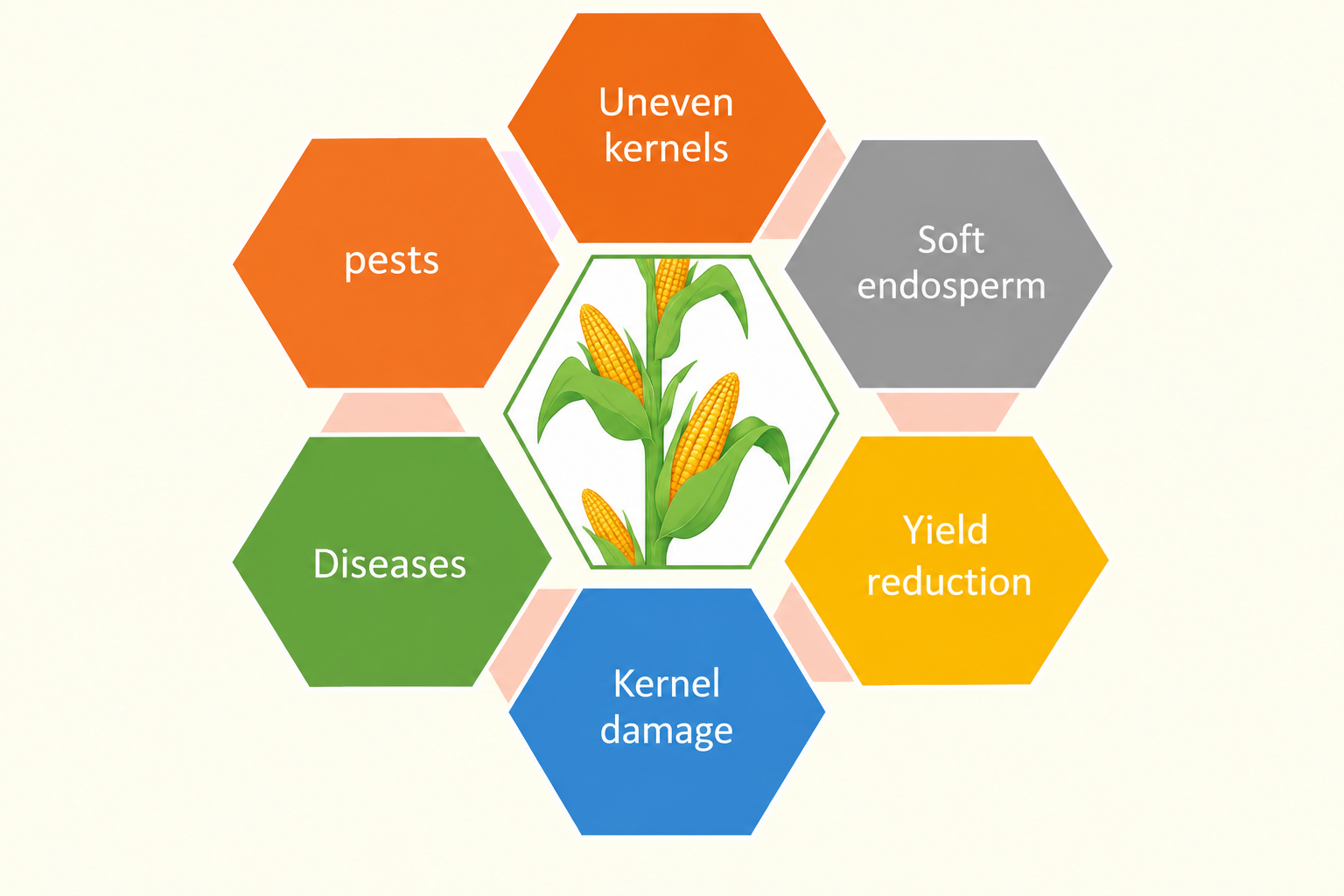
Zein proteins in maize seeds regulate food and feed quality and belong to several subfamilies. Most maize prolamin is α-zeins, which are rich in glutamine, leucine, and proline but lacking in critical amino acids (lysine and tryptophan). RNAi experiments show that 22kD zeins downregulate the quality protein maize (QPM) phenotype, not 19kD. The opaque-2 mutation caused a chalky, soft endosperm and many defects. QPM genotypes with opaque-2 alleles and firm kernels were improved. As opaque-2 is recessive and biochemical lysine and tryptophan analysis is costly, conventional backcrossing alone is not very useful. Marker-assisted selection (MAS) allowed top inbreds to be homozygous o2o2 utilizing opaque-2 gene-specific markers. Vivek QPM-9, a mixture of two QPM introgression lines, benefits various clients and customers. This review highlights the breeding strategies for QPM.
References
[1] E. T. Nuss and S. A. Tanumihardjo (2011). Quality protein maize for Africa: closing the protein inadequacy gap in vulnerable populations. Adv. Nutr., 2: 217-224.
[2] R. Babu, S. K. Nair, B. Prasanna and H. Gupta (2004). Integrating marker-assisted selection in crop breeding–prospects and challenges. Curr. Sci., 87: 607-619.
[3] B. Shiferaw, B. M. Prasanna, J. Hellin and M. Bänziger (2011). Crops that feed the world 6. Past successes and future challenges to the role played by maize in global food security. Food Secur., 3: 307-327.
[4] FAOSTAT (2020). Statistical Database. Food and Agriculture Organization of the United Nations, Rome.
[5] B. Prasanna, S. Vasal, B. Kassahun and N. Singh (2001). Quality protein maize. Curr. Sci., 81: 1308-1319.
[6] M. A. Maqbool, A. Beshir Issa and E. S. Khokhar (2021). Quality protein maize (QPM): Importance, genetics, timeline of different events, breeding strategies and varietal adoption. Plant Breed., 140: 375-399.
[7] B. Badu‐Apraku, M. Fakorede, A. Talabi, M. Oyekunle, I. Akaogu, R. Akinwale and B. Annor et al., (2016). Gene action and heterotic groups of early white quality protein maize inbreds under multiple stress environments. Crop Sci., 56: 183-199.
[8] J. Hegyi, R. A. Schwartz and V. Hegyi (2004). Pellagra: dermatitis, dementia, and diarrhea. Int. J. Dermatol., 43: 1-5.
[9] A. F. Krivanek, H. De Groote, N. S. Gunaratna, A. Diallo and D. Friesen (2007). Breeding and disseminating quality protein maize (QPM) for Africa. Afr. J. Biotechnol., 6: 312-324.
[10] B. C. Gibbon and B. A. Larkins (2005). Molecular genetic approaches to developing quality protein maize. Trends Genet., 21: 227-233.
[11] P. R. Shewry and N. G. Halford (2002). Cereal seed storage proteins: structures, properties and role in grain utilization. J. Exp. Bot., 53: 947-958.
[12] C. E. Coleman and B. A. Larkins (1999). The prolamins of maize, in: Seed proteins, Springer, 109-139.
[13] A. Leite, G. C. Neto, A. L. Vettore, J. A. Yunes and P. Arruda (1999). The prolamins of sorghum, Coix and millets. in: Seed proteins, Springer, 141-157.
[14] S. K. Vasal (1999). High quality protein corn, in: Specialty corns, CRC press, 97-142.
[15] B. Prasanna, K. Pixley, M. L. Warburton and C.-X. Xie (2010). Molecular marker-assisted breeding options for maize improvement in Asia. Mol. Breed., 26: 339-356.
[16] G. G. Graham, D. V. Glover, G. L. De RomaÑna, E. Morales and W. C. MacLean Jr (1980). Nutritional value of normal, opaque-2 and sugary-2 opaque-2 maize hybrids for infants and children: 1. Digestibility and utilization. J. Nutr., 110: 1061-1069.
[17] E. T. Mertz, L. S. Bates and O. E. Nelson (1964). Mutant gene that changes protein composition and increases lysine content of maize endosperm. Science, 145: 279-280.
[18] C. Damerval and D. De Vienne (1993). Quantification of dominance for proteins pleiotropically affected by opaque-2 in maize. Heredity, 70: 38-51.
[19] O. E. Nelson, E. T. Mertz and L. S. Bates (1965). Second mutant gene affecting the amino acid pattern of maize endosperm proteins. Science, 150: 1469-1470.
[20] P. S. Misra, R. Jambunathan, E. T. Mertz, D. V. Glover, H. M. Barbosa and K. S. McWhirter (1972). Endosperm protein synthesis in maize mutants with increased lysine content. Science, 176: 1425-1427.
[21] Y. Ma and N. OE (1975). Amino Acid Composition and Storage Proteins in Two New High-Lysine Mutants in Maize. Cereal Chem., 52: 412 - 419.
[22] F. Salamini, N. Di Fonzo, E. Fornasari, E. Gentinetta, R. Reggiani and C. Soave (1983). Mucronate, Mc, a dominant gene of maize which interacts with opaque-2 to suppress zein synthesis. Theor. Appl. Genet., 65: 123-128.
[23] W. Yang, Y. Zheng, W. Zheng and R. Feng (2005). Molecular genetic mapping of a high-lysine mutant gene (opaque-16) and the double recessive effect with opaque-2 in maize. Mol. Breed., 15: 257-269.
[24] R. A. Azevedo, C. Damerval, J. Landry, P. J. Lea, C. M. Bellato, L. W. Meinhardt and M. Le Guilloux et al., (2003). Regulation of maize lysine metabolism and endosperm protein synthesis by opaque and floury mutations. Eur. J. Biochem., 270: 4898-4908.
[25] M. R. Brochetto-Braga, A. Leite and P. Arruda (1992). Partial purification and characterization of lysine-ketoglutarate reductase in normal and opaque-2 maize endosperms. Plant Physiol., 98: 1139-1147.
[26] M. Bjarnason and S. Vasal (1992). Breeding of quality protein maize (QPM). Plant breed. rev., 9: 181-216.
[27] A. V. Paez, J. Helm and M. Zuber (1969). Lysine Content of Opaque‐2 Maize Kernels having Different Phenotypes 1. Crop Sci., 9: 251-252.
[28] S. Vasal, E. Villegas, M. Bjarnason, B. Gelaw and P. Goertz (1980). Genetic modifiers and breeding strategies in developing hard endosperm opaque-2 materials. in: Improvement of quality traits of maize for grain and silage use, 37: 73.
[29] S. Huang, W. R. Adams, Q. Zhou, K. P. Malloy, D. A. Voyles, J. Anthony and A. L. Kriz et al., (2004). Improving nutritional quality of maize proteins by expressing sense and antisense zein genes. J. Agric. Food Chem., 52: 1958-1964.
[30] H. W. Bass, C. Webster, G. R. OBrian, J. Roberts and R. S. Boston (1992). A maize ribosome-inactivating protein is controlled by the transcriptional activator Opaque-2. Plant Cell, 4: 225-234.
[31] J. E. Habben, A. W. Kirleis and B. A. Larkins (1993). The origin of lysine-containing proteins in opaque-2 maize endosperm. Plant Mol. Biol., 23: 825-838.
[32] M. A. Lopes, K. Takasaki, D. E. Bostwick, T. Helentjaris and B. A. Larkins (1995). Identification of two opaque2 modifier loci in quality protein maize. Mol. Gen. Genet., 247: 603-613.
[33] D. Dev, K. N. Chourasia and D. Koujalagi (2018). Quality protein maize: An overview. J. Pharmacogn. Phytochem., 7: 3486-3492.
[34] R. Babu and B. Prasanna (2013). Molecular breeding for quality protein maize (QPM), in: Genomics of Plant Genetic Resources: Volume 2. Crop productivity, food security and nutritional quality, Springer, 489-505.
[35] H. Hernandez and L. S. Bates (1969). A modified method for rapid tryptophan analysis of maize.
[36] X. Wang, D. K. Stumpf and B. A. Larkins (2001). Aspartate kinase 2. A candidate gene of a quantitative trait locus influencing free amino acid content in maize endosperm. Plant Physiol., 125: 1778-1787.
[37] B. Vivek, Breeding quality protein maize (QPM): Protocols for developing QPM cultivars, Cimmyt, 2008.
[38] M. Bjarnason and W. G. Pollmer (1972). The maize germ: its role as a contributing factor to protein quantity and quality. Zeitschrift fur Pflanzenzuchtung, 68: 83-89.
[39] D. R. Holding, B. G. Hunter, T. Chung, B. C. Gibbon, C. F. Ford, A. K. Bharti and J. Messing et al., (2008). Genetic analysis of opaque2 modifier loci in quality protein maize. Theor. Appl. Genet., 117: 157-170.
[40] D. Holding and B. Larkins (2008). Genetic modification of seed storage proteins. Lewis, NG Advances in plant biochemical and molecular biology vol1: Bohnert, HJ and Nguyen, HT (Eds.). Bioengineering and molecular biology of plant pathways. Elsevier Publishers Oxford, UK, 107-133.
[41] P. Sofi, S. Wani, A. Rather and S. Wani (2009). Quality protein maize (QPM): Genetic manipulation for the nutritional fortification of maize. J. Plant Breed. Crop Sci., 1: 244-253.
[42] J. W. Danson, M. Mbogori, M. Kimani, M. Lagat, A. Kuria and A. Diallo (2006). Marker assisted introgression of opaque2 gene into herbicide resistant elite maize inbred lines. Afr. J. Biotechnol., 5: 2417-2422.
[43] E. E. Magulama and E. K. Sales (2009). Marker-assisted introgression of opaque 2 gene into elite maize inbred lines. USM R & D, 17: 131-135.
[44] R. Manna, O. Okello, J. Imanywoha, K. Pixley and R. Edema (2005). Enhancing introgression of the opaque-2 trait into elite maize lines using simple sequence repeats. Afr. Crop Sci. J., 13: 215-226.
[45] H. S. Gupta, P. K. Agrawal, V. Mahajan, G. Bisht, A. Kumar, P. Verma and A. Srivastava et al., (2009). Quality protein maize for nutritional security: rapid development of short duration hybrids through molecular marker assisted breeding. Current Sci., 96: 230-237.
[46] H. S. Gupta, B. Raman, P. K. Agrawal, V. Mahajan, F. Hossain and N. Thirunavukkarasu (2013). Accelerated development of quality protein maize hybrid through marker‐assisted introgression of opaque‐2 allele. Plant Breed., 132: 77-82.
[47] F. Hossain, V. Muthusamy, N. Pandey, A. K. Vishwakarma, A. Baveja, R. U. Zunjare and N. Thirunavukkarasu et al., (2018). Marker-assisted introgression of opaque2 allele for rapid conversion of elite hybrids into quality protein maize. J. Genet., 97: 287-298.
[48] Q. Yang, D. Zhao, C. Zhang, N. Sreenivasulu, S. S.-M. Sun and Q. Liu (2021). Lysine biofortification of crops to promote sustained human health in the 21st century. J. Exp. Bot., 73: 1258-1267.
[49] W. Zhang, W. Yang, M. Wang, W. Wang, G. Zeng, Z. Chen and Y. Cai (2013). Increasing Lysine Content of Waxy Maize through Introgression of Opaque-2 and Opaque-16 Genes Using Molecular Assisted and Biochemical Development. PLOS ONE, 8: e56227. doi: 10.1371/journal.pone.0056227.
[50] L. Yang, W. Wang, W. Yang and M. Wang (2013). Marker-assisted selection for pyramiding the waxy and opaque-16 genes in maize using cross and backcross schemes. Mol. Breed., 31: 767-775.
[51] R. Naidoo, P. Tongoona, J. Derera, M. D. Laing and G. M. F. Watson (2012). Combining ability of low phytic acid (lpa1-1) and quality protein maize (QPM) lines for seed germination and vigour under stress and non-stress conditions. Euphytica, 185: 529-541.
[52] V. Muthusamy, F. Hossain, N. Thirunavukkarasu, M. Choudhary, S. Saha, J. S. Bhat and B. M. Prasanna et al., (2014). Development of β-Carotene Rich Maize Hybrids through Marker-Assisted Introgression of β-carotene hydroxylase Allele. PLOS ONE, 9: e113583. doi: 10.1371/journal.pone.0113583.
[53] S. Chander, Y. Meng, Y. Zhang, J. Yan and J. Li (2008). Comparison of Nutritional Traits Variability in Selected Eighty-Seven Inbreds from Chinese Maize (Zea mays L.) Germplasm. J. Agric. Food Chem., 56: 6506-6511.
[54] N. M. Houmard, J. L. Mainville, C. P. Bonin, S. Huang, M. H. Luethy and T. M. Malvar (2007). High-lysine corn generated by endosperm-specific suppression of lysine catabolism using RNAi. Plant Biotechnol. J., 5: 605-614.
[55] G. Segal, R. Song and J. Messing (2003). A New Opaque Variant of Maize by a Single Dominant RNA-Interference-Inducing Transgene. Genetics, 165: 387-397.
[56] S. Huang, D. E. Kruger, A. Frizzi, R. L. D’Ordine, C. A. Florida, W. R. Adams and W. E. Brown et al., (2005). High-lysine corn produced by the combination of enhanced lysine biosynthesis and reduced zein accumulation. Plant Biotechnol. J., 3: 555-569.
[57] Y. Feng, Y. Ma, F. Feng, X. Chen, W. Qi, Z. Ma and R. Song (2022). Accumulation of 22 kDa α-zein-mediated nonzein protein in protein body of maize endosperm. New Phytol. 233: 265-281.
Downloads
Published
Issue
Section
License
Copyright (c) 2024 Author (s)

This work is licensed under a Creative Commons Attribution-NonCommercial-NoDerivatives 4.0 International License.
Copyright © The Author(s). Effective from 1 July 2026, articles published in Emergent Life Sciences Research (ELSR) are distributed under the Creative Commons Attribution 4.0 International License (CC BY 4.0), which permits use, sharing, distribution, reproduction, and adaptation in any medium or format, provided that appropriate credit is given to the original author(s) and the source, a link to the license is provided, and any changes made are indicated.
Articles published before 1 July 2026 remain subject to the license applicable at the time of their original publication, including the Creative Commons Attribution-NonCommercial-NoDerivatives 4.0 International License (CC BY-NC-ND 4.0), where applicable.