Effect of composite edible coatings and modified atmospheric packaging on physical quality characteristics of ber (Ziziphus mauritiana Lamk.) cv. Umran
DOI:
https://doi.org/10.31783/elsr.2024.1014147Keywords:
decay, edible coatings, physical quality, physiological loss in weight, shrinkageAbstract
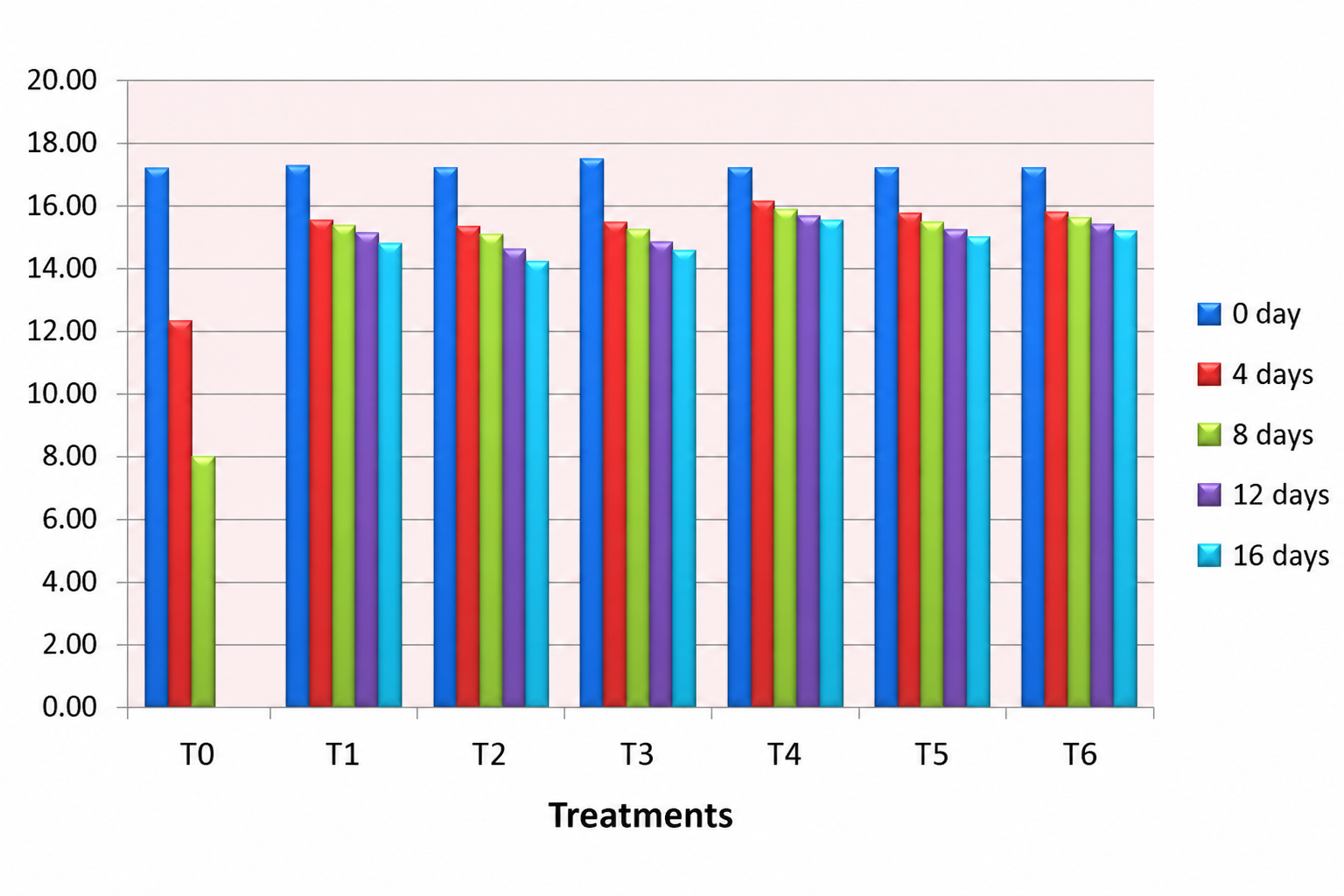
Ber (Ziziphus mauritiana Lamk.) is an indigenous and economically important tropical fruit which is also known as Indian jujube, and belongs to the family Rhamnaceae. The major constraint for the market glut is the shelf life of ber fruit which is only 4 to 5 days. Due to the short shelf life of ber fruit, there is a need for proper preservation methods to enhance the shelf life. Methods to increase its shelf life by applying different surface coating treatments were developed to regulate the market for fresh fruit. Evaluation of a composite edible coating made of Aloe vera gel was scheduled along with modified atmospheric packaging to enhance the shelf life and maintain the quality of the ber cv. Umran. The physical characteristics of fruits were analyzed and recorded at four days intervals when kept at ambient conditions of 22-25 °C. The study revealed that during 16 days Aloe vera gel coatings proved beneficial in preserving the quality of ber fruit stored in modified polyethylene bags. The lowest Physiological loss in weight (PLW) %, percent decay, and shrinkage while the highest holding in weight and diameter of fruits were found in Aloe vera gel (75%) coatings integrated with 1% ascorbic acid and 1% citric acid as an antioxidant. According to the findings, it is concluded that Aloe vera gel based edible coatings incorporated with 1% ascorbic acid, duly packed in polyethylene bags and kept at ambient conditions were proved to best combinations and could be used to maintain the quality of ber fruits until 16 days.
References
[1] Indiastat (2020). Selected State-wise Area and Production of Ber in India 2021- 2022-3rd Advance Estimates.
[2] J. M. Valverde, D. Valero, D. Martínez-Romero, F. Guillén, S. Castillo and M. Serrano (2005). Novel edible coating based Aloe vera gel to maintain table quality and safety. J. Agric. Food Chem., 53: 7807-7813.
[3] E. A. Baldwin, J. K. Burns, W. Kazokas, J. K. Brecht, R. D. Hagenmaier, R. J. Bender and E. Pesis (1999). Effect of two edible coatings with different permeability characteristics on mango (Mangifera indica L.) ripening during storage. Postharvest Biol. Technol., 17: 215-226.
[4] M. A. Pascall and S.-J. Lin (2013). The application of edible polymeric films and coatings in the food industry. Int. J. Food Process. Technol., 4: 2. doi: 10.4172/2157-7110.1000e116.
[5] A. Kader (1986). Biochemical and physiological basis for effects of controlled and modified atmospheres on fruit and vegetables. Food Technology., 40: 99-104.
[6] S. Kumar and T. Bhatnagar (2014). Shelf life of fruits using aloe vera based herbal coatings. Int. J. Agric, Environ. Technol., 5: 211-218.
[7] M. J. Ahmed, Z. Singh and A. S. Khan (2009). Postharvest aloe vera gel-coating modulates fruit ripening and quality of ‘arctic snow’ nectarine kept in ambient and cold storage. Int. J. Food Sci. Technol., 44: 1024-1033.
[8] F. Habeeb , E. Shakir, F. Bradbury, P. Cameron, M. R. Taravati, A. J. Drummond and A. I. Gray et al., (2007). Screening methods used to determine the anti-microbial properties of Aloe vera inner gel methods. Methods, 42: 315-320.
[9] S. Bautista-Baños, A. N. Hernandez-Lauzardo, M. G. Velazquez-Del Valle, M. Hernández-López, E. A. Barka, E. Bosquez-Molina and C. L. Wilson (2006). Chitosan as a potential natural compound to control pre and postharvest diseases of horticultural commodities. Crop Prot., 25: 108-118.
[10] G. A. Snedecor and W. G. Cochran (1980). Statistical methods. Oxford and J. B. H. Bub Com., 7th edn. State University Press, Iowa.
[11] N. Singh, K. K. Misra, A. Dongariyal, A. Rani and V. Nirgude (2018). Response of different coating material on post-harvest life and quality of guava (Psidium guajava L.). Int. J. Chem. Stud., 6: 2635-2639.
[12] A. Mani, N. Jain, A. K. Singh and M. Sinha (2017). Effects of Aloe vera edible coating on quality and postharvest physiology of Ber (Zizyphus mauritiana Lamk.) under ambient storage conditions. Int. J. Pure Appl. Biosci., 10: 138-146.
[13] O. Yaman and and L. Bayoindirli (2002). Effects of an edible coating and cold storage on shelf- life and quality of cherries. LWT-Food Sci. Technol., 35: 46-150.
[14] S. Galus, M. Mikus, A. Ciurzyńska, E. Domian, J. Kowalska, A. Marzec and H. Kowalska (2020). The effect of whey protein-based edible coatings incorporated with lemon and lemongrass essential oils on the quality attributes of fresh-cut pears during storage. Coatings, 11: 745. doi: 10.3390/coatings11070745.
[15] N. S. Baraiya, T. V. R. Rao and V. R. Thakkar (2014). Enhancement of storability and quality maintenance of carambola (Averrhoa carambola L.) fruit by using composite edible coating. Fruits, 69: 195-205.
[16] S. Kaur, S. K. Jawandha and H. Singh (2014). Response of baramasi lemon to various postharvest treatments. Int. J. Agric. Environ. Biotechnol., 7: 895-902.
Downloads
Published
Issue
Section
License
Copyright (c) 2024 Author (s)

This work is licensed under a Creative Commons Attribution-NonCommercial-NoDerivatives 4.0 International License.
Copyright © The Author(s). Effective from 1 July 2026, articles published in Emergent Life Sciences Research (ELSR) are distributed under the Creative Commons Attribution 4.0 International License (CC BY 4.0), which permits use, sharing, distribution, reproduction, and adaptation in any medium or format, provided that appropriate credit is given to the original author(s) and the source, a link to the license is provided, and any changes made are indicated.
Articles published before 1 July 2026 remain subject to the license applicable at the time of their original publication, including the Creative Commons Attribution-NonCommercial-NoDerivatives 4.0 International License (CC BY-NC-ND 4.0), where applicable.