Effect of probiotics supplementation on giblet and dressing percentage in caged broilers
DOI:
https://doi.org/10.31783/elsr.2024.1014854Keywords:
dressing percentage, giblet, gizzard, heart, liver, probioticsAbstract
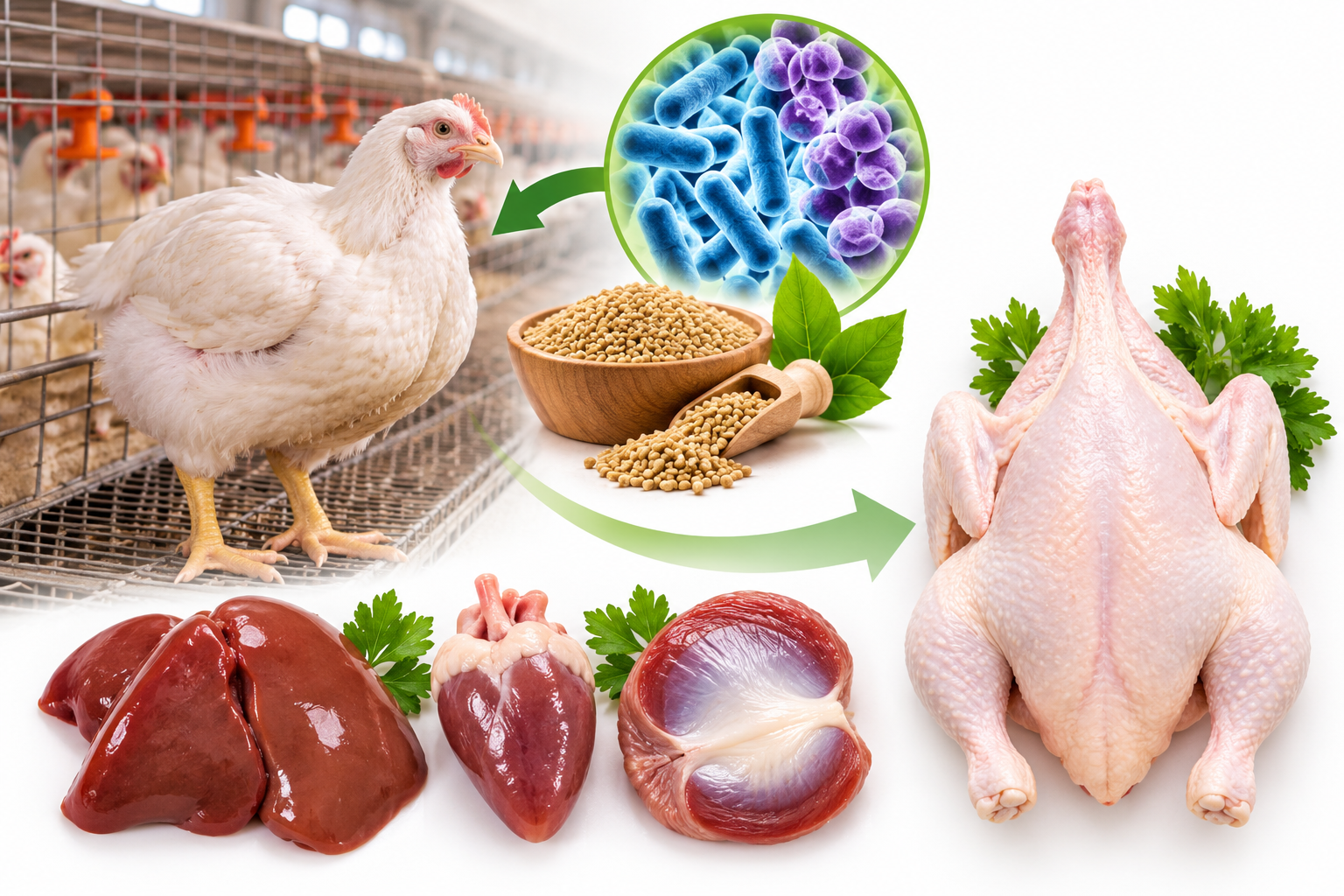
The present investigation was conducted to evaluate the effects of probiotics supplementation on giblet weight and dressing percentage of caged broilers. A total of 96, day-old chicks were randomly divided into four groups (T0, T1, T2, and T3) with 8 replicates i.e., 24 chicks in each group. The control (untreated) group was fed the basal diet, T1 was supplemented with Bacillus coagulans @40ppm along with basal diet, T2 was given Bacillus subtilis @50ppm mixed in basal diet whereas T3 was given basal diet + Bacillus licheniformis & Bacillus coagulans @20ppm. After 35 days of the trial period, weighing of the giblet and dressing percentage of four at random selected birds from each group were calculated. The mean value of liver weight recorded T0-46.420g, T1-42.352g, T2-45.275g, and T3-40.521g, respectively. However, the analysis revealed that the variations in these values were not statistically significant. The mean value of Heart weight recorded was T0-14.445g, T1-9.557g, T2-10.999g, and T3-12.940g, respectively. However, the investigation unveiled that the discrepancies in these values exhibited statistical significance (P<0.05). The mean value of Gizzard weight recorded was T0-24.017g, T1-25.327g, T2-28.088g, and T3-31.040g, respectively. However, the analysis revealed that the variations in these values were not statistically significant. The mean value of dressing percentage weight recorded was T0-58.38 %, T1-57.57 %, T2-58.64 %, and T3-59.06 % respectively which were not statistically significant.
References
[1] Y. H. Park, F. Hamidon, C. Rajangan, K. P. Soh, C. Y. Gan, T. S. Lim, W. N. W. Abdullah et al., (2016). Application of probiotics for the production of safe and high-quality poultry meat. Korean J. Food Sci. Anim. Resour., 36: 567-576.
[2] H. Kermanshahi and H. Rostami (2006). Influence of supplemental dried whey on broiler performance and cecal flora. Int. J. Poultry Sci., 5: 538-543.
[3] R. Fuller (1989). Probiotics in man and animals. J. Appl. Bacteriol., 66: 365-378.
[4] A. S. Fairchild, J. L. Grimes, F. T. Jones, M. J. Wineland, F. W. Edens and A. E. Sefton (2001). Effects of Hen Age, Bio-Mos,® and Flavomycin® on Poult Susceptibility to Oral Escherichia coli Challenge 1. Poultry Sci., 80(5): 562-571.
[5] H. A. Ghasemi, A. M. Tahmasbi, G. H. Moghaddam, M. Mehri, S. Alijani, E. Kashefi and A. Fasihi (2006). The effect of phytase and Saccharomyces cerevisiae (sc47) supplementation on performance, serum parameters, phosphorous and calcium retention of broiler chickens. Int. J. Poultry Sci., 5: 162-168.
[6] J. L. Vicente, L. Avina, A. Torres-Rodriguez, B. Hargis and G. Tellez (2007). Effect of a Lactobacillus spp-based probiotic culture product on broiler chicks performance under commercial conditions. Int. J. Poultry Sci., 6: 154-156.
[7] A. H. Mahdavi, H. R. Rahmani and J. Pourreza (2005). Effect of probiotic supplements on egg quality and laying hen’s performance. Int. J. Poultry Sci., 4: 488-492.
[8] W. A. Awad, K. Ghareeb, S. Nitsch, S. Pasteiner, S. Abdel-Raheem and J. Böhm (2008). Effects of dietary inclusion of prebiotic, probiotic and synbiotic on the intestinal glucose absorption of broiler chickens. Int. J. Poultry Sci., 7: 686-691.
[9] Y. A. Attia, M. A. Al-Harthi, A. S. El-Shafey, Y. A. Rehab and W. K. Kim (2017). Enhancing tolerance of broiler chickens to heat stress by supplementation with vitamin E, vitamin C and/or probiotics. Ann. Anim. Sci., 17: 1155-1169.
[10] F. U. Memon, Y. Yang, F. Lv, A. M. Soliman, Y. Chen, J. Sun and Y. Wang et al., (2021). Effects of probiotic and Bidens pilosa on the performance and gut health of chicken during induced Eimeria tenella infection. J. Appl. Microbiol., 131: 425-434.
[11] S. A. Baset, E. A. Ashour, M. E. Abd El-Hack and M. M. El-Mekkawy (2022). Effect of different levels of pomegranate peel powder and probiotic supplementation on growth, carcass traits, blood serum metabolites, antioxidant status and meat quality of broilers. Anim. Biotechnol., 33: 690-700.
[12] Y. Zhao, D. Zeng, H. Wang, X. Qing, N. Sun, J. Xin and M. Luo et al., (2020). Dietary probiotic Bacillus licheniformis H2 enhanced growth performance, morphology of small intestine and liver, and antioxidant capacity of broiler chickens against Clostridium perfringens–induced subclinical necrotic enteritis. Probiotics Antimicrob. Proteins, 12: 883-895.
[13] N. Rashidi, A. Khatibjoo, K. Taherpour, M. Akbari-Gharaei and H. Shirzadi (2020). Effects of licorice extract, probiotic, toxin binder and poultry litter biochar on performance, immune function, blood indices and liver histopathology of broilers exposed to aflatoxin-B1. Poult. Sci., 99: 5896-5906.
[14] T. Inatomi and K. Otomaru (2018). Effect of dietary probiotics on the semen traits and antioxidative activity of male broiler breeders. Sci. Rep., 8: 5874. doi: 10.1038/s41598-018-24345-8.
[15] M. Ghasemi-Sadabadi, Y. Ebrahimnezhad, A. Shaddel-Tili, V. Bannapour-Ghaffari, H. Kozehgari and M. Didehvar (2019). The effects of fermented milk products (kefir and yogurt) and probiotic on performance, carcass characteristics, blood parameters, and gut microbial population in broiler chickens. Arch. Anim. Breed., 62: 361-374.
[16] S. Kaushal, R. K. Sharma, D. V. Singh, S. K. Shukla, S. Kumar, J. Palod and M. K. Singh (2019). Performance, carcass characteristics and economics of broiler chickens fed dietary enzymes and probiotic. Iran. J. Vet. Res., 20: 293-298.
[17] A. Rehman, M. Arif, N. Sajjad, M. Q. Al-Ghadi, M. Alagawany, M. E. Abd El-Hack, A. R. Alhimaidi et al., (2020). Dietary effect of probiotics and prebiotics on broiler performance, carcass, and immunity. Poultry Sci., 99: 6946-6953.
[18] M. Akter, M. Asaduzzaman, M. S. Islam and M. M. U. Patoary (2022). Effects of probiotics and prebiotics on growth performance of commercial broiler. Iranian J. Appl. Anim. Sci., 12: 761-770.
[19] H. Ghafari, F. Kheiri and M. Faghani (2017). Effect of using protexin probiotic and ephedra funereal powder supplementation on performance and some carcass traits on broiler chicks. Appl. Sci. Report, 17: 41-45.
[20] M. J. Hersom, G.W. Horn, C. R. Krehbiel and W. A. Phillips (2004). Effect of live weight gain of steers during winter grazing: I. Feedlot performance, carcass characteristics, and body composition of beef steers. J. Anim. Sci., 82: 262-272.
[21] N. D. Devi, Nizamuddin and V. K. Vidyarthi (2019). Effect of dietary supplementation of probiotic on the performance of broiler chicken. Livest. Res., 7: 62-67.
Downloads
Published
Issue
Section
License
Copyright (c) 2024 Author (s)

This work is licensed under a Creative Commons Attribution-NonCommercial-NoDerivatives 4.0 International License.
Copyright © The Author(s). Effective from 1 July 2026, articles published in Emergent Life Sciences Research (ELSR) are distributed under the Creative Commons Attribution 4.0 International License (CC BY 4.0), which permits use, sharing, distribution, reproduction, and adaptation in any medium or format, provided that appropriate credit is given to the original author(s) and the source, a link to the license is provided, and any changes made are indicated.
Articles published before 1 July 2026 remain subject to the license applicable at the time of their original publication, including the Creative Commons Attribution-NonCommercial-NoDerivatives 4.0 International License (CC BY-NC-ND 4.0), where applicable.