Isolation, characterization and in vitro efficacy of banana phyllospheric bacteria
DOI:
https://doi.org/10.31783/elsr.2024.1019096Keywords:
antagonism, phosphate solubilization, phytohormone, plant growth promotionAbstract
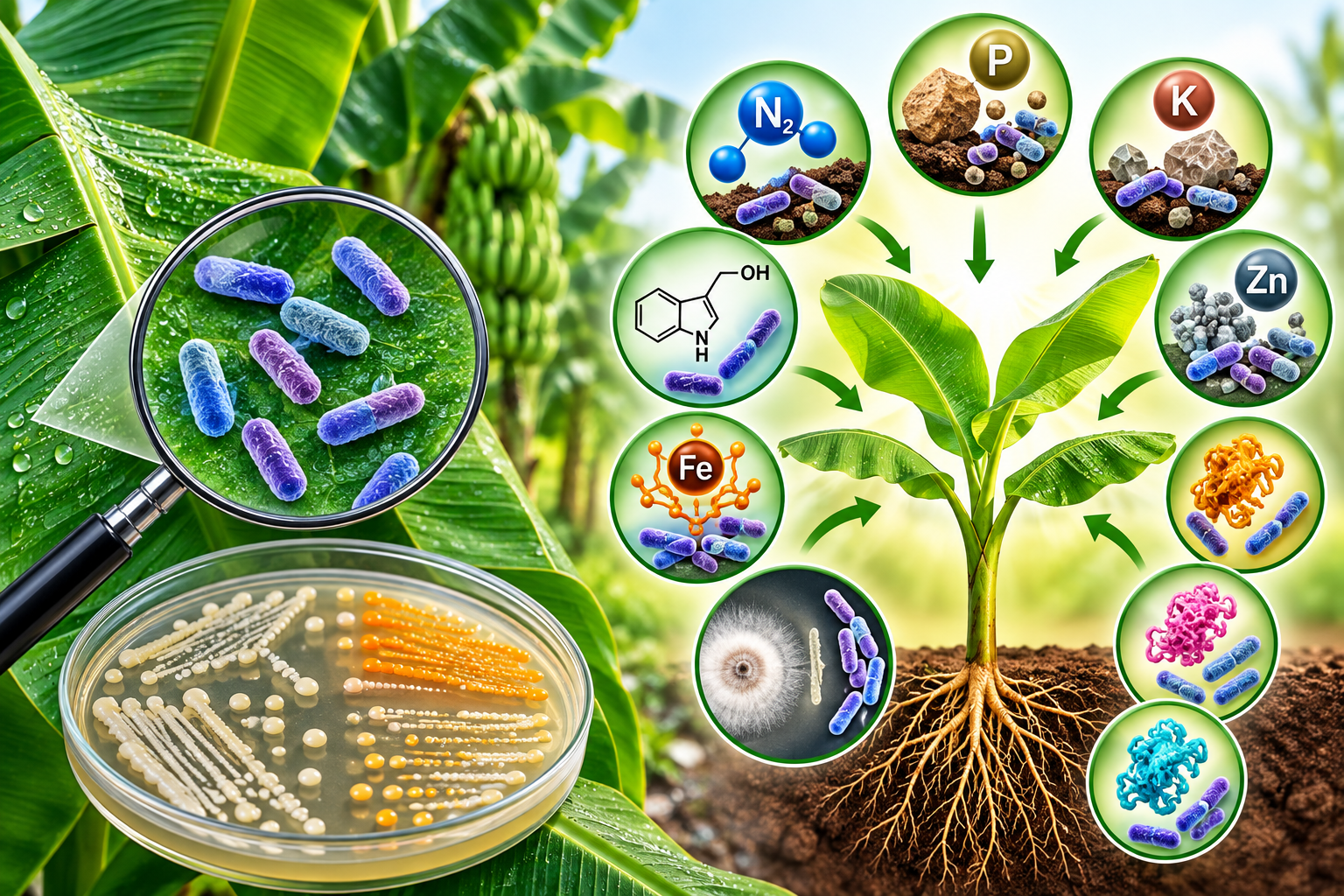
Phyllospheric bacteria can help in plant-growth promotion by various direct and indirect mechanisms. A total of ten healthy leaf samples were collected randomly from the banana farms located at Navsari Agricultural University, Navsari, Gujarat. A total of 28 morphologically distinct bacterial isolates were obtained in pure culture from collected samples and screened for their ability to plant growth-promoting parameters under in vitro conditions. Out of these, 14.28%, 14.28%, 28.57%, and 82.14% showed positive biological nitrogen fixation ability, phosphate solubilization, potassium mobilization, and zinc solubilization, respectively. Indole-3-acetic acid (IAA) production was detected in 28.57% of isolates and 21.42% isolates were found positive for siderophore production. All (100%) isolates showed antagonism against Fusarium oxysporum. Further, 78.57%, 39.28%, and 32.14% of isolates showed positive protease, lipase, and amylase secretion, respectively. Based on in vitro screening, the two most potent isolates with multiple plant-growth promoting (PGP) traits were identified by16S rRNA sequencing method, as Priestia megaterium and Pantoea cypripedii. Further, these isolates can be used in banana plant growth promotion as an alternative to synthetic chemicals for sustainable agriculture practices.
References
[1] J. M. Whipps, P. Hand, D. Pink and G. D. Bending (2008). Phyllosphere microbiology with special reference to diversity and plant genotype. J. Appl. Microbiol., 105: 1744-1755.
[2] J. Inacio, P. Pereira, M. Carvalho, A. Fonseca, M. T. Amaral-Collaco and I. Spencer-Martins (2002). Estimation and diversity of phylloplane mycobiota on selected plants in a Mediterranean-type ecosystem in Portugal. Microb. Ecol., 44: 344-353.
[3] D. S. Esser, J. H. J. Leveau, K. M. Meyer and K. Wiegand (2015). Spatial scales of interactions among bacteria and between bacteria and the leaf surface. FEMS Microbiol. Ecol., 91: 1-13.
[4] M. N. Dourado, A. A. C. Neves, D. S. Santos and W. L. Araujo (2015). Biotechnological and agronomic potential of endophytic pink-pigmented methylotrophic Methylobacterium spp. Biomed Res. Int., 2015: 909016. doi: 10.1155/2015/909016.
[5] R. K. P. Yadav, K. Karamanoli and D. Vokou (2010). Estimating bacterial population on the phyllosphere by serial dilution plating and leaf imprint methods. Ecoprint Int. J. Eco., 17: 47-52.
[6] F. Y. Shomi, M. B. Uddin and T. Zerin (2021). Isolation and characterization of nitrogen-fixing bacteria from soil sample in Dhaka, Bangladesh. Stamford J. Microbiol., 11: 11-13.
[7] R. I. Pikovskaya (1948). Mobilization of phosphorus in soil connection with the vital activity of some microbial species. Microbiol., 17: 362-370.
[8] A. S. Patel, H. N. Shelat and R. V. Vyas (2020). Isolation and characterization of native potash mobilizing plant growth promoting rhizospheric bacteria. Int. J. Curr. Microbiol. Res., 12: 1789-1793.
[9] N. K. Singh, A. P. Singh, J. Yadav and J. S. Yadav (2020). In vitro assessment of zinc solubilizing potential of bacterial isolates. Int. J. Curr. Microbiol. Appl. Sci., 9: 1504-1509. doi: 10.20546/ijcmas.2020.911.178.
[10] G. A. Walsh, R. A. Murphy, G. F. Killen, D. R. Headon and R. F. Power (1995). Technical note: detection and quantification of supplemental fungal β glucanase activity in animal feed. J. Anim. Sci., 73: 1074-1076.
[11] V. Luang-In, M. Yotchaisarn, W. Saengha, P. Udomwong, S. Deeseenthum and K. Maneewan (2019). Isolation and identification of amylase-producing bacteria from soil in Nasinuan community forest, Maha Sarakham, Thailand. Biomed. Pharmacol. J., 12: 1061-1068.
[12] U. Patel, J. Chandpura, K. Chauhan and S. Gupte (2018). Screening and isolation of an organic solvent tolerant lipase producing bacteria from various oil contaminated sites. Indian J. Appl. Microbiol., 21: 22-36.
[13] J.M. Vincent (1947). The esters of 4-hydroxybenzoic acid and related compounds. Part I. Methods for the study of their fungistatic properties. J. Soc. Chem. Ind., 66:149-155.
[14] S. Dobbelaere, A. Croonenborghs, A. Thys, A. Vande, A. B. Broek and J. Vanderleyden (1999). Phytostimulatory effect of Azospirillum brasilense wild type and mutant strains altered in IAA production on wheat. Plant Soil., 212: 153-162.
[15] S. Perez-Miranda, N. Cabirol, R. George-Tellez, L. S. Zamudio-Rivera and F. J. Fernandez (2007). O-CAS, a fast and universal method for siderophore detection. J. Microbiol. Methods, 70: 127-131.
[16] D. Chaudhary, R. Kumar, A. Kumari, Rashmi and R. Jangra (2017). Explicit effect of phyllospheric microorganism on growth promotion of pearl millet. (Pennisetum glaucum). Int. J. Curr. Microbiol. Appl. Sci., 6: 1046-1051.
[17] S. Kumar, D. Chaudhary, Rashmi, R. Jangra, A. Kumari and R. Kumar (2018). Exploring phyllosphere bacteria for growth promotion and yield of potato (Solanum tuberosum L.). Int. J. Curr. Microbiol. Appl. Sci., 7: 1065-1071.
[18] C. Y. Munoz, L. Zhou, Y. Yi and O. P. Kuipers (2022). Biocontrol properties from phyllospheric bacteria isolated from Solanum lycopersicum and Lactuca sativa and genome mining of antimicrobial gene clusters. BMC Genom., 23: 152. doi: 10.1186/s12864- 022-08392-0.
[19] D. Mina, J.A. Pereira, T. Lino-Neto and P. Baptista (2020). Screening the olive tree phyllosphere: search and find potential antagonists against Pseudomonas savastanoi pv. Savastanoi. Front. Microbiol., 11: 2051. doi: 10.3389/fmicb.2020.02051.
[20] D. Koul, D. Chander, R.S. Manhas and A. Chaubey (2021). Isolation and characterization of serratiopeptidase producing bacteria from mulberry phyllosphere. Curr. Microbiol., 78: 351-357.
Downloads
Published
Issue
Section
License
Copyright (c) 2024 Author (s)

This work is licensed under a Creative Commons Attribution-NonCommercial-NoDerivatives 4.0 International License.
Copyright © The Author(s). Effective from 1 July 2026, articles published in Emergent Life Sciences Research (ELSR) are distributed under the Creative Commons Attribution 4.0 International License (CC BY 4.0), which permits use, sharing, distribution, reproduction, and adaptation in any medium or format, provided that appropriate credit is given to the original author(s) and the source, a link to the license is provided, and any changes made are indicated.
Articles published before 1 July 2026 remain subject to the license applicable at the time of their original publication, including the Creative Commons Attribution-NonCommercial-NoDerivatives 4.0 International License (CC BY-NC-ND 4.0), where applicable.