Macrofungi diversity in a tropical wet evergreen forest of Eastern Himalayan foothills: A case study of Dihing Patkai National Park, Assam, India
DOI:
https://doi.org/10.31783/elsr.2024.101104122Keywords:
ascomycota, basidiomycota, diversity indices, ectomycorrhiza, tropical wet evergreen forestAbstract
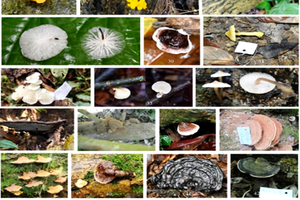
Dihing Patkai National Park (DPNP) is situated in the Tinsukia and Dibrugarh districts of Assam, India. The forest type of the park is Assam Valley Tropical Wet Evergreen Forest (category 1B/C1). In order to explore the fungal diversity, different randomly selected belt transects of size 0.1 ha were laid in the park. Overall, 159 species of macrofungi representing 81 genera, 43 families, 14 orders, 5 classes, and 2 phyla under the kingdom fungi have been recorded from the Park. Maximum species were found in the family Polyporaceae (34 spp.) followed by Mycenaceae (14 spp.), Omphalotaceae (11 spp.), Marasmiaceae (14 spp.), Russulaceae (10 spp.), Tricholomataceae, Hymenochaetaceae, Amanitaceae, Agaricaceae, Xylariaceae (5 spp. each) and so on. The values of the Shannon-Wiener Diversity Index, Simpson diversity index, and Brillouin’s index were found to be 3.54, 0.94, and 3.49 respectively, which means the level of diversity of macrofungi was in the higher category. The evenness index was found to be 0.22 or only 22% of species were common or shared among plots within the DPNP. The four diversity indices proved that the DPNP has high species diversity and a healthy forest ecosystem. Maximum species of macrofungi (22%) were found associated with Dipterocarpus retusus followed by Castanopsis indica (13%), Shorea assamica (11%), Vatica lanceaefolia (9%), Mesua ferrea (8%), and the rest of macrofungal species associated with the plant species ranged from 5% to 1%.
References
[1] J. P. Schmit and G. M. Mueller (2007). An estimate of the lower limit of global fungal diversity. Biodivers. Conserv., 16: 99-111.
[2] A. Cowan (2001). Fungi-life support for ecosystems. Essential ARB., 4: 1-5.
[3] A. S. Chang and G. P.Miles (2004). Mushrooms: cultivation, nutritional value, medicinal effect, and environmental impact, 2nd edn. CRC Press, Boca Raton.
[4] G. M. Gadd (2001). Fungi in Bioremediation. Cambridge University Press, Cambridge, pp383-423.
[5] D. L. Hawksworth (1991). The fungal dimension of biodiversity: magnitude, significance, and conservation. Mycol. Res., 95: 641-655.
[6] D. L. Hawksworth (2001). The magnitude of fungal diversity: the 1.5 million species estimate revisited. Mycol. Res., 105: 1422-1432.
[7] D. L. Hawksworth (2004). Fungal diversity and its implications for genetic resource collections. Stud. Mycol., 50: 9-18.
[8] M. Blackwell (2011). The Fungi: 1, 2, 3… 5.1 million species? Am. J. Bot., 98: 426-438.
[9] M. L. Berbee, T. Y. James and C. Strullu-Derrien (2017). Early diverging fungi: diversity and impact at the dawn of terrestrial life. Annu. Rev. Microbiol., 71: 41-60.
[10] B. Wu, M. Hussain, W. Zhang, M. Stadler, X. Liu and M. Xiang (2019). Current insights into fungal species diversity and perspective on naming the environmental DNA sequences of fungi. Mycology, 10: 127-140.
[11] K. Das (2010). Diversity and conservation of wild mushrooms in Sikkim with special reference to Barsey Rhododendron Sanctuary. NeBIO., 1: 1-13.
[12] S. T. Chang and P. G. Miles (1992). Mushroom biology–a new discipline. Mycol., 6: 64-65.
[13] G. M. Mueller, J. P. Schmit, P. R. Leacock, B. Buyck, J. Cifuentes, D. E. Desjardin and R. E. Halling et al., (2007). Global diversity and distribution of macrofungi. Biodivers. Conserv., 16: 37-48.
[14] M. B. H. B. Ali and S. L. Stephenson (2016). Preliminary checklist of the macrofungi from Northwestern Tunisia. Curr. Res. Environ. Appl. Mycol. J. Fungal Biol., 6: 35-44.
[15] A. N. Khalid (2022). A checklist of macrofungi of Pakistan published from 1998-2020. Pak. J. Bot., 54: 1947-1962.
[16] T. R. Kinge, G. Goldman, A. Jacobs, G. G. Ndiritu and M. Gryzenhout (2020). A first checklist of macrofungi for South Africa. MycoKeys, 63: 1-48.
[17] M. K. Adhikari (2018). Mushrooms of Nepal: A Brief Introduction (Kamala S. Adhikari, ed.). Published by Suman Maharjan, Balambu, Kathmandu, Nepal, pp90.
[18] M. K. Adhikari (2014). Mushrooms of Nepal. In: G, Durrieu and V.T. Cotter (eds.), Kathmandu, Nepal, pp340.
[19] M. Christensen, S. Devkota and S. Bhattarai (2008). Use of wild edible mushrooms in the annapurna conservation area. Mycol. Phytopath. Soc. Nep., 1: 1-6.
[20] N. Roy, D. K. Jha and A. K. Dutta (2022). A checklist of the macrofungi of North East India. Stud. Fungi, 7: 1-24.
[21] S. Debnath, R. C. Upadhyay, R. Saha, K. Majumdar, P. Das and A. K. Saha (2020). A checklist of macrofungi (mushroom) diversity and distributionin the forestsof Tripura, India. J. Threat. Taxa., 12: 16314-16346.
[22] A. Tapwal, R. Kumar and S. Pandey (2013). Diversity and frequency of macrofungi associated with wet ever green tropical forest in Assam, India. Biodiversitas, 14: 73-78.
[23] G. Gogoi and V. Parkash (2014). Some new records of stinkhorns (Phallaceae) from Hollongapar Gibbon Wildlife Sanctuary, Assam, India. J. Mycol., 2014: Article ID 490847. doi: 10.1155/2014/490847.
[24] G. Gogoi and V. Parkash (2015a). Diversity of gasteroid fungi (Basidiomycota) in Hollongapar Gibbon Wildlife Sanctuary, Jorhat, Assam, India. Curr. Res. Environ. Appl. Mycol., 5: 202-212.
[25] G. Gogoi and V. Parkash (2015b). A checklist of gilled mushrooms (Basidiomycota: Agaricomycetes) with diversity analysis in Hollongapar Gibbon Wildlife Sanctuary, Assam, India. J. Threat. Taxa., 7: 8272-8287.
[26] T. Ao, J. Seb, T. Ajungla and C. R. Deb (2016). Diversity of wild mushrooms in Nagaland, India. Open J For., 6: 404-419.
[27] K. K. Akshaya, A. Karthikeyan and C. Kunhikannan (2023). Status of macrofungal diversity in the wet evergreen forests of Agasthyamala biosphere reserve, Western Ghats, India. J. Threat. Taxa., 15: 23575-23586.
[28] Y. P. Sharma, S. A. J. Hashmi, R. Sharma, S. Kumar and R. K. Manhas (2022). Macrofungal diversity and distribution in Kishtwar high altitude national park, Jammu and Kashmir, India. Curr. Sci., 122: 1415-1425.
[29] G. J. MacDonald (2003). Environment: Evolution of a concept. J. Environ. Dev., 12: 151-176. doi: 10.1177/1070496503012002002.
[30] J. R. Jorgensen and E. Shoulders (1967). Mycorrhizal root development vital to survival of slash pine nursery stock. Tree Planters’ Notes, 18: 7-11.
[31] G. C. Marks and T. T. Kozolowski (1973). Ectomycorrhizae: their ecology and physiology. Academic Press, New York, pp444.
[32] N. A. Onguene and T. W. Kuyper (2001). Mycorrhizal associations in the rain forest of South Cameroon. For. Ecol. Manage., 140: 277-287.
[33] B. Senn-Irlet, J. Heilmann-Clausen, D. Genney and A. Dahlberg (2007). Guidance for conservation of macrofungi in Europe. The Directorate of Culture and Cultural and Natural Heritage, Council of Europe, Strasbourg.
[34] G. Gates (2009). The ecology and diversity of macrofungi on dead wood and standing trees with special reference to coarse woody debris. In: Coarse woody debris, macrofungal assemblages, and sustainable forest management in a Eucalyptus obliqua forest of southern Tasmania.
[35] P. Pradhan, A.K. Dutta, S. Paloi, A. Roy and K. Acharya (2016). Diversity and distribution of macrofungi in the Eastern Himalayan ecosystem. Euras. J. Biosci., 10: 1-12.
[36] S. E. Smith and D. J. Read (2008). Mycorrhizal Symbiosis. 3rd Edition, Academic Press, London.
Downloads
Published
Issue
Section
License
Copyright (c) 2024 Author (s)

This work is licensed under a Creative Commons Attribution-NonCommercial-NoDerivatives 4.0 International License.
Copyright © The Author(s). Effective from 1 July 2026, articles published in Emergent Life Sciences Research (ELSR) are distributed under the Creative Commons Attribution 4.0 International License (CC BY 4.0), which permits use, sharing, distribution, reproduction, and adaptation in any medium or format, provided that appropriate credit is given to the original author(s) and the source, a link to the license is provided, and any changes made are indicated.
Articles published before 1 July 2026 remain subject to the license applicable at the time of their original publication, including the Creative Commons Attribution-NonCommercial-NoDerivatives 4.0 International License (CC BY-NC-ND 4.0), where applicable.