Effect of conservation agriculture on soil organic carbon, soil physical properties and yield of different cropping systems in Vertisols of central India
DOI:
https://doi.org/10.31783/elsr.2024.101129139Keywords:
conservation agriculture, conventional tillage, no-tillage, soil physical health, soybean grain equivalent yieldAbstract
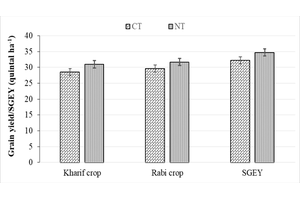
Intensive agriculture coupled with mechanization has become a threat to agricultural sustainability and hence, novel changes like conservation agriculture or regenerative agriculture are required to achieve desirable productivity and upkeep of natural assets. Around the world, conservation agriculture (CA), is gaining acceptance as an innovative and sustainable farming method that can improve the health of the soil, reduce the effect of climate change, enhance organic carbon in the soil, and increase agricultural production. The present research study examined the impact of conservation agriculture in the form of no-tillage on soil organic carbon (SOC), aggregate stability, soil penetration resistance (SPR), and yield of different cropping systems in terms of soybean grain equivalent yield (SGEY). The study was carried out in the Vertisols of central India during the kharif season (July-October) and rabi season (November-April) of 2022-23 on the existing long-term CRP-CA research project at the research farm of the ICAR-Indian Institute of Soil Science, Bhopal, (M.P.), India, initiated way back in 2010. The field experiment was set up using a factorial randomized block design with two tillage systems, no-tillage (NT) and conventional tillage (CT), and three cropping systems, namely, soybean-wheat, maize-gram, and maize-wheat with four replications. Results revealed that CA-based NT plots have significantly higher SOC (0.93%), mean weight diameter (1.29 mm), and water-stable aggregate (82.12%) compared to the CT plots on the surface soil (0-10 cm).
References
[1] J. Somasundaram, N. K. Sinha, R. C. Dalal, R. Lal, M. Mohanty, A. K. Naorem and K. M. Hati et al., (2020). No-till farming and conservation agriculture in South Asia-issues, challenges, prospects and benefits. Crit. Rev. Plant Sci., 39: 236-279.
[2] FAO. (2014). What is conservation agriculture? FAO-CA. http://www.fao.org/ag/ca/1a.html.
[3] A. Singh, V. K. Phogat, R. Dahiya, and S. D. Batra (2014). Impact of long-term zero till wheat on soil physical properties and wheat productivity under rice–wheat cropping system. Soil and Tillage Res., 140: 98-105.
[4] R. Lal (2011). Sequestering carbon in soils of agroecosystems. Food Policy, 36: S33-S39.
[5] M. Paudel, S. K. Sah, A. McDonald and N. K. Chaudhary (2014). Soil organic carbon sequestration in rice-wheat system under conservation and conventional agriculture in western Chitwan, Nepal. World J. Agric. Res., 2: 1-5.
[6] T. Li, Z. Sun, C. He, X. Ge, Z. Ouyang and L. Wu (2019). Changes in soil bacterial community structure and microbial function caused by straw retention in the North China Plain. Arch. Agron. Soil Sci., 66: 1-12.
[7] B. Govaerts, K. D. Sayre, B. Goudeseune, P. De Corte, K. Lichter, L. Dendooven and J. Deckers (2009). Conservation agriculture as a sustainable option for the central Mexican highlands. Soil Tillage Res., 103: 222-230.
[8] M. L. Jat, M. K. Gathala, Y. S. Saharawat, J. P. Tetarwal, R. Gupta and Y. Singh (2013). Double no-till and permanent raised beds in maize–wheat rotation of north western Indo-Gangetic plains of India: Effects on crop yields, water productivity, proftability and soil physical properties. Field Crop Res., 149: 291-299.
[9] J. M. Baker, T. E. Ochsner, R. T. Venterea, and T. J. Griffis (2007). Tillage and soil carbon sequestration-what do we really know? Agric. Ecosyst. Environ. 118: 1-5.
[10] J. Somasundaram, R. S. Chaudhary, D. AwanishKumar, A. K. Biswas, N. K. Sinha, M. Mohanty and K. M. Hati et al., (2018). Effect of contrasting tillage and cropping systems on soil aggregation, carbon pools and aggregate-associated carbon in rainfed Vertisols. Eur. J. Soil Sci., 69: 879-891.
[11] J. Somasundaram, S. Reeves, W. Wang, M. Heenan and R. Dalal (2017). Impact of 47 years of no-tillage and stubble retention on soil aggregation and carbon distribution in a Vertisol. Land Degrad. Dev., 28: 1589-1602.
[12] K. Abdalla, P. Chivenge, P. Ciais and V. Chaplot (2016). No-tillage lessens soil CO2 emissions the most under arid and sandy soil conditions: results from a meta-analysis. Biogeosciences. 13: 3619-3633.
[13] K. Oorts, R. Merckx, E. Grehan, J. Labreuche and B. Nicolardot (2007). Determinants of annual fluxes of CO2 and N2O in long-term no-tillage and conventional tillage systems in northern France. Soil Tillage Res., 95: 133-148.
[14] M. K. Alam, N. Salahin, S. Islam, R. A. Begum, M. Hasanuzzaman, M.S. Islam and M. M. Rahman (2017). Patterns of change in soil organic matter, physical properties and crop productivity under tillage practices and cropping systems in Bangladesh. J. Agri. Sci., 155: 216-238.
[15] M. Choudhary, A. Datta, H. S. Jat, A. K. Yadav, M. K. Gathala, T. B. Sapkota and A. K. Das et al., (2018). Changes in soil biology under conservation agriculture-based sustainable intensification of cereal systems in Indo-Gangetic Plains. Geoderma, 313: 193-204.
[16] A. Kassam, T. Friedrich, R. Derpsch and J. Kienzle (2015). Overview of the worldwide spread of conservation agriculture. Field Actions Sci. Rep., 8: 1-11.
[17] A. Walkley and I. A. Black (1934). An examination of degtjareff method for determining soil organic matter and a proposed modification of the chromic acid titration method. Soil Sci., 37: 29-38.
[18] R. E. Yoder (1936). A direct method of aggregate analysis and study of the physical nature of erosion losses(1). Soil Sci. Soc. Am. J., 28: 337-351.
[19] W. D. Kemper, and R. C. Rosenau (1986). Aggregate stability and size distribution. In: Arnold Klute (Ed) Methods of soil analysis: Part 1 Physical and mineralogical methods. Second Edition, pp425-442.
[20] K. A. Gomez and A. A. Gomez (1984). Statistical procedures for agricultural research. 2nd edn. John Wiley and Sons, New York, USA, pp704.
[21] R. K. Naresh, P. C. Jat, V. Kumar, S. P. Singh and Y. Kumar (2019). Carbon and nitrogen dynamics, carbon sequestration and energy saving in soils under different tillage, stubble mulching and fertilizer management in rice–wheat cropping system. J. Pharmacogn. Phytochem., 7: 723-740.
[22] S. Marahatta, S. K. Sah, A. MacDonald, J. Timilnisa and K. P. Devkota (2014). Influence of conservation agriculture practices on physical and chemical properties of soil. Int. J. Adv. Res., 2: 43-52.
[23] A. F. Plante and W. B. McGill (2002). Soil aggregated dynamics and retention of organic matter in laboratory -incubate d soil with differing simulated tillage frequencies. Soil Tillage Res., 66: 79-92.
[24] H. Zhang, Y. Zhang, C. Yan, E. Liu and B. Chen (2016). Soil nitrogen and its fractions between long-term conventional and no-tillage systems with straw retention in dryland farming in northern China. Geoderma, 269: 138-144.
[25] K. M. Hati, R. K. Singh, K. G. Mandal, K. K. Bandyopadhyay, J. Somasundaram, M. Mohanty and N. K. Sinha et al., (2014). Conservation tillage effects on soil physical properties, organic carbon concentration and productivity of soybean-wheat cropping system. J. Agric. Physics, 14: 121-129.
[26] J. Sheehy, K. Regina, L. Alakukku, J. Six (2015). Impact of no-till and reduced tillage on aggregation and aggregate-associated carbon in Northern European agroecosystems. Soil Till. Res., 150: 107-113.
[27] K. M. Hati, R. S. Chaudhary, K. G. Mandal, K. K. Bandyopadhyay, R. K. Singh, N. K. Sinha, M. Mohanty et al., (2015). Effects of tillage, residue and fertilizer nitrogen on crop yields, and soil physical properties under soybean-wheat rotation in vertisols of Central India. Agric. Res., 4: 48-56.
[28] D. L. Karlen, C. A. Cambardella, J. L. Kovar, T. S. Colvin (2013). Soil quality response to long -term tillage and crop rotation practices. Soil Tillage Res., 133: 54-64.
[29] S. M. Zuber, G. D. Behnke, E. D. Nafziger and M. B. Villamil (2015). Crop rotation and tillage effects on soil physical and chemical properties in Illinois. Agronomy J., 107: 971-978.
[30] J. Six, E.T. Elliott, K. Paustian (2000). Soil macroaggregate turnover and microaggregate formation: a mechanism for C sequestration under no-tillage agriculture. Soil Biol. Biochem., 32: 2099-2103.
[31] C. M. Parihar, M. R. Yadav, S. L. Jat, A. K. Singh, B. Kumar, S. Pradhan and D. Chakraborty et al., (2016). Long term effect of conservation agriculture in maize rotations on total organic carbon, physical and biological properties of a sandy loam soil in north-western Indo-Gangetic Plains. Soil Tillage Res., 161: 116-128.
[32] B. Lowery and J.E. Morrison (2002). Soil penetrometers and penetrability. In: J. H. Dane, G. C. Topp (eds.) Methods of Soil Analysis, Part 4, Physical Methods, Soil Science Society of America, Madison, pp363-388.
[33] D. Roy, A. Datta, H. S. Jat, M. Choudhary, P. C. Sharma, P. K. Singh, M. L. Jat (2022). Impact of long- term conservation agriculture on soil quality under cereal based systems of North West India. Geoderma, 405: 115391. doi: 10.1016/j.geoderma.2021.115391.
[34] S. Mondal, D. Chakraborty, T. K. Das, M. Shrivastava, A. K. Mishra, K. K. Bandyopadhyay and P. Aggarwal et al., (2019). Conservation agriculture had a strong impact on the sub-surface soil strength and root growth in wheat after a 7-year transition period. Soil Till. Res., 195: 104385. doi: 10.1016/j.still.2019.104385.
Downloads
Published
Issue
Section
License
Copyright (c) 2024 Author (s)

This work is licensed under a Creative Commons Attribution-NonCommercial-NoDerivatives 4.0 International License.
Copyright © The Author(s). Effective from 1 July 2026, articles published in Emergent Life Sciences Research (ELSR) are distributed under the Creative Commons Attribution 4.0 International License (CC BY 4.0), which permits use, sharing, distribution, reproduction, and adaptation in any medium or format, provided that appropriate credit is given to the original author(s) and the source, a link to the license is provided, and any changes made are indicated.
Articles published before 1 July 2026 remain subject to the license applicable at the time of their original publication, including the Creative Commons Attribution-NonCommercial-NoDerivatives 4.0 International License (CC BY-NC-ND 4.0), where applicable.