Assessment of microbial exopolysaccharides for improving soil fertility and crop yield in semi-arid India
DOI:
https://doi.org/10.31783/elsr.2024.101140153Keywords:
basaltic soil, maize, microbial exopolysaccharides, nitrogen, soil fertility, soybeanAbstract
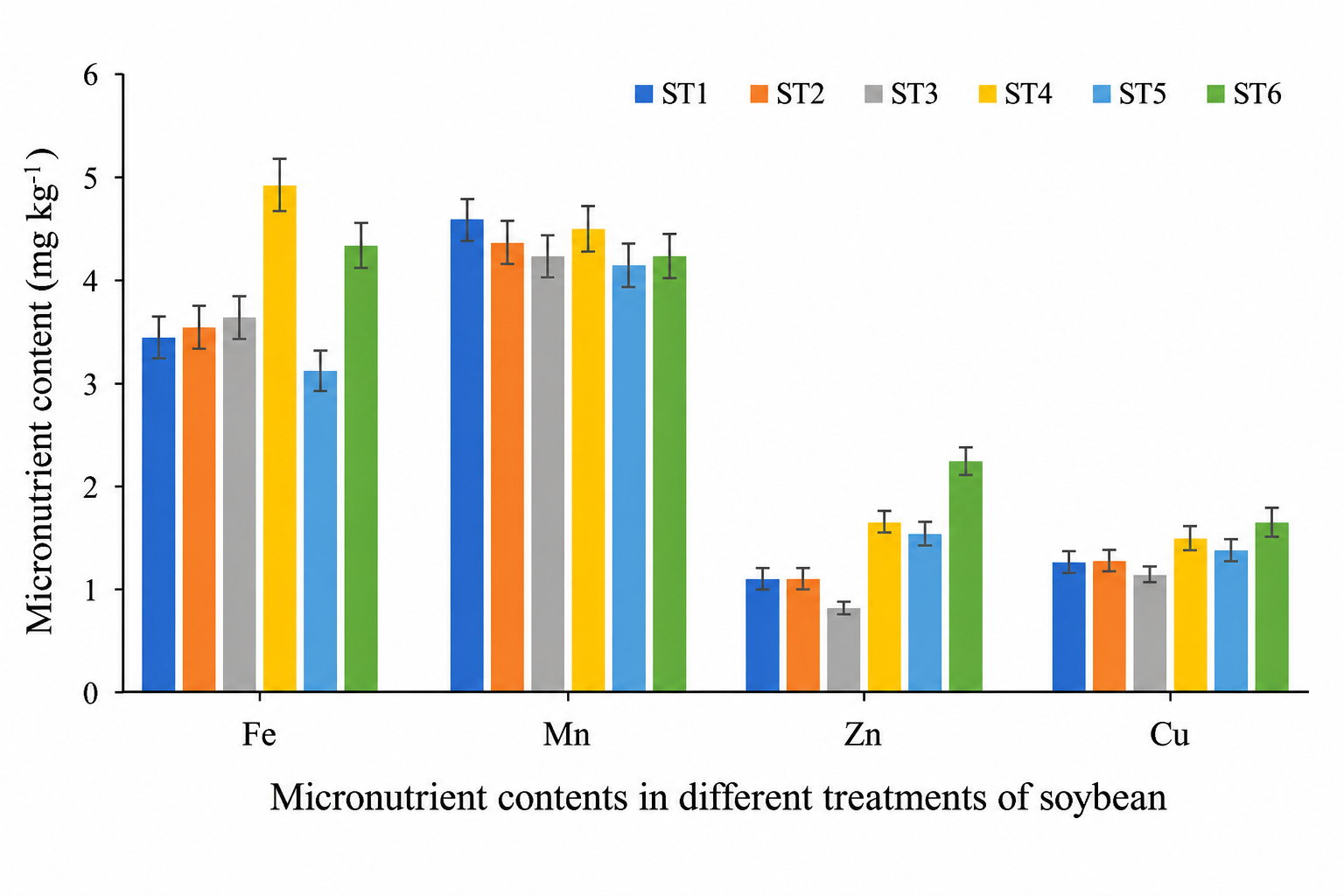
Soil degradation and poor fertility are major concerns in semi-arid regions of India. Microbial exopolysaccharides (EPS) have demonstrated potential in mitigating abiotic and biotic stresses in these areas. However, the studies on the impact of EPS on crop performance and soil fertility under natural field conditions remain limited. To address this knowledge gap, a field experiment was conducted during the rainy season of 2019-20 and 2020-21 at ICAR-NIASM, Baramati, Maharashtra, to examine the effects of microbial EPS on average crop yields of soybean and maize, microbial colonization status in soybean and maize, and soil fertility parameters in basaltic soils of India. Seeds inoculated with Rhizobium or nitrogen fixers and 10 kg ha-1 EPS resulted in a significant increase in soybean and maize yields by 57.7% and 44.8%, respectively, compared to the control. Additionally, the Rhizobium treated seeds with EPS 10 kg ha-1 showed improvements in soil organic carbon, dehydrogenase activity, and nitrogen content by 15.5%, 214.5%, and 70.0%, respectively, in soybean compared to the control. Conversely, the application of microbial EPS did not cause any significant change in soil pH, E.C., or available P, K, Fe, Mn, and Zn contents in both crops. While the presence of EPS within the rhizosphere of soybean actively promoted nodule formation, it also enhanced microbial colonization within the rhizosphere of both soybean and maize. Moreover, the best subset regression analysis revealed that EPS altered the soil parameters for the yield of both crops.
References
[1] A. Chaudhary, M. C. Meena, B. S. Dwivedi, S. P. Datta, C. M. Parihar, A. Dey and V. K. Sharma (2019). Effect of conservation agriculture on soil fertility in Maize (Zea Mays)-based systems. Indian J. Agric. Sci., 89: 1654-1659.
[2] M. S. Aulakh and G. S. Sidhu (2015). Soil degradation in india: causes, major threats, and management options. In MARCO Symposium 2015-Next Challenges of Agro-Environmental research in Monsoon Asia. Tsukuba, Japan: National Institute for Agro-Environmental Sciences (NIAES). pp151-156.
[3] V. Rajagopal, R. L. Choudhary, N. Kumar, K. K. Krishnani, Y. Singh, S. K. Bal and P. S. Minhas et al., (2018). Soil health status of NIASM Southern farm land. NIASM Technology Bulletin-15, ICAR-National Institute of Abiotic Stress Management, Baramati, Pune, Maharashtra, India, pp64.
[4] P. V. Bramhachari, G. P. Nagaraju and E. Kariali (2018). Current perspectives on rhizobacterial-eps interactions in alleviation of stress responses: novel strategies for sustainable agricultural productivity. In: role of rhizospheric microbes in soil; Springer Science and Business Media LLC: Berlin/Heidelberg, Germany, pp33-55.
[5] S. S. Şengör (2019). Review of current applications of microbial biopolymers in soil and future perspectives. ACS Symposium series. R. N. Rathinam and R. K. Sani (Eds) (Washington, DC: American Chemical Society), pp275-299. doi: 10.1021/bk-2019-1323.ch013.
[6] S. Timmusk and E. Nevo (2011). Plant root associated biofilms: perspectives for natural product mining. In: D. K. Maheshwari (Eds), Bacteria in agrobiology: Plant nutrient management. Springer Verlag, Berlin, pp285-300. doi: 10.1007/978-3-642-21061-7_12.
[7] E. Rolli, R. Marasco, G. Vigani, B. Ettoumi, F. Mapelli, M. L. Deangelis and C. Gandolfi et al., (2015). Improved plant resistance to drought is promoted by the root‐associated microbiome as a water stress‐dependent trait. Environ. Microbiol., 17: 316-331.
[8] F. Chu, D. B. Kearns, S. S. Branda, R. Kolter and R. Losick (2006). Targets of the master regulator of biofilm formation in bacillus subtilis. Mol. Microbiol., 59: 1216-1228.
[9] D. Romero, C. Aguilar, R. Losick and R. Kolter (2010). Amyloid fibers provide structural integrity to bacillus subtilis biofilms. Proc. Natl. Acad. Sci. U. S. A., 107: 2230-2234.
[10] M. C. Vargas‐Garcia, M. J. Lopez, M. A. Elorrieta, J. Suarez and J. Moreno (2003). Properties of polysaccharide produced by Azotobacter vinelandii cultured on 4‐hydroxybenzoic acid. J. Appl. Microbiol., 94: 388-395.
[11] Y. Han, E. Liu, L. Liu, B. Zhang, Y. Wang, M. Gui and R. Wu et al., (2015). Rheological, emulsifying and thermostability properties of two exopolysaccharides produced by Bacillus amyloliquefaciens LPL061. Carbohydr. Polym., 115: 230-237.
[12] S. Larpin, N. Sauvageot, V. Pichereau, J. M. Laplace and Y. Auffray (2002). Biosynthesis of exopolysaccharide by a Bacillus licheniformis strain isolated from ropy cider. Int. J. Food Microbiol., 77: 1-9.
[13] A. M. Sorty, K. K. Meena, K. Choudhary, U. M. Bitla, P. S. Minhas and K. K. Krishnani (2016). Effect of plant growth promoting bacteria associated with halophytic weed (Psoralea corylifolia L.) on germination and seedling growth of wheat under saline conditions. Appl. Biochem. Biotechnol., 180: 872-882.
[14] C. S. Nautiyal (1999). An efficient microbiological growth medium for screening phosphate solubilizing microorganisms. FEMS Microbiol. Lett., 170: 265-270.
[15] M. Sen and S. P. Sen (1965). Interspecific transformation in Azotobacter. J. Gen. Microbiol., 41: 1-6.
[16] M. L. Jackson (1967). Soil chemical analysis. Prentic-Hall of India Pvt. & Ltd. New Delhi.
[17] A. Walkley and I. A. Black (1934). An examination of the Degtjareff method for determining soil organic matter, and a proposed modification of the chromic acid titration method. Soil Sci., 37: 29-38.
[18] L. E. Casida Jr, D. A. Klein and T. Santoro (1964). Soil dehydrogenase activity. Soil Sci., 98: 371-376.
[19] S. R. Olsen, C. Cole, F. S. Watanabe and L. Dean (1954). Estimation of available phosphorus in soils by extraction with sodium bicarbonate. Circular (No. 939). Washington DC: USDA Press. pp1-19.
[20] F. S. Watanabe and S. R. Olsen (1965). Test of an ascorbic acid method for determining phosphorus in water and NaHCO3 extracts from soil. Soil Sci. Soc. Amer. J., 29: 677-678.
[21] J. J. Hanway and H. Heidel (1952). Soil analysis methods as used in the Iowa State College soil testing laboratory. Iowa Agri. News, 57: 1-31
[22] W. L. Lindsay and W. A. Norvell (1978). Development of a DTPA soil test for zinc, iron, manganese, and copper. Soil Sci. Soc. Am. J., 42: 421-428.
[23] F. de Mendiburu and M. Yaseen (2020). Agricolae: Statistical Procedures for Agricultural Research. R Package Version 1.4. 0. https://myaseen208.github.io/agricolae/https://cran.r-project.org/package=agricolae.
[24] J. A. Downie (2010). The roles of extracellular proteins, polysaccharides and signals in the interactions of rhizobia with legume roots. FEMS Microbiol. Rev., 34: 150-170.
[25] Y. Alami, W. Achouak, C. Marol and T. Heulin (2000). Rhizosphere soil aggregation and plant growth promotion of sunflowers by an exopolysaccharide-producing Rhizobium sp. Strain isolated from sunflower roots. Appl. Environ. Microbiol., 66: 3393-3398.
[26] R. Bhattacharyya, S. Das, R. Bhattacharya, M. Chatterjee and A. Dey (2017). Rhizobial exopolysaccharides: a novel biopolymer for legume-rhizobia symbiosis and environmental monitoring. In: Zaidi A, Khan MS, Musarrat J (eds) Microbes for legume improvement. Springer International Publishing, London, pp119-133.
[27] M. Ashraf, S. Hussain and F. Hasnain (2005). Exo-polysaccharides (EPS) producing biofilm bacteria in improving physico-chemical characteristics of the salt-affected soils. In: Raja IA et. al., (eds) Proceedings of International Conference Environment and Sustainable Development. COMSATS Institute of Information Technology, Abbottabad, pp1527-1536.
[28] P. Deka, G. Goswami, P. Das, T. Gautom, N. Chowdhury, R. C. Boro and M. Barooah (2019). Bacterial exopolysaccharide promotes acid tolerance in Bacillus amyloliquefaciens and improves soil aggregation. Mol. Biol. Rep., 46: 1079-1091.
[29] S. L. Rogers and R. G. Burns (1994). Changes in Aggregate Stability, Nutrient Status, Indigenous Microbial Populations, and Seedling Emergence, Following Inoculation of Soil with Nostoc muscorum. Biol. Fertil. Soils, 18: 209-215.
[30] Y. M. Awad, E. Blagodatskaya, Y. S. Ok and Y. Kuzyakov (2012). Effects of polyacrylamide, biopolymer, and biochar on decomposition of soil organic matter and plant residues as determined by 14C and enzyme activities. Eur. J. Soil Biol., 48: 1-10.
[31] S. V. Patil, B. K. Salunke, C. D. Patil and R. B.Salunkhe (2011). Studies on amendment of different biopolymers in sandy loam and their effect on germination, seedling growth of Gossypium Herbaceum L. Appl. Biochem. Biotechnol., 163: 780-791.
[32] V. Sandhya, S. K. Z. Ali, M. Grover, G. Reddy and B. Venkateswarlu (2009). Alleviation of drought stress effects in sunflower seedlings by the exopolysaccharides producing Pseudomonas Putida strain GAP-P45. Biol. Fertil. Soils, 46: 17-26.
[33] I. M. Bamatov, E. V. Rumyantsev and A. K. Zanilov (2019). The influence of biopolymer modification of mineral fertilizers on main agrochemical parameters of soil. IOP Conf. Ser.: Earth Environ. Sci., 315: 52059. doi: 10.1088/1755-1315/315/5/052059.
[34] K. K. Raj, U. R.; Sardar, E. Bhargavi, I. Devi, B. Bhunia and O. N. Tiwari (2018). Advances in exopolysaccharides based bioremediation of heavy metals in soil and water: A critical review. Carbohydr. Polym., 199: 353-364.
[35] V. T. H. Pham, P. Murugaraj, F. Mathes, B. K. Tan, V. K. Truong, D. V. Murphy and D. E. Mainwaring (2017). Copolymers enhance selective bacterial community colonization for potential root zone applications. Sci Rep, 7: 15902. doi: 10.1038/s41598-017-16253-0.
[36] P. V. Bramhachari, G. P. Nagaraju and E. Kariali (2018). Current perspectives on rhizobacterial-eps interactions in alleviation of stress responses: novel strategies for sustainable agricultural productivity. In role of rhizospheric microbes in soil; Springer Science and Business Media LLC: Berlin/Heidelberg, Germany, pp33-55.
[37] M. Jaszek, M. Janczarek, K. Kuczyński, T. Piersiak and K. Grzywnowicz (2014). The response of the Rhizobium leguminosarum bv. Trifolii wild-type and exopolysaccharide-deficient mutants to oxidative stress. Plant Soil, 376: 75-94.
Downloads
Published
Issue
Section
License
Copyright (c) 2024 Author (s)

This work is licensed under a Creative Commons Attribution-NonCommercial-NoDerivatives 4.0 International License.
Copyright © The Author(s). Effective from 1 July 2026, articles published in Emergent Life Sciences Research (ELSR) are distributed under the Creative Commons Attribution 4.0 International License (CC BY 4.0), which permits use, sharing, distribution, reproduction, and adaptation in any medium or format, provided that appropriate credit is given to the original author(s) and the source, a link to the license is provided, and any changes made are indicated.
Articles published before 1 July 2026 remain subject to the license applicable at the time of their original publication, including the Creative Commons Attribution-NonCommercial-NoDerivatives 4.0 International License (CC BY-NC-ND 4.0), where applicable.