Disorders of forestomach in large ruminants: A review
DOI:
https://doi.org/10.31783/elsr.2024.101154161Keywords:
advanced imaging techniques, disorder, forestomachAbstract
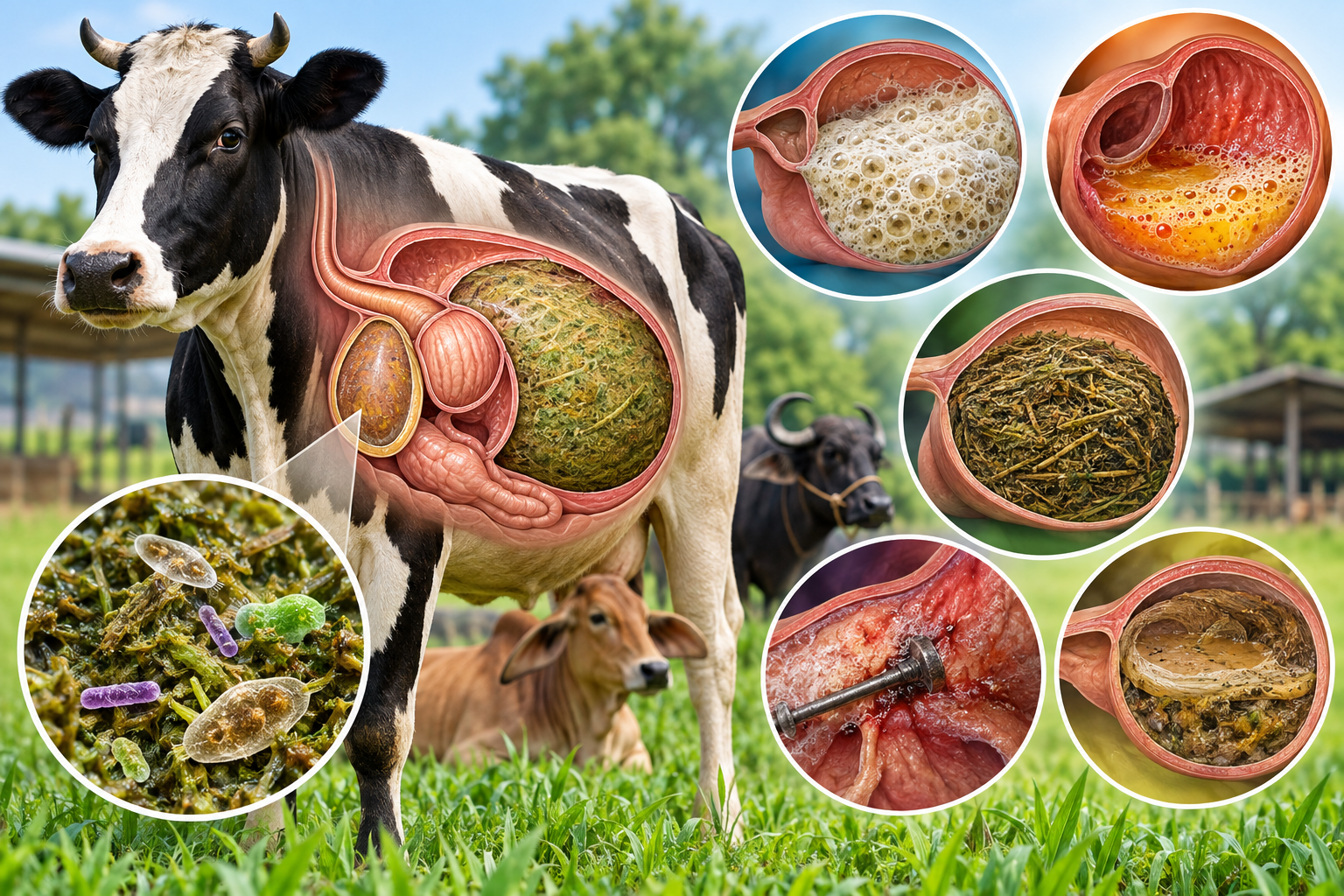
In countries like India where growth of human population is a major problem, livestock products are major source of nutrition to fulfil the demands of this large growing population. Disorder affecting the forestomach of large ruminants pose a significant challenge to livestock productivity. This review presents important findings on understanding ruminal disorder, diagnostic techniques and their treatment of common clinical conditions like ruminal acidosis, bloat, ruminal impaction, reticulo-peritonitis, and predisposing factors such as nutrition, management practices and environmental factors have been explained. The currently available diagnostic techniques, advanced imaging laboratory techniques, their timely assessment have been discussed in detail. The diagnosis of the disorders through various diagnostic methods and subsequent treatment methods, dietary adjustments and precautions to be taken to protect the livestock from the effects of these disorders have been described. Animal welfare requires the availability of animal nutrition for clinical solution to diseases and a holistic approach towards treatment of disease.
References
[1] A. Kumar, S. Potliya, V. Thakur, H. Singh, S. Ruhil, Y. Bangar and R. S. Bisla (2020). Disorders of forestomach in cattle and buffaloes of Haryana. Indian J. Anim. Sci., 90: 1229-1233.
[2] R. A. Erdman (1988). Dietary buffering requirements of the lactating dairy cow: A review. J. Dairy Sci., 71: 3246-3266.
[3] R. R. Carter and W. L. Grovum (1990). A review of the physiological significance of hypertonic body fluids on feed intake and ruminal function: salivation, motility and microbes. J. Anim. Sci., 68: 2811-2832.
[4] R. E. Howarth (1975). A review of bloat in cattle. Can. Vet. J., 16: 281-294.
[5] S. K. George, M. T. Dipu, U. R. Mehra, P. Singh, A. K. Verma and R. Thomas (2006). Efficacy of chlorpheneramine maleate and B-complex vitamins in the clinical management of simple indigestion in crossbred cattle. Intas Polivet, 7: 8-9.
[6] R. Rivera-Chacon, E. Castillo-Lopez, S. Ricci, R. M. Petri, N. Reisinger and Q. Zebeli, (2022). Supplementing a phytogenic feed additive modulates the risk of subacute rumen acidosis, rumen fermentation and systemic inflammation in cattle fed acidogenic diets. Animals, 12: 1201. doi: 10.3390/ani12091201.
[7] Y. Wang, L. Wang, Z. Wang, B. Xue, Q. Peng, R. Hu and T. Yan (2023). Recent advances in research in the rumen bloat of ruminant animals fed high-concentrate diets. Front. Vet. Sci., 10: 1142965. doi: 10.3389/fvets.2023.1142965.
[8] E. A. Ahmed, A. O. Ali, A. M. Abdelaal and A. E. Mahmoud (2023). Ultrasonography, cardiac biomarkers and biochemical analysis as a diagnostic tool in traumatic reticulitis and its sequelae in Egyptian buffaloes. J. Adv. Vet. Res., 13: 1920-1924.
[9] K. T. Maddy (1954). Incidence of perforation of the bovine reticulum. J. Am. Vet. Med. Ass., 124: 113-115.
[10] U. S. Abdullahi, G. S. H. Usman and T. A. Mshelia (1984). Impaction of rumen with indigestible garbage in cattle and sheep reared within urban and sub-urban environment. Nigerian Vet. J., 13: 89-95.
[11] D. M. Makhdoomi, M. A. Gazi and J. D. Parah (2012). Foreign body syndrome-etiology, clinical symptoms, diagnosis and treatment, A Review. Int. J. Livest. Res., 2: 48-52.
[12] K. A. K. Reddy, M. L. Namratha, K. S. Kumar, Y. R. Kumar and M. Lakshman (2020). Occurrence of foreign body induced ruminal impaction in ruminants-gross findings of necropsy. J. Entomol. Zool. Stud., 8: 177-181.
[13] G. Dirksen (1982). Current aspects of the primary insufficiency of the motor functions of the reticulum and rumen. The Bovine Practitioner, 17: 85-89. doi: 10.21423/bovine-vol1982no17p85-89.
[14] S. A. Hussain, S. K. Uppal, A. Singh and S. K. Mahajan (2014). Vagal indigestion in a buffalo due to obstruction of cardia by a cloth. Buffalo Bull., 33: 258-262.
[15] D. Lacasta, M. Climent, L. M. Ferrer, J. J. Ramos, L. Figueras and M. Borobia (2013). Vagus indigestion resulting from a Cysticercus tenuicollis cyst in an adult ewe. Small Rumin. Res., 110: 62-64.
[16] R. G. Motta, L. D. S. A. Martins, I. J. Gonçalves, M. G. Ribeiro, P. A. dos Santos and G. D. N. Junior (2017). Indigestão vagal em bovino secundária a leucose enzoótica juvenil–relato de caso. In VI Jornacitec-Jornada Científica e Tecnológica.
[17] A. D. S. B. Reis, H. D. A. Bomjardim, C. M. C. Oliveira, C. H. S. Oliveira, J. A. S. D. Silveira, N. D. S. Silva and F. M. Salvarani et al., (2016). Vagal indigestion in Zebu cattle in Brazil. Rev. Salud. Anim., 38: 149-153.
[18] G. S. L. Soares, P. R. Firmino, D. D. A. Santos, M. T. S. Frade, S. V. D. Simoes and E. G. D. M. Neto (2017). Unusual vagal indigestion in goat associated with liver abscess by Corynebacterium pseudotuberculosis. Vet. Zootec., 24: 691-697.
[19] M. H. Ratib (2001). Correlation between some ruminal contents and the respective morphological changes in sheep in Assiut governorate. MV Sc. Fac. of Vet. Medicine, Assiut. University.
[20] R. Arora, A. Tyagi, S. Shekhar, V. S. Rajora and N. Arora (2018). Clinico-pathological alterations in simple indigestion in buffaloes. J. Entomol. Zool. Stud., 6: 1430-1433.
[21] S. Morwal, S. K. Sharma, R. K. Dhuria, D. Goklaney, S. Sharma, M. C. Parashar and R. K. Khinchi (2019). Prevalence of fore-stomach disorders in buffaloes in and around Udaipur district in Rajasthan. Int. J. Chemical Stud., 7: 1977-1980.
[22] S. Morwal (2023). Role of health status of buffalo in different fore-stomach disorders. Int. J. Vet. Sci. Anim. Husb., 8: 458-461
[23] A. K. Sharma, P. S. Dhaliwal and C. S. Randhawa (2015). Epidemiological studies on forestomach disorders in cattle and buffaloes. Vet. World, 8: 1063–-067.
[24] S. A. Hussain and U. K. Uppal (2015). A study on the prevalence and some epidemiological features of gastrointestinal impaction disorders in cattle and buffaloes of Punjab area. J. Anim. Res., 5: 511-518.
[25] A. D. Wilson and J. G. Ferguson (1984). Use of flexible fiberoptic laparoscope as a diagnostic tool in cattle. Can. Vet. J., 25: 229-234.
[26] J. E. Nocek (1997). Bovine acidosis: implications on laminitis. J. Dairy Sci., 80: 1005-1028.
[27] T. G. Nagaraja and E. C. Titgemeyer (2007). Ruminal acidosis in beef cattle: the current microbiological and nutritional outlook. J. Dairy Sci., 90: E17-E38.
[28] H. M. Golder, S. J. LeBlanc, T. Duffield, H. A. Rossow, R. Bogdanich, L. Hernandez and I. J. Lean (2023). Characterizing ruminal acidosis risk: A multiherd, multicountry study. J. Dairy Sci., 106: 3155-3175.
[29] P. D. Constable, K. W. Hinchcliff, S. H. Done and W. Grünberg (2016). Veterinary medicine: a textbook of the diseases of cattle, horses, sheep, pigs and goats. Elsevier Health Sciences. 11th edn. Elsevier, London, p 1591.
[30] B. K. M. Lim, J. R. Tan, Y. C. Chen, K. W. Chan, P. C. Hsu and J. M. Lai (2023). Case report: A new factor of rumen bloat in goats after the covid-19 pandemic. Taiwan Vet. J., 48: 45-48.
[31] J. D. Barbosa, M. F. Brito, A.-de M. C. Lins, C. C. Barbosa, P. S. C.-da Costa, M. D. Duarte and T. T. A. Ferreira et al., (2023). Proximal and distal vagal indigestion in buffaloes (Bubalus bubalis) in the Amazon Biome. Vet. Sci., 10: 254. doi: 10.3390/vetsci10040254.
Downloads
Published
Issue
Section
License
Copyright (c) 2024 Author (s)

This work is licensed under a Creative Commons Attribution-NonCommercial-NoDerivatives 4.0 International License.
Copyright © The Author(s). Effective from 1 July 2026, articles published in Emergent Life Sciences Research (ELSR) are distributed under the Creative Commons Attribution 4.0 International License (CC BY 4.0), which permits use, sharing, distribution, reproduction, and adaptation in any medium or format, provided that appropriate credit is given to the original author(s) and the source, a link to the license is provided, and any changes made are indicated.
Articles published before 1 July 2026 remain subject to the license applicable at the time of their original publication, including the Creative Commons Attribution-NonCommercial-NoDerivatives 4.0 International License (CC BY-NC-ND 4.0), where applicable.