
Scope of androgenesis for genetic improvement in rice
DOI:
https://doi.org/10.31783/elsr.2019.512328Keywords:
androgenesis, anther culture response, double haploids, riceAbstract
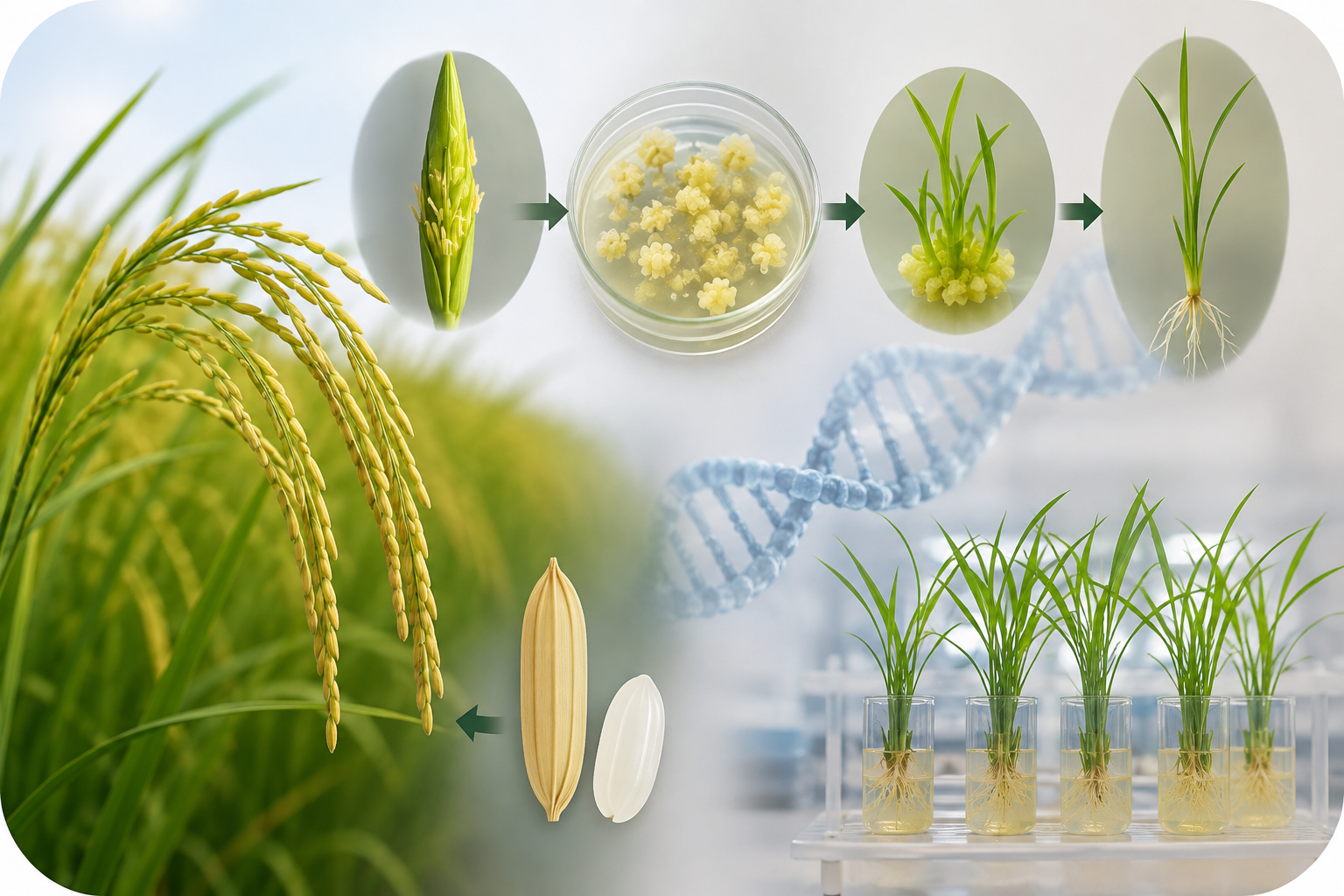
Rice is an autogamous crop. A number of varieties have been bred in this crop using conventional breeding. However, further genetic improvement for seed yield is rarely being achieved as the yield potential has already reached plateau. Recently, frequent disease, pests and insect out-break particularly in areas of intensive cultivation warrants immediate attention. Besides, there is a continuous shift in consumer’s preference with the change in the life style. To keep pace with these problems, there is a need to reorient the rice breeding programs in order to short-cut the breeding cycle. Production of double haploids of elite crosses following androgenesis can be a way forward to fine tune the conventional breeding. In this review, the authors stressed upon the use of androgenesis in rice for genetic improvement of tolerance to biotic and abiotic stresses, quality traits and yield per se.
References
[1] FAOSTAT (2017). UN Food and Agriculture Organization, Corporate Statistical Database. Retrieved November 9, 2018.
[2] J. Yan, Q. Xue and J. Zhu (1996). Genetic studies of anther culture ability in rice (Oryza sativa). Plant Cell Tissue Organ Cult., 45: 253-258.
[3] S. C. Harland (1920). A note on a peculiar tribe of rogue in Sea Island cotton. Agr. News, Barbados, 19, 29.
[4] A. F. Blakeslee, J. Belling, M. E. Farnham and A. D. Bergner (1922). A haploid mutant in the Jimson weed, Datum stramonium. Science, 55: 646-647.
[5] S. Guha and S. C. Maheshwari (1964). In vitro production of embryos from anthers of Datura. Nature, 204: 497.
[6] S. Guha and S.C. Maheshwari (1966). Cell division and differentiation of embryos in the pollen grains of Datura in vitro. Nature, 212: 97-98.
[7] H. Niizeki and K. Oono (1968). Induction of haploid rice plant from anther culture Proc Japan Acad., 44: 554-557.
[8] J. P. Nitsch and C. Nitsch (1969). Haploid plants from pollen grains. Science, 163:85-87.
[9] B. P. Forster, E. Heberle-Bors, K. J. Kasha and A. Touraev (2007). The resurgence of haploids in higher plants. Trends Plant Sci, 12: 368-375.
[10] S. Agache, B. Bachelier, J. de Buyser, Y. Henry and J. Snape (1989). Genetic analysis of anther culture response in wheat using aneuploid, chromosome substitution and translocation lines. Theor Appl Genet., 77: 7-11.
[11] M. A. Germana (2011). Anther culture for haploid and doubled haploid production, Plant Cell Tissue Organ Cult., 104: 283-300.
[12] M. Maluszynski; K. J. Kasha and I. Szarejko (2003). Published doubled haploid protocols in plant species. In Doubled haploid production in crop plants. pp. 309-335. Springer, Dordrecht.
[13] H. Hu and J. Z. Zeng (1984). Development of new varieties via anther culture. (No. 86-043649. CIMMYT.).
[14] P. Premvaranon, S. Vearasilp, S. N. Thanapornpoonpong, D. Karladee, S. Gorinstein (2011). In vitro studies to produce double haploid in Indica hybrid rice, Biologia, 66: 1074-1081.
[15] M. L. Magoon and K. R. Khanna (1963). Haploids. Caryologia, 16: 191-235.
[16] S. Nakamura (1933). The haploid plant in rice. Jap. Jour. Gen., 8: 223-227.
[17] M. Rukmini, G. J. N. Rao and R. N. Rao (2013) Effect of cold pretreatment and phytohormones on anther culture efficiency of two Indica rice (Oryza sativa L.) hybrids: Ajay and Rajalaxmi. Experimental Biol. Agricultural Sci., 1: 69-76.
[18] S. K. Tripathy (2018). Anther culture for double haploid breeding in rice-a way forward, Rice Genomics and Genetics, 9: 1-6.
[19] A. M. Castillo, L. Cistué, M. P. Vallés, and M. Soriano (2009). Chromosome doubling in monocots. In Advances in haploid production in higher plants. pp329-338. Springer, Dordrecht.
[20] S. M. Jain, S. K. Sopory and R. Veilleux (Eds.). (1996). In Vitro Haploid Production in Higher Plants: Volume 2: Applications, Vol. 24. Springer Science and Business Media.
[21] L. Kaushal, R. Sharma, S. M. Balachandran, K. Ulaganathan and V. Shenoy (2014). Effect of cold pretreatment on improving anther culture response of rice (Oryza sativa L.). J. Exp. Biol. Agric. Sci., 2: 233-242.
[22] J. Murovec and B. Bohanec (2012). Haploids and doubled haploids in plant breeding. In Plant breeding. IntechOpen. doi: 10.5772/29982.
[23] R. Mishra, G. J. N. Rao (2016). In-vitro Androgenesis in Rice: Advantages, Constraints and Future Prospects. Rice Science, 23: 57-68.
[24] W. T. B. Thomas, B. Gertson and B. P. Forster (2003). Doubled haploids in breeding. In Doubled Haploid Production in Crop Plants (pp. 337-349). Springer, Dordrecht.
[25] I. S. Dewi, B. S. Purwoko, H. Aswidinnoor, I. H. Somantri and M. A. Chozin (2009). Plant regeneration from anther cultures of several genotypes of Indica rice tolerant to aluminum toxicity. Indonesian J Agric., 2: 1-5.
[26] D. Grewal, C. Manito and V. Bartolome (2011). Doubled Haploids Generated through Anther Culture from Crosses of Elite Indica and Japonica Cultivars and/or Lines of Rice: Large-Scale Production, Agronomic Performance, and Molecular Characterization. Crop Sci., 51: 2544-2553.
[27] S. S. Gosal, A. S. Sindhu, J. S. Sandhu, R. Sandhu-Gill, B. Singh, G. S. Khera and G. S. Sidhu et al., (1997). Haploidy in rice. In: S. M. Jain, S. K. Sopory and R. E. Veilleux (eds) Cereals, In Vitro Haploid Production in Higher Plants, 1-35. Kluwer Academic Publishers, Dordrecht
[28] T. D. Silva (2010). Indica rice anther culture: Can the impasse be surpassed? Plant Cell Tissue Organ Cult., 100: 1-11.
[29] Z. Lentini, P. Reyes, C. P. Martinez, W. M. Roca (1995). Androgenesis of highly recalcitrant rice genotypes with maltose and silver nitrate Plant Sci., 110:127-138.
[30] R. Veeraraghavan (2007). A study on the comparison of anther culture response in different varieties of rice Oryza sativa L. subspecies Indica. University of Colombo, Colombo, Sri Lanka.
[31] U. Bishnoi, R. K. Jain, J. S. Rohilla, V. K. Chowdhury, K. R. Gupta and J. B. Chowdhury (2000). Anther culture of recalcitrant indica × Basmati rice hybrids. Euphytica, 114: 93-101.
[32] S. K. Datta and G. Wenzel (1988). Single microspore derived embryogenesis and plant formation in barley (Hordeum vulgare L.). Archiv fuer. Zuechtungsforschung (German DR).
[33] S. Cha-Um and B. Srianan, A. Pichakum and C. Kirdmanee (2009). An efficient procedure for embryogenic callus induction and double haploid plant regeneration through anther culture of Thai aromatic rice (Oryza sativa L. subsp. indica). In Vitro Cell. Dev. Biol.- Plant, 45:171-179.
[34] E. Kiviharju and E. Pehu (1998). The effect cold and heat pretreatments on anther culture response of Avena sativa and A. sterilis. Plant Cell Tiss Organ Cult., 54: 97-104.
[35] H. M. I. Herath, D. C. Bandara, P. K. Samarajeewa and D. S. A. Wijesundara (2009). Effect of low temperature pre-treatment on anther culture in selected indica, japonica rice varieties and their inter subspecific hybrids. Cey. J. Sci. (Bio. Sci.), 38: 11-16.
[36] J. M. Dunwell, M. Cornish, A. G. L. de Courcel and J. E. Middlefelll-Williams (1983). Induction and growth of ‘microspore-derived’ embryo of Brassica napus ssp. oleifera. J. Exp. Bot. 34: 1768-1778.
[37] A. M. R. Ferrie and W. A. Keller (1995). Development of methodology and applications of doubled haploids in Brassica rapa. In: Proceedings of the 9th International Rapeseed Congress. Pp 807-809. GCIRC, Cambridge.
[38] J. W. Ouyang, S. M. Zhou, S. E. Jia (1983). The response of anther culture to culture temperature in Triticum aestivum. Theor Appl Genet., 66: 101-109.
[39] P.C. Lapitan, V. N. Villegas (1999). Anther culture response of some genotypes with varying amylase content to nitrogen fertilization. Philippine Journal of Crop Sci., 24: 79-84.
[40] C. Chih-Ching, W. Ching-Chu, S. Ching-San, H. Chen, Y. Kwang-Chu,C. Chih-Yin and B. Feng-Yun (1975). Establishment of an efficient medium for anther culture of rice through comparative experiments on the nitrogen sources. Scientia Sinica. 18: 659-668.
[41] S. Lutts, J. M. Kinet and J. Bouharmont (1999). Improvement of rice callus regeneration in the presence of NaCl. Plant Cell Tissue Organ Cult., 57: 3-11.
[42] C. Sen , R. P.Singh, M. K. Singh and H. B. Singh (2011). Effect of cold pretreatment on anther culture of boro rice hybrids. Int. J. Plant Rep. Biol., 3: 69-73.
[43] S. G. Park, M. Ubaidillah and K.-M. Kim (2013). Effect of maltose concentration on plant regeneration of anther culture with different genotypes in rice (Oryza sativa L.). American Journal of Plant Sci., 4(11): 2265-2270.
[44] B. Ba Bong and M. S. Swaminathan (1995). Magnitude of hybrid vigor retained in double haploid lines of some heterotic rice hybrids. Theor. Appl. Genet., 90: 253-257.
[45] F. J. Zapata-Arias (2003). Laboratory protocol for anther culture technique in rice. In Doubled Haploid Production in Crop Plants. pp109-116. Springer, Dordrecht.
[46] R. Siddique (2015). Impact of different media and genotypes in improving anther culture response in rice (Oryza sativa) in Bangladesh. European Scientific J., 11: 164-169.
[47] G. W. Schaeffer (1982). Recovery of heritable variability in anther derived double haploid rice. Crop Sci., 22: 1160-1164.
[48] G. W. Schaeffer, F. T. Jr Sharpe and P. B. Creagan (1984). Variation for improved protein and yield from rice anther culture. Theor Appl Genet., 67: 383-389.
[49] T. T. Xa and N. T. Lang (2011). Rice breeding for high grain quality through anther culture. Omonrice, 18: 68-72.
[50] V. Rasoazanakolona, B. B. Rabealaina, A. Andrianjaka, X. Rakotonjanahary, R. S. Sangwan, and N. V. Rakotoarisoa (2016). Evaluation of Grain Quality and Nutritional Quality of Double Haploid DHP6, An Elite Rice Line in Madagascar, Proc. Latvian Acad. Sci. Section B, 70: 378-383.
Downloads
Published
Issue
Section
License
Copyright (c) 2019 Author (s)

This work is licensed under a Creative Commons Attribution-NonCommercial-NoDerivatives 4.0 International License.
Copyright © The Author(s). This is an open access article distributed under the terms of the Creative Commons Attribution-NonCommercial-NoDerivatives 4.0 International License (CC BY-NC-ND 4.0), which permits unrestricted non-commercial use, distribution, and reproduction in any medium, provided the original author(s) and source are properly credited, and the work is not modified or adapted.