
Synergy between fungal endophytes improves fruit production in strawberry cultivar
DOI:
https://doi.org/10.31783/elsr.2019.512941Keywords:
biological control, Botrytis cinerea, endophytes, pathogen, strawberry, synergy, yieldAbstract
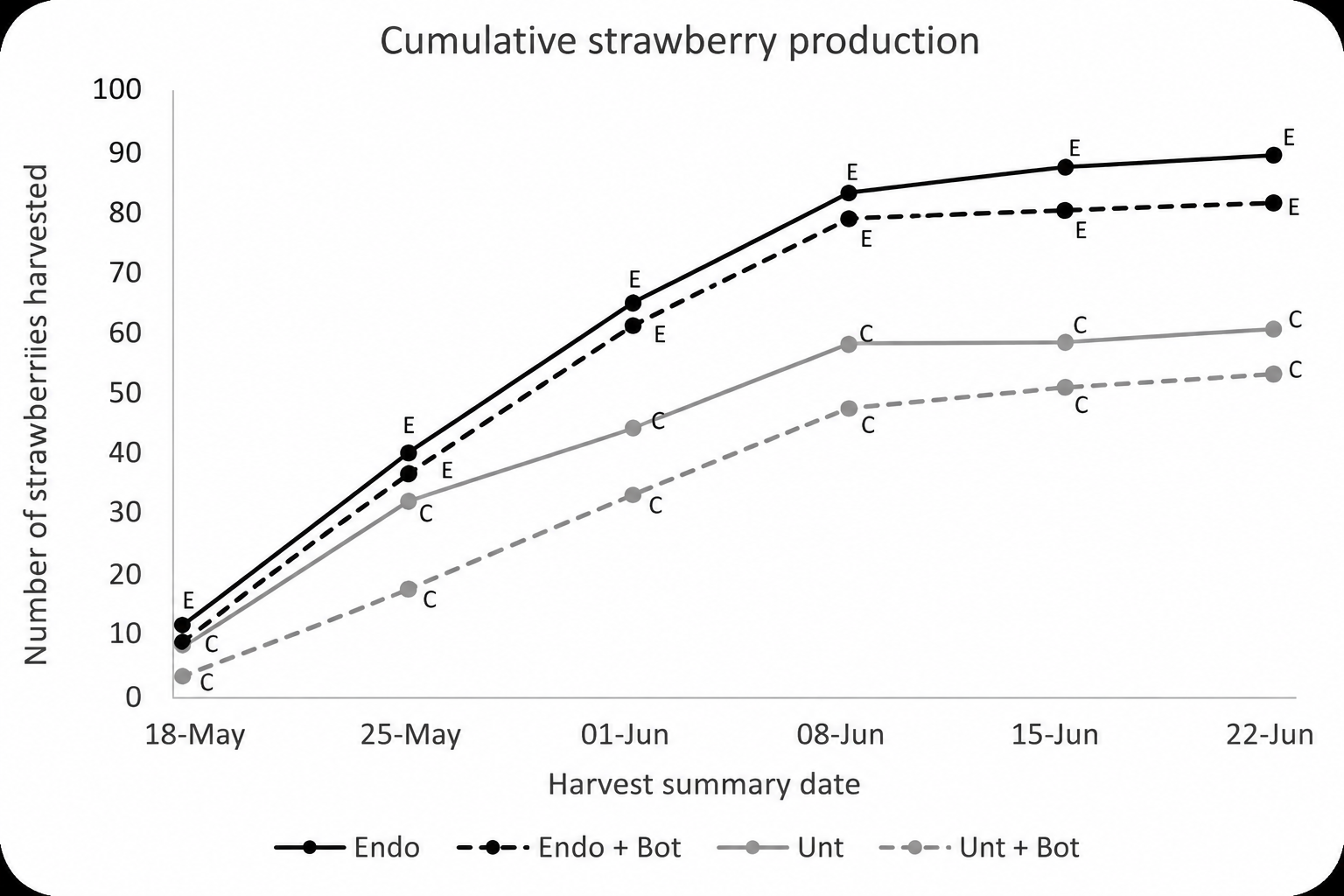
Strawberries are important global soft-fruit crop, but optimal production is constrained by the diseases and chemical treatments. Grey mould disease, caused by the pathogen Botrytis cinerea, is a devastating pathogen of strawberry crops worldwide. In this study, we recovered fungal leaf endophytes from a wild relative of strawberry, Fragaria vesca, and tested the effect of inoculating the endophytes into plants of the strawberry cultivar, Elsanta grown in a glasshouse. The strawberry plants were either untreated or treated with endophytes, infected with B. cinerea or inoculated with both endophytes and B. cinerea. The endophytes were applied as a consortium of six strains (identified as strains of Cladosporium cladosporioides, Colletotrichum circinans, Penicillium brevicompactum and Phoma exigua). The plants treated with endophytes had a longer production period and produced a significantly greater quantity of fruits with increased weight. Compared with the controls, plants inoculated with the endophytes produced 48% more berries and a 22% greater weight of berries; plants inoculated with both endophytes and B. cinerea produced 49% more berries and a 51% greater weight of berries. While strains of each endophyte species have previously been reported to be potentially pathogenic, we have shown that the synergistic interactions between them boosted strawberry fruit production. They can be considered to act on the positive side of a mutualism-parasitism continuum. These results suggest that the endophytes have the potential to improve strawberry production in a larger scale agricultural setting and reduce the negative impact of grey mould disease.
References
[1] Index Box Marketing & Consulting (2018). World: Strawberries - Market Report. Analysis and Forecast to 2025.
[2] FAOSTAT. 2016.
[3] A. M. Husaini and D. Neri (Eds.). (2016). Strawberry: Growth, development and diseases. CABI.
[4] O. Daugovish, K. M. Klonsky and R. L. De Moura (2011). Sample costs to produce strawberries, South Coast–Ventura County, Oxnard Plain 2011.University of California Cooperative Extension, Oakland, CA, USA.
[5] G. Romanazzi, and E. Feliziani (2014). Botrytis cinerea (Gray mold). In Postharvest decay. pp131-146. Academic Press.
[6] J. J. Haydu and D. E. Legard (2003). An economic analysis of preharvest fungicide applications to control Botrytis fruit rot in annual strawberries in Florida. HortScience, 38:124-127.
[7] F. Dianez, M. Santos, R. Blanco and J. C. Tello (2002). Fungicide resistance in Botrytis cinerea isolates from strawberry crops in Huelva (southwestern Spain). Phytoparasitica, 30: 529-534.
[8] L. F. Yourman and S. N. Jeffers (1999). Resistance to benzimidazole and dicarboximide fungicides in greenhouse isolates of Botrytis cinerea. Plant Dis., 83: 569-575.
[9] A. Amiri, S. M. Heath and N. A. Peres (2014). Resistance to fluopyram, fluxapyroxad, and penthiopyrad in Botrytis cinerea from strawberry. Plant dis., 98: 532-539.
[10] A. Grabke and G. A. Stammler (2015). Botrytis cinerea population from a single strawberry field in germany has a complex fungicide resistance pattern. Plant Dis., 99:1078-1086.
[11] B. Yeung, K. Taggart and A. Donohue (2014). California’s strawberry industry is hooked on dangerous pesticides, Dark Side of the Strawberry. Available from: https://www.revealnews.org/article/californias-strawberry-industry-is-hooked-on-dangerous-pesticides/
[12] P. Braun and J. Sutton (1987). Inoculum sources of Botrytis cinerea in fruit rot of strawberries in Ontario. Can. J. Plant Pathol., 9: 1-5.
[13] H. Daugaard (1999). Cultural methods for controlling Botrytis cinerea Pers. in strawberry. Biol. Agric. Hortic., 16: 351-361.
[14] A. Schmid (1996). Biologischer Erdbeeranbau. Merkblatt Forschungsinstitut fur biologischen. pp1-11.
[15] J. Dijkstra, A. Van Oosten (1985). Culture experiments with strawberries. In: annual report of the research station of fruit growing. Wilhelminadorp, pp39-42.
[16] B. C. Strik, P. Stonerod, N. Bell and H. Cahn (1996). Alternative production systems in perennial and annual culture of june-bearing strawberry. Acta Hortic., 439: 433-438..
[17] H. Daugaard (2000). Effect of Cultural methods on the occurrence of grey mould (Botrytis cinerea Pers.) in strawberries. Biol Agric Hortic., 18: 77-83.
[18]. F. M. Gabler, J. L. Smilanick, M. Mansour, D. W. Ramming and B. E. Mackey (2003). Correlations of morphological, anatomical, and chemical features of grape berries with resistance to Botrytis cinerea. Phytopathology, 93: 1263-1273.
[19] G. Lima, A. Ippolito, F. Nigro, M. Salerno (1997). Effectiveness of Aureobasidium pullulans and Candida oleophila against postharvest strawberry rots. Postharvest Biol Technol., 10: 169-178.
[20] N. K. B. Adikaram, D. C. Joyce and L. A. Terry (2002). Biocontrol activity and induced resistance as a possible mode of action for Aureobasidium pullulans against grey mould of strawberry fruit. Aust Plant Pathol., 31: 223-229.
[21] J. Kovach, R. Petzoldt and G. Harman (2000). Use of honey bees and bumble bees to disseminate Trichoderma harzianum 1295-22 to Strawberries for Botrytis Control. Biol Control, 18: 235-242.
[22] Helbig J, Bochow H. Effectiveness of Bacillus subtilis (isolate 25021) in controlling Botrytis cinerea in strawberry. (2001). Zeitschrift für Pflanzenkrankheiten und Pflanzenschutz/J Plant Dis Prot., 108: 545-559.
[23] Freeman S, Minz D, Kolesnik I, Barbul O, Zveibil A, Maymon M, Y. Nitzani et al., (2004). Trichoderma biocontrol of Colletotrichum acutatum and Botrytis cinerea and survival in strawberry. Eur. J. Plant Pathol., 110: 361-370.
[24] S. Shafir, A. Dag, A. Bilu, M. Abu-Toamy and Y. Elad (2006). Honey bee dispersal of the biocontrol agent Trichoderma harzianum T39: effectiveness in suppressing Botrytis cinerea on strawberry under field conditions. Eur. J. Plant Pathol., 116:119-128.
[25] B. A. Bailey, M. D. Strem, D. Wood (2009). Trichoderma species form endophytic associations within Theobroma cacao trichomes. Mycol. Res., 113:1365-1376.
[26] D. E. Mathre, R. H. Johnston, W. E. Grey (1998). Biological control of take-all disease of wheat caused by Gaeumannomyces graminis var. tritici under field conditions using a Phialophora sp. Biocontrol Sci Technol., 8: 449-457.
[27] J. G. Maciá-Vicente, H. B. Jansson, K. Mendgen, L. V. Lopez-Llorca (2008). Colonization of barley roots by endophytic fungi and their reduction of take-all caused by Gaeumannomyces graminis var . tritici. Can. J. Microbiol., 54: 600-609.
[28] D. Zafari, M. M. Koushki, E. Bazgir (2008). Biocontrol evaluation of wheat take-all disease by Trichoderma screened isolates. African J. Biotechnol., 7: 3650-3656.
[29] K. A.O’Hanlon, K. Knorr, L. N. Jørgensen, M. Nicolaisen and B. Boelt (2012). Exploring the potential of symbiotic fungal endophytes in cereal disease suppression. Biol Control., 63: 69-78.
[30] L. V. Cota, L. A. Maffia, E. S. G. Mizubuti and P. E. F. Macedo (2009). Biological control by Clonostachys rosea as a key component in the integrated management of strawberry gray mold. Biol Control, 50: 222-230.
[31] G. Sinclair, C. Charest, Y. Dalpé and S. Khanizadeh (2013). Influence of arbuscular mycorrhizal fungi and a root endophyte on the biomass and root morphology of selected strawberry cultivars under salt conditions. Can. J. Plant Sci., 93: 997-999.
[32] S. K. Dara (2016). First field study evaluating the impact of the entomopathogenic fungus Beauveria bassiana on strawberry plant growth and yield. UCANR eJournal Strawberrries and Vegetables, 7.
[33] T. R. Hodkinson, S. Waldren, J. A. Parnell, C. T. Kelleher, K. Salamin and N. Salamin (2007). DNA banking for plant breeding, biotechnology and biodiversity evaluation. J. Plant Res., 120:17-29.
[34] M. Gardes and T. D. Bruns (1993). ITS primers with enhanced specificity for basidiomycetes-application to the identification of mycorrhizae and rusts. Mol Ecol., 2:113-118.
[35] T. J. White, T. Bruns, S. J. W. T. Lee and J. L. Taylor (1990). Amplification and direct sequencing of fungal ribosomal RNA genes for phylogenetics. PCR protocols: a guide to methods and applications, 18: 315-322.
[36] B. R. Murphy, L. Martin Nieto, F. M. Doohan and T. R. Hodkinson (2015). Fungal endophytes enhance agronomically important traits in severely drought-stressed barley. J. Agr. Crop Sci., 201: 419-427.
[37] P. F. Cannon and P. M. Kirk (Eds.) (2007). Fungal families of the world. Cabi. ISBN: 978-0-851-99827-5
[38] C. Guzmán, M. Bagga, A. Kaur, J. Westermarck and D. Abankwa (2014). Colony Area: An ImageJ Plugin to Automatically Quantify Colony Formation in Clonogenic Assays. PLoS One. 2014;9:e92444. doi: 10.1371/journal.pone.0092444
[39] J. A. van Kan, M. W. Shaw and R. T. Grant-Downton (2014). Botrytis species: relentless necrotrophic thugs or endophytes gone rogue? Mol. Plant. Pathol., 15: 957-961.
[40] X. Fang, R. Jost, P. M. Finnegan and M. J. Barbetti (2013). Comparative proteome analysis of the strawberry-fusarium oxysporum f. sp. fragariae pathosystem reveals early activation of defense responses as a crucial determinant of host resistance. J. Proteome Res., 12: 1772-1788.
[41] A. J. Dik and J. P. Wubben (2007). Epidemiology of botrytis cinerea diseases in greenhouses. In botrytis: biology, pathology and control. pp319-333. Springer, Dordrecht. doi: 10.1007/978-1-4020-2626-3_17.
[42] Y. Fan, Y. Luan, L. An and K. Yu (2008). Arbuscular mycorrhizae formed by Penicillium pinophilum improve the growth, nutrient uptake and photosynthesis of strawberry with two inoculum- types. Biotechnol. Lett., 30:1489-1494.
[43] M. Chialva, A. S. di Fossalunga, S. Daghino, S. Ghignone, P. Bagnaresi, M. Chiapello and M. Novero et al., (2018). Native soils with their microbiotas elicit a state of alert in tomato plants. New Phytol., 220: 1296-1308.
[44] A. Molitor and K. H. Kogel Induced resistance triggered by Piriformospora indica. Plant Signal. Behav., 4: 215-216.
[45] W. M. Haggag, F. Abd-El-Kareem and S. D. Abou-Hussein (2013). Bioprocessing of brevibacillus brevis and bacillus polymyxa: a potential biocontrol agent of gray mould disease of strawberry fruits. International J. Engineering Innovative Technology, 3: 509-518.
[46] A. Esitken, H. E. Yildiz, S. Ercisli, M. F. Donmez, M. Turan and A. Gunes (2010). Effects of plant growth promoting bacteria (PGPB) on yield, growth and nutrient contents of organically grown strawberry. Sci. Hort., 124: 62-66.
[47] S. Jersch, C. Scherer, G. Huth and E. Schlösser (1989). . Proanthocyanidins as a basis for quiescense of Botrytis cinerea in immature strawberry fruits. J. Plant Dis. Protect., 96: 365-378.
[48] G. Peng and J. C. Sutton (1991). Evaluation of microorganisms for biocontrol of Botrytis cinerea in strawberry. Can. J. Plant Pathol., 13: 247-257.
[49] C. M. Vos, K. De Cremer, B. P. Cammue and B. De Coninck (2015). The toolbox of Trichoderma spp. in biocontrol of Botrytis cinerea disease. Mol Plant Pathol., 16: 400-412.
[50]. W. D. Gubler, A. J. Feliciano, A. C. Bordas, E. C. Civerolo, J. A. Melvin and N. C. Welch (1999). First report of blossom blight of strawberry caused by Xanthomonas fragariae and Cladosporium cladosporioides in California. Plant Dis., 83: 400-400.
[51] S. T. Koike, M. S. Vilchez and A. O. Paulus (2003). Fungal ecology of strawberry flower anthers and the saprobic role of Cladosporium cladosporioides in relation to fruit deformity problems. HortScience, 38: 246-250.
[52]. M. H. Nam, M. S. Park, H. S. Kim, T. II Kim and H. G. Kim (2015). Cladosporium cladosporioides and C. tenuissimum Cause Blossom Blight in Strawberry in Korea. Mycobiology, 43: 354-359.
[53] L. L. B. Necha and S. Bautista-Baños (2016). Prospects for the use of chitosan and other alternatives in ornamental conservation. In Chitosan in the Preservation of Agricultural Commodities. pp221-249. Academic Press.
[54] B. R. Murphy, T. R. Hodkinson and F. M. Doohan (2018). Endophytic Cladosporium strains from a crop wild relative increase grain yield in barley. Biology and Environment: Proceedings of the Royal Irish Academy, 118B: 147-156. doi:10.3318/bioe.2018.14.
[55] A. Kondo and T. Hemmi (1953). Comparative studies on the anthracnose of Welsh onion and onion smudge. Scientific Reports of the Shiga Agricultural College, 3:19-35.
[56] W. G. Kim, S. K. Hong and J. H. Kim (2008). Occurrence of anthracnose on welsh onion caused by colletotrichum circinans. Mycobiology. 36: 274-276.
[57] M. Kiehr, R. Delhey and A. Azpilicueta (2012). Smudge and other diseases of onion caused by Colletotrichum circinans, in southern Argentina. Phyton (B Aires), 81:161-164.
[58] S. Leylaie, D. Zafari and Sh B. Abadi (2014). First report of colletotrichum circinans causing smudge on onion in Iran. New Dis. Reports, 30: 2. doi: 10.5197/j.2044-0588.2014.030.002.
[59] H. Irieda, H. Maeda, K. Akiyama, A. Hagiwara, H. Saitoh, A. Uemura and R. Terauchi et al. (2014). Colletotrichum orbiculare secretes virulence effectors to a biotrophic interface at the primary hyphal neck via exocytosis coupled with SEC22-mediated traffic. Plant Cell, 26: 2265-2281.
[60] L. Morin, B. A. Auld and J. F. Brown (1993). Synergy between Puccinia xanthii and Colletotrichum orbiculare on Xanthium occidentale. Biol Control, 3: 296-310.
[61] K. Hiruma, N. Gerlach, S. Sacristán, R. T. Nakano, S. Hacquard, B. Kracher and U. Neumann, et al., (2016). Root endophyte colletotrichum tofieldiae confers plant fitness benefits that are phosphate status dependent. Cell, 165: 464-474.
[62] J. Pitt, A. D. Hocking (2009). Fungi and Food Spoilage. (Vol. 519). New York: Springer..
[63] D. P. Overy and J. C. Frisvad (2003). New penicillium species associated with bulbs and root vegetables. Syst. Appl. Microbiol., 26: 631-639.
[64] A. G. Brown, T. C. Smale, T. J. King, R. Hasenkamp and R. H. Thompson (1976). Crystal and molecular structure of compactin, a new antifungal metabolite from Penicillium brevicompactum. J. Chem. Soc. Perkin Trans. 1,11: 1165-1170.
[65] A. J. Jackson, D. R. Walters and G. Marshall (1994). Evaluation of Penicillium chrysogenum and its antifungal extracts as potential biological control agents against Botrytis fabae on faba beans. Mycological Res., 98: 1117-1126.
[66] B. R. Murphy, F. M. Doohan and T. R. Hodkinson (2015). Persistent fungal root endophytes isolated from a wild barley species suppress seed- borne infections in a barley cultivar. Biocontrol, 60: 281-292.
[67] D. Berner, C. Cavin, J. H. C. Woudenberg, B. Tunali, O. Büyük and B. Kansu (2015). Assessment of Boeremia exigua var. rhapontica, as a biological control agent of Russian knapweed (Rhaponticum repens). Biol. Control, 81: 65-75.
[68] A. Cimmino, A. Andolfi, A. Berestetskiy and A. Evidente (2008). Production of phytotoxins by Phoma exigua var. exigua, a potential mycoherbicide against perennial thistles. J. Agric. Food Chem., 56: 6304-6309.
[69] T. A. Y. L. O. R. Joan (1964). Microbial Behaviour,'in vivo'and'in vitro'. Fourteenth Symposium of the Society for General Microbiology held at the Royal Institution, London, April 1964. In Microbial Behaviour,'in vivo'and'in vitro'. Fourteenth Symposium of the Society for General Microbiology held at the Royal Institution, London, April 1964. London: Cambridge University Press, Bentley House, 200, Euston Road, NWl.
[70] G. Vinderola, M. Gueimonde, C. Gomez-Gallego, L. Delfederico and S. Salminen (2017). Correlation between in vitro and in vivo assays in selection of probiotics from traditional species of bacteria. Trends Food Sci Technol., 68: 83-90.
[71] R. S. Redman, Y. O. Kim, C. J. D. A. Woodward, C. Greer, L. Espino, S. L. Doty and R. J. Rodriguez (2011). Increased fitness of rice plants to abiotic stress via habitat adapted symbiosis: a strategy for mitigating impacts of climate change. PLoS One, 6: e14823. doi:10.1371/journal.pone.0014823.
[72] Y. Qin, I. S. Druzhinina, X. Pan and Z. Yuan (2016). Microbially mediated plant salt tolerance and microbiome-based solutions for saline agriculture. Biotechnol Adv., 34:1245-1259.
[73] Murphy B, Doohan F, Hodkinson T. From concept to commerce: developing a successful fungal endophyte inoculant for agricultural crops. J. Fungi (Basel), 4: 1-11.
Downloads
Published
Issue
Section
License
Copyright (c) 2019 Author (s)

This work is licensed under a Creative Commons Attribution-NonCommercial-NoDerivatives 4.0 International License.
Copyright © The Author(s). This is an open access article distributed under the terms of the Creative Commons Attribution-NonCommercial-NoDerivatives 4.0 International License (CC BY-NC-ND 4.0), which permits unrestricted non-commercial use, distribution, and reproduction in any medium, provided the original author(s) and source are properly credited, and the work is not modified or adapted.