
Micronutrient status of pomegranate growing soils of Hosadurga Taluk in Karnataka, India
DOI:
https://doi.org/10.31783/elsr.2019.515662Keywords:
fertility, micronutrient, nutrient content, pomegranate, variationAbstract
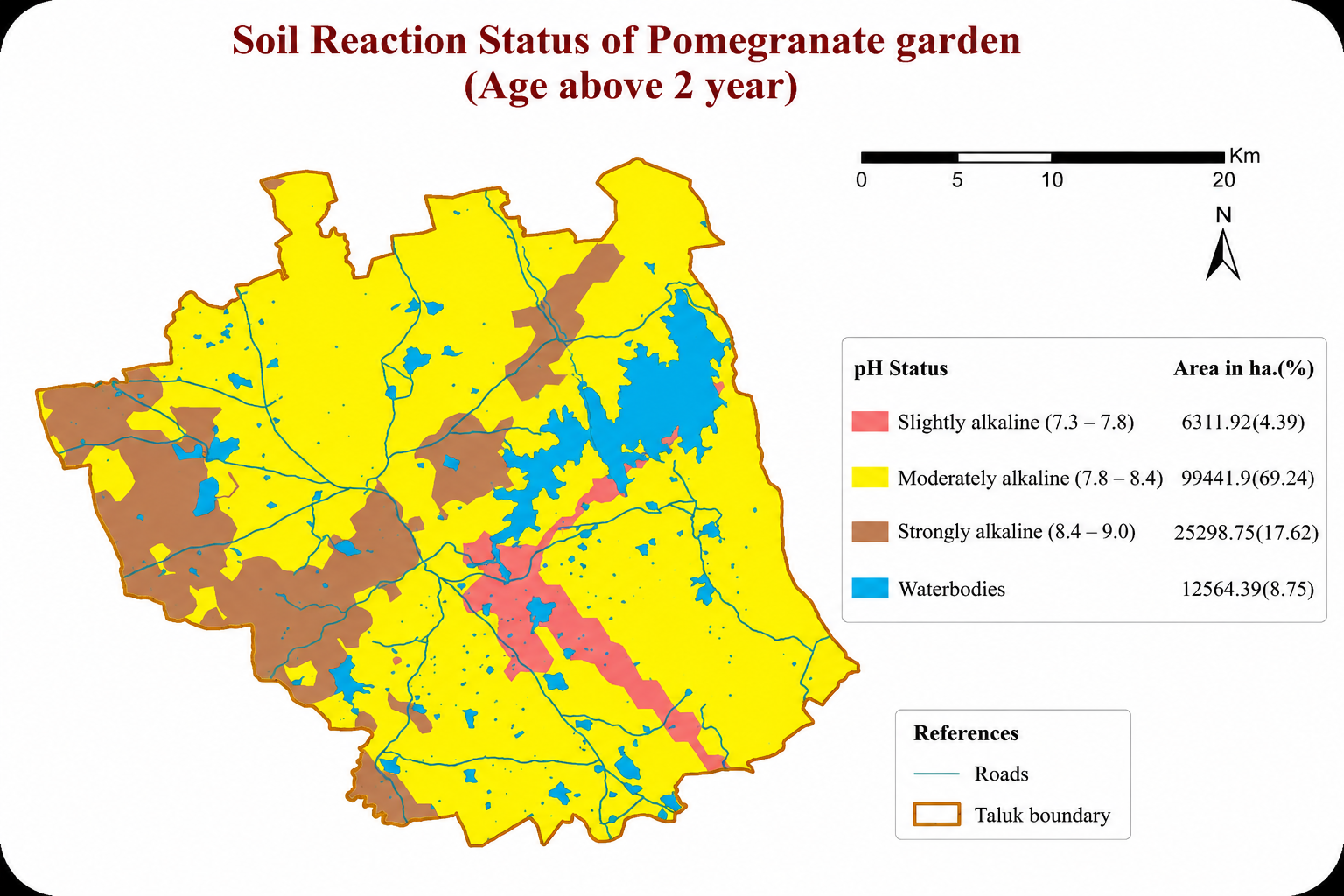
A study was conducted in 2015 to investigate the micronutrient status of pomegranate growing soils of Hosadurga Taluk in Chitradurga district of Karnataka. Total 100 soil samples were collected considering two categories as >2 years old pomegranate garden and <2 years old pomegranate gardens. The samples were analyzed for pH, electrical conductivity (EC), organic boron (OC), micronutrients like Zn, Fe, Mn, Cu, and hot water soluble boron. The results revealed that soil had slightly acidic to alkaline (6.28 to 9.80) pH, had low level of organic carbon (mean 0.40 %) and had lower soluble salt concentration. Micronutrients content viz; Fe, Zn and B were recorded lower in both <2 years old and >2 years old gardens; whereas other nutrients were sufficient. By using the longitude and latitude positions, soil fertility maps were prepared. Correlation study between soil micronutrient status and yield observation explained that soil nutrient content has direct relationship with yield variations.
References
[1] Annonymous (2015).
http://agriexchange.apeda.gov.in/Market%20Profile/MOA/Product/Pomegranate.pdf.
[2] M. L. Jackson (1973). Soil Chemical analysis. Prentice Hall of India (pvt.) Ltd., New Delhi.
[3] W. L. Lindsay, and W. A. Norvell (1978). Development of DTPA soil test for zinc, iron, manganese and copper. Soil Sci. Soc. Am. J., 42: 421-428.
[4] K. C. Berger and E. Troug (1939). Boron determination in soils and plants. Ind. Eng. Chem. Anal., 11: 540-545.
[5] H. B. Raghupathi and B. S. Bhargava (1998). Leaf and soil nutrient diagnostic norms for pomegranate (Punicagranatum L.). J. Indian Society of Soil Science, 46: 412-416.
[6] Y. Pawar, S. Kadam and P. H. Vaidya (2014). Characterization and classification of pomegranate growing soils of Osmanabad district, Maharashtra. Int. J. Innovative Res. Development, 3: 187-188.
[7] M. S. Anitha (2011). Distribution of boron in some identified soils and land use systems of Karnataka (Doctoral dissertation, University of Agricultural Sciences GKVK, Bangalore).
[8] R. Jayaprakash, S. Vishwanath and B. C. Punitha (2012). Vertical distribution of chemical properties and macro nutrient status in non-traditional areca growing soil profiles of Karnataka. Ind. J. Fundam. Appl. Life Sci., 2: 72-77.
[9] Y. V. Shetty, C. Narayanaswamy, B. C. Dhananjaya and K. S. Shesagiri (2009). Available micronutrient status in the traditional arecanut growing soils of Karnataka. Mysore J. Agric. Sci., 43: 579-582.
[10] Y. V. Shetty, M. S. Nagamma, M. D. Kumar and S. M. Jayaprakash (2008). Fertility status in arecanut garden soils of Karnataka. Karnataka J. Agric. Sci., 21: 503-506.
Downloads
Published
Issue
Section
License
Copyright (c) 2019 Author (s)

This work is licensed under a Creative Commons Attribution-NonCommercial-NoDerivatives 4.0 International License.
Copyright © The Author(s). This is an open access article distributed under the terms of the Creative Commons Attribution-NonCommercial-NoDerivatives 4.0 International License (CC BY-NC-ND 4.0), which permits unrestricted non-commercial use, distribution, and reproduction in any medium, provided the original author(s) and source are properly credited, and the work is not modified or adapted.