Influence of aging on nutrient retention and organoleptic characteristics of wine developed from star fruit (Averrhoa carambola L.)
DOI:
https://doi.org/10.31783/elsr.2019.521727Keywords:
aging, alcohol, jaggery, nutrients, star fruit, sugar, wineAbstract
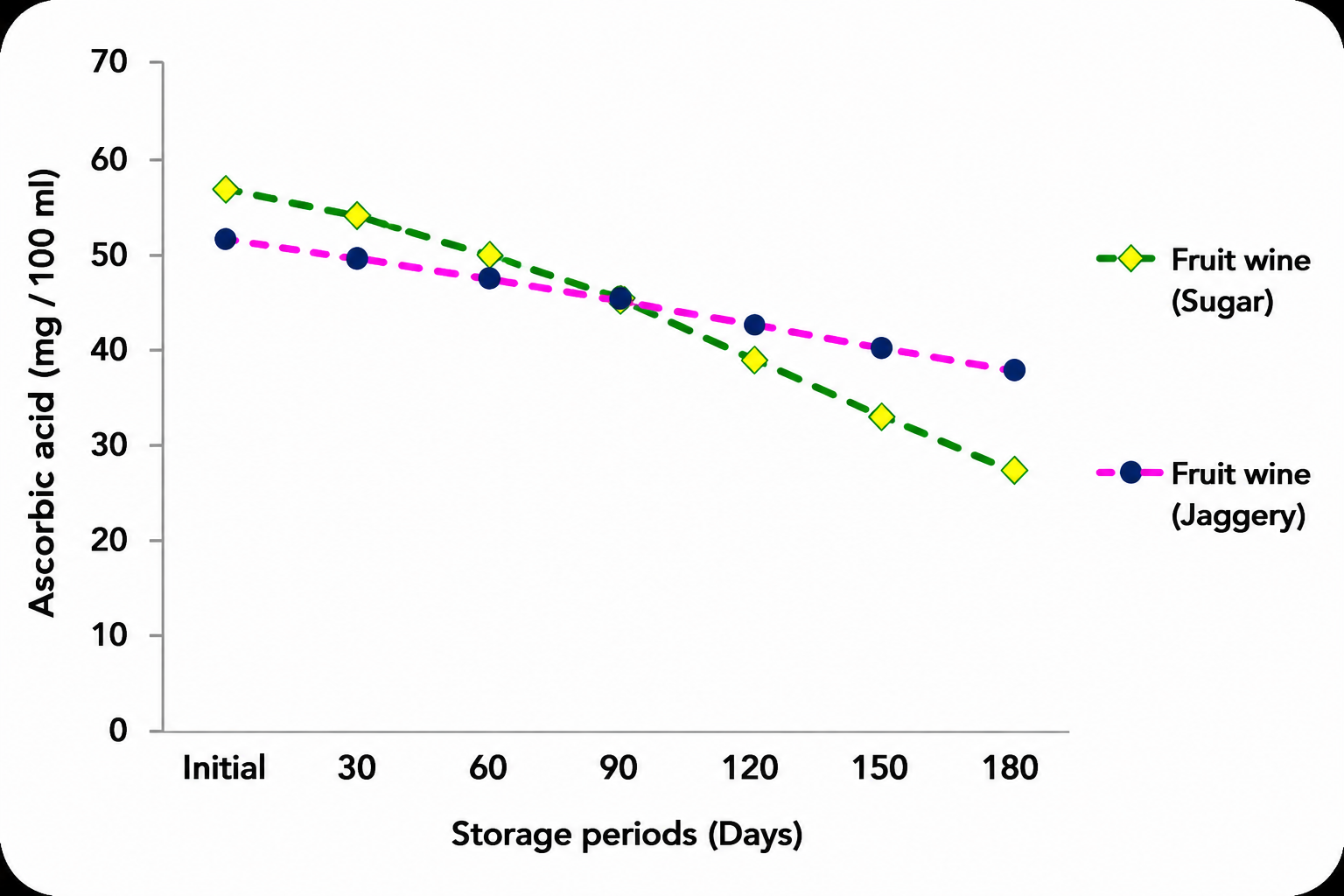
Wine is an alcoholic beverage normally prepared from fermented fruit juice. It is a popular drink enjoyed all over the world. The present investigation was carried out to standardize wine from star fruit using sugar and jaggery as a carbohydrate source for yeast and to study change in nutrients and sensory parameters during aging process. The results showed that the star fruit juice is most appropriate for the preparation of wine than its pulp. Star fruit wines were further analyzed for nutrients composition, microbial safety, and sensory characteristics during 6 months of aging under ambient temperature in a dark place. Initially the wine prepared using sugar had highest total soluble solids (TSS), total sugar; reducing and non-reducing sugars, ascorbic acid, and β-carotene content as compared to the wine prepared using jaggery. Mineral content did not vary in both wines. During aging, the nutrients and sensory parameters were decreased in both wines except taste scores. At the end of aging, the wine prepared using jaggery had better retention of TSS (92.34 %), total sugar (89.29 %), reducing sugar (93.31 %) and ascorbic acid (71.82 %) than wine prepared using sugar. The microbial study indicated that both wines were safe for consumption after six months of aging. Overall acceptability scores (8.95 and 8.90) were found reasonably similar in both the wines after 180 days of aging.
References
[1] R. Bhardwaj and S. Pandey (2011). Juice blends -A way of utilization of under-utilized fruits, vegetables, and spices: a review. Crit. Rev. Food. Sci. Nutr., 51: 563-570.
[2] J. Kubola, S. Siriamornpun and N. Meeso (2011). Phytochemicals, vitamin C and sugar content of Thai wild fruits. Food. Chem., 126: 972-981.
[3] R. Phapale and S. Misra-Thakur (2010). Antioxidant activity and antimutagenic effect of phenolic compounds in Feronia limonia (L) swingle fruit. Intl. J. Pharm Pharm. Sci., 2: 68-73.
[4] K. W. Kong, H. E. Khoo, N. K. Prasad, L. Y. Chew and I. Amin (2013). Total phenolics and antioxidant activities of Pouteria campechiana fruit parts. Sains Malaysiana, 42: 123-127.
[5] C. F. Chau, C.-H. Chen and C.-Y. Lin (2004). Insoluble fibre-rich fractions derived from Averrhoa carambola L: hypoglycemic effect determined by in-vitro method. Ebensm.-Wiss. u.-Technol., 37: 331-336.
[6] K. R. Kirtikar and B. D. Basu (1996). Indian Medicinal Plants. Vol. II, Dehradun, India. International Book Distributers, 1581.
[7] A. G. Patil, D. A. Patil, A. V. Phatak and N. Chandra (2010). Physical and chemical characteristics of carambola (Averrhoa carambola L.) fruit at three stages of maturity. Int. J. Appl. Biol. Pharm. Technol., 1: 624-629.
[8] A. Abdullah and T.C. Cheng (2001). Optimization of reduced calorie tropical mixed fruit jam. Food. Qual. Prefer, 12: 63-68.
[9] S. Yusof and L. K. Chiong (1997). Effect of brix processing techniques and storage temperature on the quality of carambola fruit cordial. Food Chem., 59: 27-32.
[10] A. Weller, C. A. Sims, R. F. Mathews, R. P. Bates and K. N. Brecht (1997). Browning susceptibility and changes in composition during storage of carambola slices. J. Food. Sci., 62: 256-260.
[11] A. A. Karim and C. C. Wai (1999). Foam-mat drying of star fruit (Averrhoa carambola L.) puree. Stability and air drying characteristics. Food Chem., 64: 337-343.
[12] P. Adiyaman and S. Kanchana (2014). Phytochemical Profiles and Antioxidant Capacity of Fresh and Osmo-dried Star Fruit (Averrhoa carambola L.) Slices on Storage. Res. J. Agric. Sci., 5: 494-500.
[13] N. Roopa, O. P. Chauhan, P. S. Raju, D. K. Das Gupta, R. K. R. Singh and A. S. Bawa (2014). Process optimization for osmo-dehydrated carambola (Averrhoa carambola L.) slices and its storage studies. J. Food. Sci. Technol., 51: 2472-2480.
[14] P. Sibounnavong, S. Daungpanya, S. Sidtiphanthong, C. Keoudone and M. Sayavong (2010). Application of Saccharomyces cerevisiae for wine production from star gooseberry and carambola. J. Agric. Technol., 6: 99-105.
[15] A. Altenburg and C.C. Zouboulis (2008). Current concepts in the treatment of recurrent aphthous stomatitis, Skin therapy letter. 13: 1-7. http://www.skintherapyletter.com/aphthous-stomatitis/treatment-concepts/
[16] L. C. Tapsell, I. Hemphill, L. Cobiac, C. S. Patch, D. R. Sullivan, M. Fenech and S. Roodenrys, et al., (2006). Health benefits of herbs and spices: the past, the present, the future. Med. J. Aust., 185: 4-24.
[17] H. W. Zimmermann (1963). Studies on the dichromate method of alcohol determination. Am. J. Enology Vitic., 14: 205-213.
[18] AOAC (Association of Official Analytical Chemists) (2005). Official methods of analysis of the association of official analytical chemistry, 16th (Eds.), Washington. 2: 235-236.
[19] I. Araṅkacāmi and R. Rangaswamy (1995). A Text Book of Agricultural Statistics. New Age International Publisher Ltd., New Delhi.
[20] C. D. Pawar (2009). Standardization of wine making technology in sapota [manilkara achras (mill) forsberg]. Ph.D. Thesis. Department of Horticulture. College of Agriculture, University of Agricultural Sciences, Dharwad, Karnataka, India. https://krishikosh.egranth.ac.in/handle/1/69509
[21] G. S. Kocher and Pooja (2011). Status of wine production from guava (Psidium guajava L.): A traditional fruit of India. Afr. J. Food. Sci., 5: 851-860.
[22] C. Maragatham and A. Panneerselvam (2011). Standardization technology of papaya wine making and quality changes in papaya wine as influenced by different sources of inoculums and pectolytic enzyme. Adv. Appl. Sci. Res., 2: 37-46.
[23] V. K. Joshi, R. Sharma, A. Girdher and G. S. Abrol (2012). Effect of dilution and maturation on physico-chemical and sensory quality of jamun (Black plum) wine. Indian J. Nat. Prod. Resour., 3: 222-227.
[24] U. C. Sahu, S. K. Panda, U. B. Mohapatra and R. C. Ray (2012). Preparation and evaluation of wine from tendu (Diospyros melanoxylon L) fruits with antioxidants. Int. J. of Food. Ferment. Technol., 2: 171-178.
Downloads
Published
Issue
Section
License
Copyright (c) 2019 Author (s)

This work is licensed under a Creative Commons Attribution-NonCommercial-NoDerivatives 4.0 International License.
Copyright © The Author(s). Effective from 1 July 2026, articles published in Emergent Life Sciences Research (ELSR) are distributed under the Creative Commons Attribution 4.0 International License (CC BY 4.0), which permits use, sharing, distribution, reproduction, and adaptation in any medium or format, provided that appropriate credit is given to the original author(s) and the source, a link to the license is provided, and any changes made are indicated.
Articles published before 1 July 2026 remain subject to the license applicable at the time of their original publication, including the Creative Commons Attribution-NonCommercial-NoDerivatives 4.0 International License (CC BY-NC-ND 4.0), where applicable.