Effect of selected medicinal herbs on viability and acid production of lactic dairy starters
DOI:
https://doi.org/10.31783/elsr.2019.523542Keywords:
fermented milk, lactic acid bacteria, medicinal herbs, probioticsAbstract
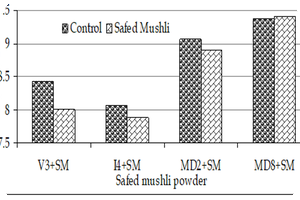
Four medicinal herbs viz., Zingiber officinale (Ginger), Asparagus racemosus (Satavari), Chlorophytum borivillianum (Safed Musli) and Withania somnifera (Ashwagandha) were evaluated for their antimicrobial/stimulatory effects on four selected lactic acid bacteria viz., Lactobacillus helveticus MTCC 5463, Lactobacillus rhamnosus MTCC 5462, Streptococcus thermophilus MTCC 5460 and Streptococcus thermophilus MTCC 5461 by cup well assay technique as well as by observing changes in pH, acidity and viable lactic acid bacterial counts in skimmed milk in the presence of medicinal herbs (@1%). Safed Musli and ginger did not show any inhibition to any of the tested lactic cultures. Satavari had shown very little inhibition, while Ashwagandha powder significantly inhibited the growth of all the lactic cultures with maximum effect on Lb. helveticus MTCC 5463. The pH ranged from 4.67 to 5.35, and the percent lactic acid ranged from 0.44 to 0.67. The log viable count ranged from 7.15 to 9.40 in the herbs added fermented milk while control ranged from 8.07 to 9.4. The increase in the log viable count was least in the fermented milk with ashwagandha. The ginger and Safed Musli added milk had either no or least inhibitory effect on viable lactic bacterial count compared to the control during fermentation. However, with culture Streptococcus thermophilus MTCC 5461, the log count was higher in ginger (9.42) and Safed Musli (9.40) added fermented milk as compared to the control (9.38) indicating a supportive role.
References
[1] N. Shah, J. B. Prajapati and A. Jana (2009). Fizzy fermented milk products-a viable alternative to soft drinks. Ind Food Indus (AFSTI), 28: 39-44.
[2] P. Thakkar, H. A. Modi and J. B. Prajapati (2015). Isolation , characterization and safety assessment of lactic acid bacterial isolates from fermented food products. Int. J. Curr. Microbiol. Appl. Sci., 4: 713-725.
[3] Z. F. Bhat and H. Bhat (2011). Milk and Dairy Products as Functional Foods: A review. Int. J. Dairy Sci., 6: 1-12.
[4] S. M. El-Sayed and A. M. Youssef (2019). Potential application of herbs and spices and their effects in functional dairy products. Heliyon, 5: e01989.
[5] C. L. Chan, R.Y. Gan, N. P. Shah and H. Corke (2018). Polyphenols from selected dietary spices and medicinal herbs differentially affect common food-borne pathogenic bacteria and lactic acid bacteria. Food Control, 92: 437-443.
[6] T. Bintsis (2018). Lactic acid bacteria: their applications in foods. J Bacteriol Mycol., 6: 89-94.
[7] N. Shah and J. B. Prajapati (2014). Effect of carbon dioxide on sensory attributes, physico-chemical parameters and viability of Probiotic L. helveticus MTCC 5463 in fermented milk. J Food Sci Technol., 51: 3886-3893.
[8] I. Bakirci (1999). The effects of some herbs on the activities of thermophilic dairy cultures. Nahrung, 43: 333-335.
[9] H. Coşkun (1998). Microbiological and biochemical changes in herby cheese during ripening. Nahrung., 42: S309– 313.
[10] L. L. Zaika and J. C. Kissinger (1979). Effects of some spices on acid production by starter cultures. J. Food Protection., 42: 572-576.
[11] J. B. Prajapati, C. D. Khedkar, J. Chitra, S. Suja, V. Mishra, V. Sreeja and R. K. Patel et al. (2011). Whole-genome shotgun sequencing of an Indian-origin L. helveticus strain, MTCC 5463, with probiotic potential. J. Bacteriol., 193: 4282-4283.
[12] M. N. Ashar and J. B. Prajapati (2001). Serum cholesterol levels in humans fed with Acidophilus milk. Ind J Microbiol., 41: 257-263.
[13] S. K. Patidar and J. B. Prajapati (1999). Effect of feeding lactobacilli on serum antibody titer and faecal microflora in chicks. Microbiol, Aliments, Nutri., 17: 145-154.
[14] V. Kodaikkal, J.B. Prajapati and A. Ljungh (2012). Evaluation of adhesion of Lactobacillus strains to HT-29 cells by a flow cytometric assay. Int. J. Appl. Animal Sci., 1: 1-7.
[15] J. B. Prajapati, R. I. Dave and S. S. Sannabhadti (1995). Evaluation of perfor- mance of S. thermophilus and L. acidophilus in buffalo milk. I. J. Dairy Sci., 48: 525-528.
[16] S. K. Patidar and J. B. Prajapati (1998). Standardization and evaluation of lassi prepared using Lactobacillus acidophilus and Streptococcus ther- mophilus. J. Food Sci. Technol., 35: 428-431.
[17] Indian Standards (1960). IS: 1479. Methods of testing for dairy industry. Part-I. Rapid examination of milk. Indian Standards Institution, New Delhi.
[18] IDF Standards 117 A (1989). Yoghurt enumeration of characteristic microorganism colony count technique at 37°C.
[19] Indian Standards (1962) IS: 1479. Method of test for Dairy industry. Part III. Bacteriological Examination of Milk. Indian Standards Institution, New Delhi.
[20] H. S. Lee and Y. J. Ahn (1998). Growth-Inhibiting Effects of Cinnamomum cassia Bark-Derived Materials on Human Intestinal Bacteria. J. Agric. Food Chem., 46: 8-12.
[21] F. C. Guo, B. A. Williams, R. P. Kwakkel, H.S. Li, X.P. Li, J. Y. Luo and W. K. Li (2004). Effects of mushroom and herbs polysaccharides, as alternatives for an antibiotic, on the cecal microbial ecosystem in broiler chickens. Poult. Sci., 83: 175-182.
Downloads
Published
Issue
Section
License
Copyright (c) 2019 Author (s)

This work is licensed under a Creative Commons Attribution-NonCommercial-NoDerivatives 4.0 International License.
Copyright © The Author(s). Effective from 1 July 2026, articles published in Emergent Life Sciences Research (ELSR) are distributed under the Creative Commons Attribution 4.0 International License (CC BY 4.0), which permits use, sharing, distribution, reproduction, and adaptation in any medium or format, provided that appropriate credit is given to the original author(s) and the source, a link to the license is provided, and any changes made are indicated.
Articles published before 1 July 2026 remain subject to the license applicable at the time of their original publication, including the Creative Commons Attribution-NonCommercial-NoDerivatives 4.0 International License (CC BY-NC-ND 4.0), where applicable.