Soil nutrient status of mulberry gardens in varied clusters of Andhra Pradesh
DOI:
https://doi.org/10.31783/elsr.2019.524351Keywords:
leaf production, mulberry, organic carbon, soil analysis, soil fertilityAbstract
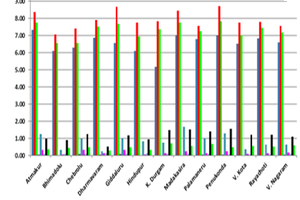
Intensive cropping systems have led to an increase in the demand of the crucial nutrients in the soil. Thus, addition of essential inorganic and inorganic nutrients to attain the coveted soil status is necessary for the sustainable leaf production in mulberry. This study was conducted on a total of 1472 soil samples from conventional sericultural regions present in 8 districts of Andhra Pradesh, India. The soils were subjected to the chemical analysis to determine their soil reaction, salinity, and nutrient status including pH, EC, OC, available macro (N, P and K) and micro (S) nutrients. The perusal of the results indicated that out of the received soils, soil pH was recorded at desired levels (6.5-75) in 58% soils, low (<6.5) in 8% soils and high (>7.5) in 33% soils. Most of the cluster soils (99%) showed an ideal range of soluble salts (<1.0 dS/m). Organic carbon (OC) was low in 74% soils (<0.65%), medium (0.65-1.0%) in 21% and high (>1.0%) in only 5% soils. In case of essential macronutrients, available Nitrogen (N) recorded low in 50% soils (<250kg/ha), desired level in 37% (250-500kg/ha) and registered high (>500kg/ha) in only 13% soils. Phosphorous (P) and Potassium (K) were recorded high, >25kg/ha and >224kg/ha in 52% and 54% soils, medium level, 10-25kg/ha and 110-224kg/ha in 21 and 37%; whereas low, <10kg and <110kg/ha in 26% and 9% soils, respectively. In case of micronutrient sulphur (S), 61% of the cluster soils were registered rich in sulphur (>15ppm/ha), 25% showed the admissible range (10-15ppm/ha) whereas only 14% soils were recorded with low levels of S (<10ppm/ha) indicating that most of the cluster soils are rich in sulphur.
References
[1] S. B. Dandin, J. Jayaswal and K. Giridhar (2003). Handbook of sericulture technologies. central silk board, Bangalore, India. Pp1-259.
[2] A. Sarkar (2000). Improvement in mulberry-current status and future strategies, Lead paper In: Natl. Conf. Strat. Seric. Res., Central Sericultural Research and Training Institute, Mysore, India, pp1-11.
[3] Anonymous (2011). Methods manual-soil testing in India. Published by Dept. of Agriculture and Co-operation. Ministry of Agriculture, Govt. of India, New Delhi. Pp1-208.
[4] F. Chen, J. Lu, M. Zhang, K. Wan and D. Liu (2009). Mulberry nutrient management for silk production in Hubei Province of China. J. Plant Nutr. Soil Sci., 172: 245-253.
[5] R. Kar, P. C. Bose, S. K. Majumdar and R. N. Dutta (2008). Physical characterization of mulberry (Morus sp.) growing soils in four states of eastern India in relation to their organic carbon and available nutrient contents. Indian J. Seric., 47: 126-129.
[6] M. R. Subbaswamy, N. R. Singhvi, B. V. Naidu, M. M. Reddy, H. Jayaram and N. Suryanarayana (2001). Effect of source of nitrogen on phosphorus uptake and arginine content in mulberry. Indian J. Seric., 40: 182-184.
[7] B.V. Subbaiah and G. L. Asija (1956). A rapid procedure for the estimation of available nitrogen in soil. Curr. Sci., 25: 259-260.
[8] M. L. Jackson (2005). Soil Chemical Analysis. Advanced course. UW-Madison Libraries Parallel Press.
[9] L. Pradhan, L. Dixit, D. Rout and A. Misra (1992). Effect of source of nitrogen and yield of groundnut (Arachis hypogea) in acid lateritic soils of Orissa. Indian J. Agron., 37: 273-275.
[10] R. Prasad, S. N. Sharma and S. Singh (1992). Fertilizer nitrogen Interaction in crop production. Fert. News, 37: 75-83.
[11] W. E. Bennet (1993). Nutrient defficiencies and toxicities in crop plants. Collage of Agricultural Sciences and Natural Resources. Texas University Lubbock.
[12] H. Maschner (1983). General introduction to the mineral nutrition of plants. In: Inorganic plant nutrition. pp5-60. Springer, Berlin, Heidelberg.
[13] S. V. Eaton (1922). Sulphur content of soils and its relation to plant nutrition. Botanical. Gazette. 74: 32-58.
[14] T. Kurose (1966). Studies on dietetical value of phosphorus deficient mulberry leaves. VI. Influence of arginine on the growth of silkworm larvae. J. Seric. Sci. Jpn., 35: 121-124.
[15] N. K. Fageria, V. C. Baligar and R. B. Clark (2002). Micronutrients in crop production. In Advances in Agronomy, Academic Press, 77: 185-268.
[16] M. Govindaraj, K. Pandian and P. Arunachalam (2011). Implication of micronutrients in agriculture and health with special reference to Iron and Zinc. Int. J. Agric. Management Devel., 1: 207-220.
[17] M. V. Singh (2008) Micronutrient Deficiencies in Crops and Soils in India. Micronutrient deficiencies in global crop production. Springer, Dordrecht. pp93-125.
[18] P. C. Bose, B. D. Das and R. Kar (2008). Soil test based phosphorous and potassium fertilizer prescription for targeted yields of S1635 mulberry (Morus albla L.) under rainfed cultivation in eastern ghat region of Orissa. Indian J. of Seric., 47: 60-63.
[19] Q. Yu and Z. Rengel (1999). Micronutrient Deficiency Influences Plant Growth and Activities of Superoxide Dismutases in Narrow-leafed Lupins. Ann. Bot., 83: 175-182.
[20] P. Sudhakar, V. Sobhana, M. R. S. Gowda, J. S. Kumar and V. Sivaprasad (2018). Soil fertility status of mulberry (Morus alba L.) soils under bivoltine sericultural areas of north, south and eastern regions of Karnataka. Int. J. Adv. Res., 6: 132-140.
[21] P. Sudhakar, V. Sobhana, S. Sen., M.V. Sneha, M. R. S. Gowda, J. S. Kumar and V. Sivaprasad (2019). Nutrient status of mulberry soils of sericulturists under varied bivoltine sericultural clusters of Karnataka. Int. J. Cur. Res., 11: 2351-2357.
Downloads
Published
Issue
Section
License
Copyright (c) 2019 Author (s)

This work is licensed under a Creative Commons Attribution-NonCommercial-NoDerivatives 4.0 International License.
Copyright © The Author(s). Effective from 1 July 2026, articles published in Emergent Life Sciences Research (ELSR) are distributed under the Creative Commons Attribution 4.0 International License (CC BY 4.0), which permits use, sharing, distribution, reproduction, and adaptation in any medium or format, provided that appropriate credit is given to the original author(s) and the source, a link to the license is provided, and any changes made are indicated.
Articles published before 1 July 2026 remain subject to the license applicable at the time of their original publication, including the Creative Commons Attribution-NonCommercial-NoDerivatives 4.0 International License (CC BY-NC-ND 4.0), where applicable.