
Scope of double haploid production for inbred development in tropical maize
DOI:
https://doi.org/10.31783/elsr.2020.612127Keywords:
double haploids, haploid inducers, in vivo gynogenesis, in vitro androgenesis, maize (Zea mays L.)Abstract
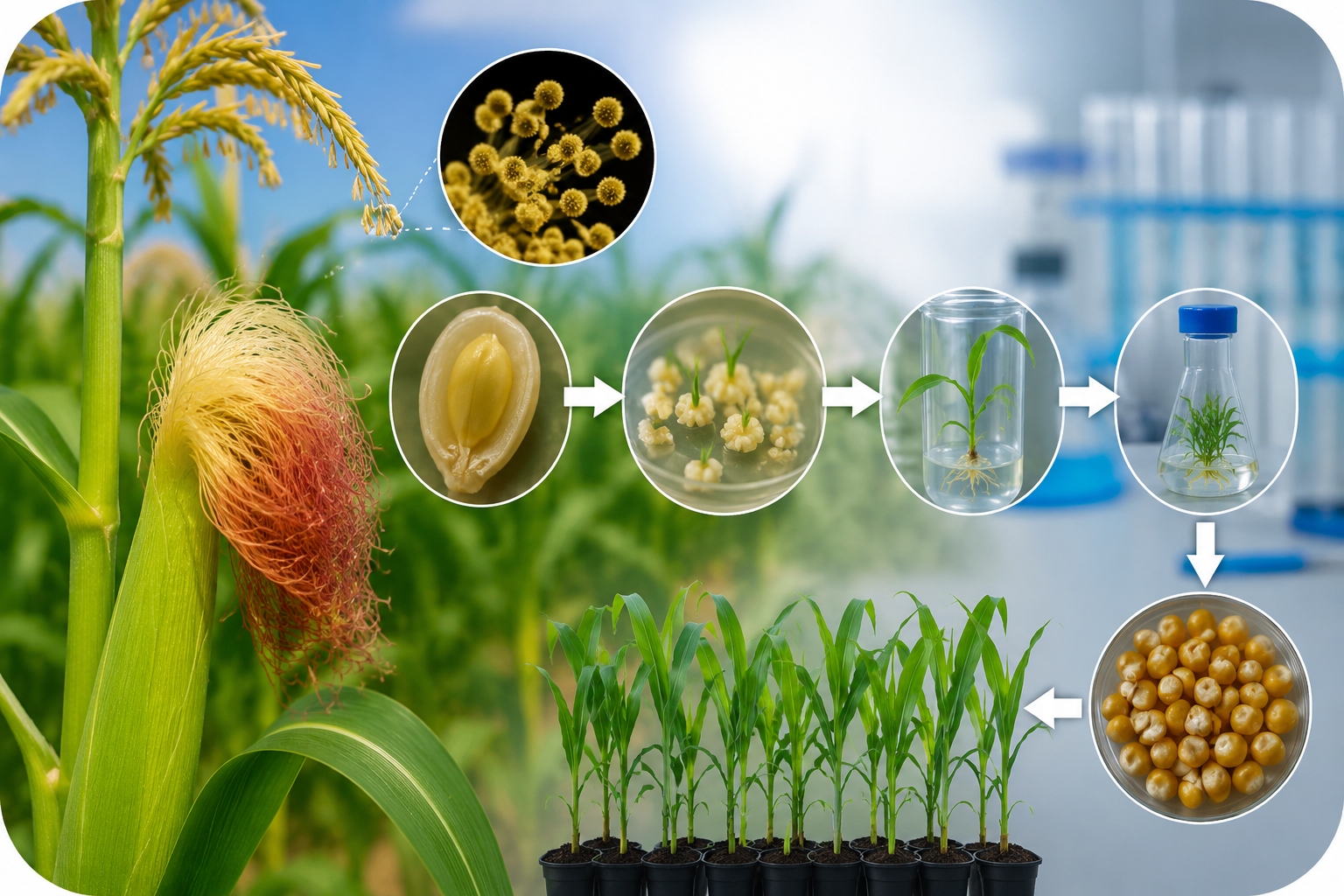
Maize is a predominantly cross-pollinated crop. Maximum exploitation of yield potential can be achieved by harnessing heterosis through hybrid development. Inbred development for the purpose requires a lot of time. However, inherent mechanisms do exist in temperate maize for parthenogenetic development of haploid embryos in the seed parent due to the influence of haploid inducer gene(s) in the pollen. In contrast, the tropical maize neither has such haploid inducer gene(s) for gynogenic haploid induction nor responds better to in vitro androgenesis (anther culture). Introgression of haploid induction to tropical maize can open up avenues for gynogenic haploid production. In addition, the resulting introgressed haploid inducer lines may be amenable for in vitro anther culture for production of haploids and follow-up recovery of double haploids by colchicines treatment.
References
[1] FAOSTAT (2017). UN Food and Agriculture Organization, Corporate Statistical Database. Retrieved November 9, 2018.
[2] K. J. Kasha and M. Maluszynsky (2003). Production of doubled haploids in crop plants. An introduction. In: Doubled haploid production in crop plants (pp 1-4). Springer, Dordrecht.
[3] S. S. Chase (1974). Utilization of haploids in plant breeding: breeding diploid species. In: Haploids in higher plants: advances and potentials. Proceedings of the First International Symposium (pp. 21-34). Guelph University Press.
[4] J. M. Dunwell (2010). Haploids in flowering plants: origins and exploitation. Plant Biotechnol. J., 8: 377-424.
[5] S. H. Miao, C. S. Kuo, Y. L. Kwei, A.T. Sun, S. Y. Ku, W. L. Lu and Y. Y. Wang (1981). Induction of pollen plants of maize and observations on their progeny. In: Proceedings of the Symposium on Plant Tissue Culture, Beijing (pp. 23-34).
[6] F. K. Röber, G. A. Gordillo and H. H. Geiger (2005). In vivo haploid induction in maize-performance of new inducers and significance of doubled haploid lines in hybrid breeding. Maydica.50:275-283.
[7] S. L. Dwivedi, A. B. Britt, L. Tripathi, S. Sharma, H. D. Upadhyaya and R.Ortiz (2015). Haploids constraints and opportunities in plant breeding. Biotechnol. Adv., 33: 812-829.
[8] H. H. Geiger (2009). Doubled haploids. In Handbook of maize (pp. 641-657). Springer, New York, NY.
[9] J. Ren, P. Wu, B. Trampe, X. Tian, T. Lübberstedt and S. Chen (2017). Novel technologies in doubled haploid line development.” Plant Biotechnol. J., 15: 1361-1370.
[10] B. Barnabás, B. Obert, G. Kovacs (1999). Colchicine, an efficient genome-doubling agent for maize (Zea mays L) microspore cultured in vitro. Plant Cell Rep., 18: 858-862.
[11] B. Barnabas (2003). Protocol for producing double haploid plants from anther culture of wheat(Triticum aestivum L). In: Doubled haploid production in crop plants (pp 65-76). Springer, Dordrecht.
[12] J. J. Wassom, C. Mei, T. R. Rocheford and J. M. Widholm (2001). Interaction of environment and ABA and GA treatments on the maize anther culture response. Plant Cell, Tissue Organ Cult., 64: 69-72.
[13] P. Smykal (2000). 'Pollen embryogenesis: the stress mediated switch from gamatophytic to sporophytic development; current status and future prospects'. Biol. Plantarum, 43: 481-489.
[14] A. D. Genovesi (1990). Maize (Zea mays L.) in vitro production of haploids. In: Haploids in crop Improvement I (pp. 176-203). Springer, Berlin, Heidelberg.
[15] A. Touraev, O. Vicente and E. Heberle-Bors (1997). Initiation of microspore embryogenesis by stress. Trends Plant Sci., 2: 297-302.
[16]M.V. Macdonald (1992). Donor plant growth factors affecting anther culture of maize and sweetcorn (Zea mays L.). Ann. Bot., 70: 357-363.
[17] S. Z. Hosseini, P. P. Mahammadi and G. R. Cheshmeali (2015). Effect of induction medium on embryogenesis of maize anther culture and increase of normal haploid plantlet regeneration with Whathman filter paper. Iranian J. Plant Physiology, 5:1503-1510.
[18] C. Nitsch, S. Andersen, M. Godard, M. G. Neuffer and W. F. Sheridan (1982).Production of haploid plants of Zea mays and Pennisetum through androgenesis. In: Variability in plants regenerated from tissue culture (pp. 69-91). Praeger, New York.
[19] C. Bomal and F. M. Tremblay (1999). Effect of desiccation to low moisture content on germination, synchronization of root emergence, and plantlet regeneration of black spruce somatic embryos. Plant Cell Tissue Organ Cult., 56:193-200.
[20] K. Koinuma, N. Mochizuki and Y. Inoue (1990). Embryoid and callus induction and plant regeneration by anther culture of japanese local varieties of maize (Zea mays L.). Bullet National Grassland Res. Inst. (Japan), 43: 13-22.
[21] K. Rikiishi, T. Matsuura, M. Maekawa and K. Takeda (2008). Light control of shoot regeneration in callus cultures derived from barley (Hordeum vulgare L.) immature embryos. Breed. Sci., 58: 129-135.
[22] E. Picard, C. Hours, S. Gregoire, T. H. Phan, J. P. Meunier (1987). Significant improvement of androgenetic haploid and doubled haploid induction from wheat plants treated with a chemical hybridization agent. Theor. Appl. Genet., 74: 289-297.
[23] B. Buter (1997). In vitro haploid production in maize. In: In vitro haploid production in higher plants (pp. 37-71). Springer, Dordrecht.
[24] S. Z. Hosseini, A. Ismaili and P.P. Mahammadi (2014). Improvement of maize (Zea mays L.) anther culture embryogenesis and direct regeneration by different plant growth regulators and gelling agent. J. Appl. Biotech. Reports, 1: 17-21.
[25] A. D. Genovesi (1990). Maize (Zea mays L.): In vitro production of haploids. In: haploids in crop improvement I (pp. 176-203). Springer, Berlin, Heidelberg.
[26] K. Jager, T. Bartok, V. Ordogand and B. Barnabas (2010). Improvement of maize (Zea mays L.) anther culture responses by algae-derived natural substances. S. Afr. J. Bot., 76: 511-516.
[27] M. Rakoczy-Trojanowska, M. Smiech and S. Malpszy (1997). The influence of genotype and medium on rye (Secale cereale L.) anther culture. Plant Cell Tissue Organ Cult., 48:15-21.
[28] A. M. R. Ferrie, C. E. Palmer and W. A. Keller (1995). Haploid embryogenesis. In: In Vitro embryogenesis in plants (pp. 309-344). Springer, Dordrecht.
[29] A. D. Genovesi and G. B. Collins (1982). In vitro production of haploid plants of corn via anther culture. Crop Sci., 22:1137 -1144.
[30] G. M. Pace, J. N. Reed, L.C. Ho and J. W. Fahey (1987). Anther culture of maize and the visualization of embryogenic microspores by fluorescent microspory. Theor. Appl. Genet., 73: 863-869.
[31] M. K. Ku, W.C. Cheng, L. C. Kuo, Y. L. Kuan, H. P. An and C. H. Huang (1981). Induction factors and morpho-cytological characteristics of pollen-derived plants in maize (Zea mays L.). In: Proceedings of the Symposium on Plant Tissue Culture, Beijing. (pp. 35-42).
[32] L. Hassan, S. D. Ahmad and A. Okumus (2001). The direct regeneration of maize haploids through anther culture. Journal of Biological Sci., 1: 900-901.
[33] E. Choe, C.H. Carbonero, K. Mulvaney, A. L. Rayburn, R. H. Mumm (2012). Improving in vivo maize doubled haploid production efficiency through early detection of false positives. Plant Breed., 131: 399-401.
[34] H. M. Shapiro (2005). Practical Flow Cytometry. John Wiley and Sons.
[35] A. E. Melchinger, W. Schipprack, T. Würschum, S. Chen, F. Technow (2013). Rapid and accurate identification of in vivo-induced haploid seeds based on oil content in maize. Sci. Rep., 3: 1-5.
[36] C. B. Ribeiro, F. D. C. Pereira, L. D. N. Filho, B. A. Rezende, K. O. D. G. Dias and G. T. Braz et al., (2018). Haploid identification using tropicalized haploid inducer progenies in maize. Crop Breed. Appl. Biot., 18: 16-23.
[37] J. L. Kermicle (1969). Androgenesis conditioned by a mutation in maize. Science 166:1422-1424.
[38] P. Barret, M. Brinkmann and M. Beckert (2008). A major locus expressed in the male gametophyte with incomplete penetrance is responsible for in situ gynogenesis in maize. Theor. Appl. Genet. 117: 581-594.
[39] M. M. S. Evans (2007). The indeterminate gametophyte1 gene of maize encodes a LOB domain protein required for embryo Sac and leaf development. Plant Cell, 19: 46-62.
[40] B. M. Prasanna, C.Vijay, G. Mahuku (2012). Doubled haploid technology in maize breeding: Theory and practice.DHTechnology Manual by CIMMYT.
[41] S.T. Chalyk (1994). Properties of maternal haploid maize plant s and potential application to maize breeding. Euphytica, 79:13-18.
[42] E. H. Coe and K. R. Sarkar (1964). The detection of haploids in maize. J. Heredity, 55: 231-233.
[43] G. Mahuku, L. Martinez, V. Prigge, A. Z. Kebede and J. L. Araus (2010). Progress in doubled haploid production at CIMMYT. In: Presentation held at the Drought Tolerant Maize for Africa (DTMA) Annual Project Meeting, 13-18 Sept; 2010. Nairobi, Kenya.
[44] D. K. Nanda and S. S. Chase (1966). An embryo marker for detecting monoploids of maize(Zea mays L.). Crop Sci., 6: 213-215.
[45] V. Chaikam, S. K. Nair, R. Babu, L. Martínez, J. Tejomurtula and P. M. Boddupalli (2015). Analysisof effectiveness of R1-nj anthocyanin marker forin vivo haploid identification in maize and molecular markers for predicting the inhibition of R1-nj expression. Theor. Appl. Genet.,128: 159-171.
[46] A. Marhic, S. Antoine-Michard, J. Bordes, M. Pollacsek, A. Murigneux and M. Beckert (1998). Genetic improvement of anther culture response in maize: relationship with molecular, Mendelian and agronomic traits. Theor. Appl. Genet., 97: 520-525.
[47]M. Ravi and S. W. L. Chan (2010). Haploid plants produced by centromere-mediated genome elimination. Nature, 464: 615-619.
[48]T. Kelliher, D. Starr, W.Wang, J. Mc. Cuiston, H. Zhong and M. L. Nuccio et al., (2016). Maternal haploids are preferentially induced by CENH3-tailswap transgenic complementation in maize. Front. Plant Sci., 7: 414. doi: 10.3389/fpls.2016.00414
[49] V. Chaikam, S. K. Nair, L. Martinez, L. A. Lopez, H. F. Utz and A. E. Melchinger (2018). Marker assisted breeding of improved maternal haploid inducers in maize for the tropical/subtropical regions. Front. Plant Sci., 9: 1527. doi: 10.3389/fpls.2018.01527
[50] X.Dong, X.Xu, J.Miao, L. Li, D. Zhang and X. Mi et al., (2013). Fine mapping of qhir1 influencing in vivo haploid induction in maize. Theor.Appl.Genet., 126:1713-1720.
[51] X. Xu, L. Li, X. Dong, W. Jin, A. E. Melchinger and S.Chen (2013). Gametophytic and zygotic selection leads to segregation distortion through in vivo induction of a maternal haploid in maize. J. Exp. Bot., 64: 1083-1096.
[52] V. Prigge, X. Xu, L. Li, R. Babu, S. Chen and G. N. Atlin (2012). New insights into the genetics of in vivo induction of maternal haploids, the backbone of doubled haploid technology in maize. Genetics.190: 781-793.
[53] L. M. Gilles, A. Khaled, J. B. Laffaire, S. Chaignon, G. Gendrot, J. Laplaige et al., (2017). Loss of pollen-specific phospholipase NOT LIKE DAD triggers gynogenesis in maize. EMBO J., 36: 707-717.
[54] C. Liu, X. Li, D. Meng, Y. Zhong, C. Chen and X. Dong (2017). A 4-bp insertion at ZmPLA1 encoding a putative phospholipase A generates haploid induction in maize. Mol. Plant., 10: 520-522.
[55] T. Kelliher, D. Starr, L. Richbourg, S. Chintamanani, B. Delzer and M. L. Nuccio (2017). MATRILINEAL, a sperm-specific phospholipase, triggers maize haploid induction. Nature, 542: 105-109.
[56] P. Wu, H. Li, J. Ren and S. Chen (2014). Mapping of maternal QTLs for in vivo haploid induction rate in maize (Zea mays L.). Euphytica, 196: 413-421.
[57] S. S. Chase (1952). Monoploids in maize. In: J.W. Gowen (Ed.) Heterosis. Iowa State College Press, Ames, IA.
[58] S. Saisingtong, J. E. Schmid, P. Tamp and B. Buter (1996). Colchicine mediated chromosome doubling during anther culture of maize(Zea mays L.). Theor. Appl. Genet., 92: 1017-1023.
[59] Y. Wan, J. F. Petolino, J. M. Widholm (1989). Efficient production of doubled haploid plants through colchicine treatment of anther derived maize callus. Theor. Appl. Genet., 77: 889-892.
Downloads
Published
Issue
Section
License
Copyright (c) 2020 Author (s)

This work is licensed under a Creative Commons Attribution-NonCommercial-NoDerivatives 4.0 International License.
Copyright © The Author(s). This is an open access article distributed under the terms of the Creative Commons Attribution-NonCommercial-NoDerivatives 4.0 International License (CC BY-NC-ND 4.0), which permits unrestricted non-commercial use, distribution, and reproduction in any medium, provided the original author(s) and source are properly credited, and the work is not modified or adapted.