Human health risk assessment of heavy metals in major carp (Labeo rohita) of Mahananda river in Northern India
DOI:
https://doi.org/10.31783/elsr.2020.613449Keywords:
bathua, Chenopodium album, health benefits, medicinal properties, nutritional composition, phytochemicalsAbstract
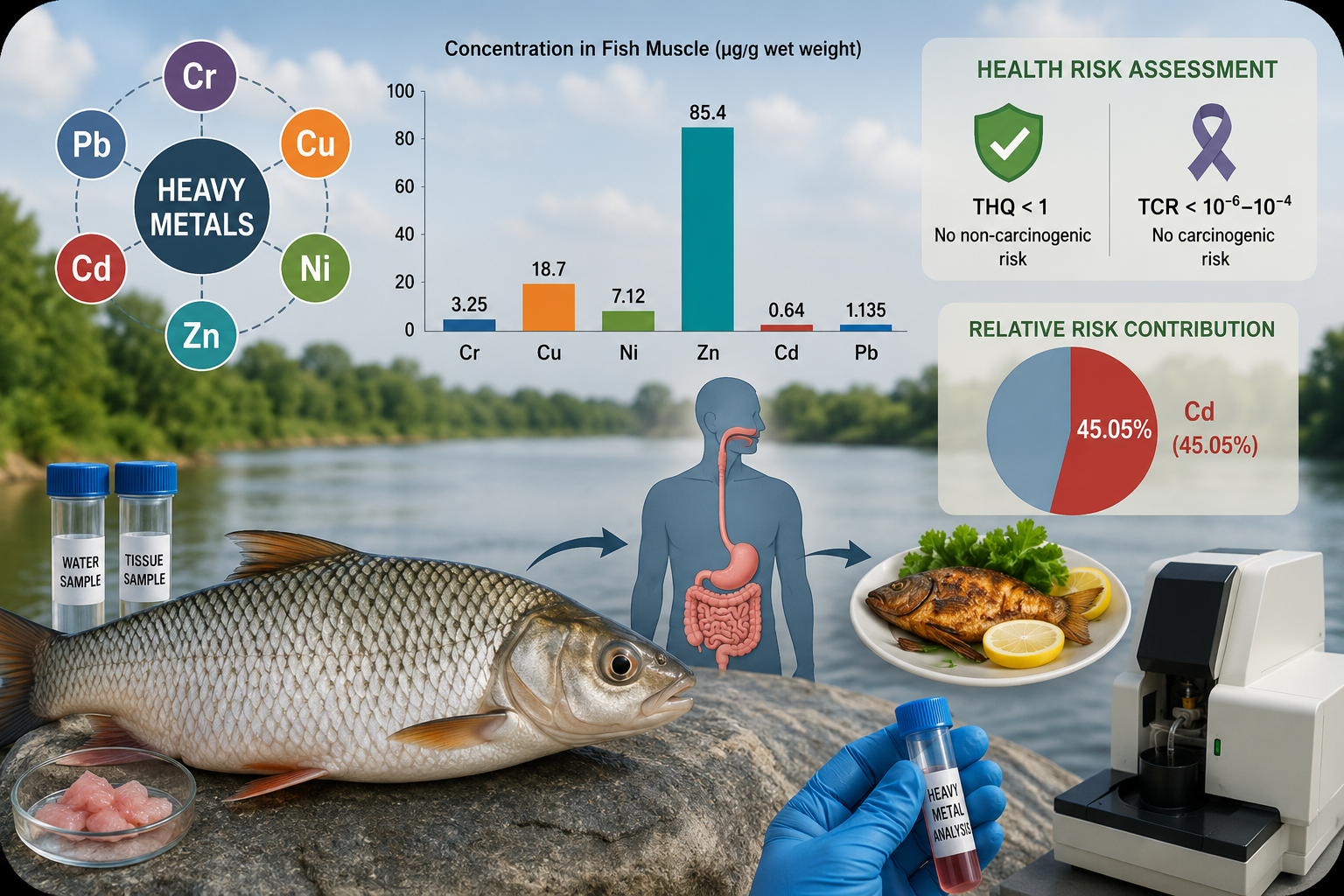
This study determined the levels of heavy metals (Cr, Cu, Ni, Zn, Cd, and Pb) in muscle tissues of Labeo rohita from river Mahananda and estimated the consumption rate limits and health risk posed by fish ingestion. The metals followed the magnitude order of Zn > Cu > Pb > Ni > Cr > Cd. The levels of studied metals were below the permissible limits set by WHO (1995) and USFDA (1993), while Cd and Pb had a mean value of 0.64 ± 0.017 and 1.135 ± 0.013 μg/gw respectively, which was above the FAO (1983) and FAO/WHO (1989) guidelines. The estimated tolerable weekly intake (ETWI) was 10 times below the provisional tolerable weekly intake (PTWI) sea by JECFA (2003).To estimate human health risk target hazard quotient (THQ), hazard index (HI) and target cancer risk (TCR) were calculated and discussed. THQ for individual and combined metals were lower than one representing no non-carcinogenic risk to consumers. The TCR of Cr, Ni, Cd, and Pb for intake fish was 7.3x10⁻⁷, 1.07 x10⁻⁷, 1.85 x 10⁻⁷, and 6.67 x 10⁻⁷ respectively was below the acceptable carcinogenic risk (10-6 -10-4) set by USEPA (2010) showing no carcinogenic risk to consumers. The correlation matrix indicated positive and significant correlations among studied metals, establishing chemical affinity. Significant relationships were found between metal levels in fish with weight and length. Relative risk showed that potential health risk could be attributed only to Cd (45.05%) level. The study concluded that consumption of the muscle tissues of L. rohita may not pose a health risk to human health at the levels of the analyzed metals, but should be consumed moderately to prevent bioaccumulation of the metals especially Cd.
References
[1] A. A. Mohammdi, A. Zarei, S. Majidi, A. Ghaderpoury, Y. Hashempour, M. H. Saghi, et al., , , (2019). Carcinogenic and non-carcinogenic health risk assessment of heavy metal in drinking water of Khorramabad, Iran. MethodsX, 6:1642-1651, doi:10.1016/j.mex.2019.07.017
[2] H. Ali, E. Khan and I. Ilahi (2019). Environmental chemistry and ecotoxicology of hazardous heavy metals: environmental persistence, toxicity and bioaccumulation. J. Chem., doi:10.1155/2019/6730305.
[3] M. Mozumder, S. Permanok, S. K. Mandal and S. Rohatgi (2015). Assessment of water quality of river Mahananda, West Bengal, India. Int. J. Multidiscip. Res. Dev., 2: 22-26.
[4]A. Kumar, Seema and V. Kumar (2017). Human health risk of heavy metals in vegetables grown in contaminated soil irrigated with sewage water. American J. Food Sci. Nutr. 4: 23-35.
[5] A. Kumar and Seema (2017). Health risk of heavy metals in vegetables collected from different market sites and agricultural fields of Katihar, Bihar, India. World J. Dairy Food Sci., 12: 87-93. doi:10.5829/idosi.wjdfs.2017.87.93.
[6] A. Kumar and Seema (2016). Accumulation of heavy metals in soil and green leafy vegetables, irrigated with wastewater. J. Environ. Sci. Toxic Food Tech., 10: 8-19.
[7] A. Kumar and V. Kumar (2018). Heavy metal pollution load in the sediment of the river mahananda within Katihar district, Bihar, India. Int. Res. J. Basic Appl. Sci., 8: 515-532.
[8] D. A. Jovanovic, R. V. Markovic, V. B. Teodorovic, D. S. Sefer, M. P. Krstic, S. B. Radulovic et al., , , (2017). Determination of heavy metals in muscle tissue of six fish species with different feeding habit from the Danube River, Belgrade public health and environment risk assessment. Environ. Sci. Pollut. Res. Int., 24:11383-11391.
[9] K. M. El-Moselhy (2000). Accumulation of copper, cadmium and lead in some fish from the Guif of Suez. Egypt. Egypt. Aquat. Biol. Fish., 4: 235-249.
[10] P. Kris-Etherton, W. S. Harris and L. J. Appel (2002). Fish consumption, fish oil, omega-3 fatty acids, and cardiovascular disease. Circulation, 106: 2747-2757.
[11] M. I. Castro-Gonzalez and M. Mendez-Armenta (2008). Heavy metals: implications associated to fish consumption. Environ. Toxicol. Pharmacol., 26: 263-271.
[12] M. S. Rahman, R. H. Molla, N. Sahaand and A. Rahman (2012). Study on heavy metals levels and its risk assessment in some edible fishes from Bangshi River, Savar, Dhaka, Bangladesh. Food Chem., 134: 1847-1854.
[13] M. Javed and N. Usmani (2015). Stress response of biomolecules (carbohydrate, protein and lipid profiles) in fish Channa punctatus inhabiting river polluted by thermal power plant effluent. Saudi J Bio Sci. doi:10.1016/j.sjbs.2014.09.021.
[14] S. Kayrak and S. T. Ozan (2018). Determination of heavy metal content in water, sediments and tissues of Tincatinca in Kovadalake, Turkey. J Aquatic Eng. Fish Res., 4:73-84.
[15] C. M. A. Iwegbue (2015). Metal concentrations in selected brands of canned fish in Nigeria: estimation of dietary intakes and target hazard quotients. Environ. Monit. Assess., 187: 85. doi:10.1007/s10661-014-4135-5.
[16] S. Giri and A. K. Singh (2015). Human health risk and ecological risk assessment of metals in fishes, shrimps and sediment from a tropical river. Int. J. Environ. Sci. Te., 12: 2349-2362. doi:10.1007/s13762-014-0600-5.
[17] M. V. Monferran, P. L. Garnero, D. A. Wunderlin and M-de los. A. Bistoni (2016). Potential human health risks from metals and as via Odontesthes bonariensis consumption and ecological risk assessments in a eutrophic lake. Ecotoxicol. Environ. Saf., 129: 302-310. doi:10.1016/j.ecoenv.2016.03.030.
[18] D. D. Rodriguez-Mendivil, E. Garcia-Flores, J. Tomores-Pena and F. T. Wakida (2019). Health Risk Assessment of Some Heavy Metals from Canned Tuna and Fish in Tijuana Mexico. Health Scope, 8: e78956. doi:10.5812/jhealthscope.78956.
[19] O. Akoto, E. Gyimah, Z. Zhan, H. Xu and C. Nimako (2019). Evaluation of health risks associated with trace metal exposure in water from the Barekese reservoir in Kumasi, Ghana, Hum. Ecol. Risk Assess., 26:1134-1148. doi:10.1080/10807039.2018.1559033.
[20] A. Atta, R. B. Voegborlo and E. S. Agorku (2012). Total mercury distribution in different tissues of six species of freshwater fish from the Kpong hydroelectric reservoir in Ghana Environ. Mont. Assess., 184: 3259-3265.
[21] B. Song, M. Lei, T. Chen, Y. M. Zheng, Y. F. Xie and X. Li et al., , , (2009). Assessing the health risk of heavy metals in vegetables to the general population in Beijing, China. J. Environ. Sci. (China), 21: 1702-1709.
[22] U. Epa (2011). Exposure factors handbook 2011 edition (final). Washington, DC.
[23] D. C. Little, N. Kundu, M. Mukherjee and B. K. Barman (2002). Marketing of fish in peri-urban Kolkata. Institute of Aquaculture, University of Stirling. http://www.dfid.stir.ac.uk/dfid/nrsp/kolkata.htm
[24] A. W. Speedy (2003). Global production and consumption of animal source foods. J. Nutr., 133: 4048S-4053S.
[25] N. Saha, M. Mollah, M. Alam and M. S. Rahaman (2016). Seasonal investigation of heavy metals in marine fishes captured from the bay of Bengal and the implications for human health risk assessment. Food Control, 70: 110-118.
[26] H. C. Shukla, P. C. Gupta, H. C. Mehta and J. R. Hebert (2002). Descriptive epidemiology of body mass index of an urban adult population in western India. J. Epidemiol. Commun. H., 56: 876-880.
[27] USEPA (US Environmental Protection Agency) (2000). Guidance for assessing chemical contaminant data for use in fish advisories. Vol. 1: Fish Sampling and Analysis.
[28] M. Miri, E. Akbari, A. Amrane, S. J. Jafari, H. Eslami, and E. Hoseinzadeh et al., , , (2017). Health risk assessment of heavy metal intake due to fish consumption in the Sistan region, Iran. Environ. Monit. Assess., 189: 583. doi:10.1007/s10661-016-5706-4.
[29] FAO (2016). Fishery Information Data and Statistics Unit. FISHSTAT + Databases and Statistics. Food and Agriculture Organization of the United Nation, Rome, Italy.
[30]T. S. Yeh, Y.-T. Liuu, P.-J. Liou, H.-P. Li and C.-C. Chen (2016). Investigation of aluminium content of imported candies and snack food in Taiwan. J. Food Drug Anal., 24: 771-779.
[31] World Health Organization (2003). Diet, nutrition, and the prevention of chronic diseases: report of a joint WHO/FAO expert consultation (Vol. 916). World Health Organization
[32] USEPA (United States Environmental Protection Agency) (2011). USEPA Regional Screening Level (RSL) summary table: November 2011.
[33] Y. Yu, X. Wang, D. Yang, B. Lei, X. Zhang and X. Zhang (2014). Evaluation of human health risks posed by carcinogenic and non–carcinogenic multiple contaminants associated with consumption of fish from Taihu Lake, China. Food Chem. Toxicol., 69: 86-93.
doi:10.1016/j.fct.2014.04.001.
[34] A. Shakeri, R. Shakeri and B. Mehrabi (2015). Potentially toxic elements and persistent organic pollutants in water and fish at Shahid Rajaei Dam, North of Iran. Int. J. Environ. Sci. Technol., 12: 2201-2212.
[35] J. Usero, E. Gonzalez-Regalado and I. Gracia (1997). Trace metal in the bivalve mollusks Ruditapes decussates and Ruditapes philippinarum from the Atlantic coast of southern Spain. J. Environment Int., 23: 291-298.
[36] M. Htun-Han (1978). The reproductive biology of the dab Limanda limanada (L.) in the North Sea: gonadosomatic index, hepatosomatic index and condition factor. J. Fish Biol., 13: 351-377.
[37] P.S M Charles Barnham and Alan Baxter (2003). Condition Factor, for Salmonid Fish .State of Victoria, Department of Primary Industries
[38] P. K. Maurya, D. S. Malik, K. K. Yadav, A. Kumar, S. Kumar and H. Kumar (2019). Bioaccumulation and potential sources of heavy metal contamination in fish species in River Ganga basin: Possible human risks evaluation. Toxicol. Rep., 6: 472-481.
[39] S. Rajeshkumar and X. Li (2018). Bioaccumulation of heavy metals in fish species from the Meiliang Bay, Taihu Lake, China. Toxicol. Rep., 5: 288-295.
[40] FEPA (Federal Environmental Protection Agency) (2003). Guidelines and Standard for Environmental Pollution Control in Nigeria.
[41] USFDA (1993). Food and drug administration, Guidance document for nickel in shell fish. DHHS/PHS/ FDA/CFSAN/Office of seafood, Washington D.C.
[42]M. K. Ahmaed, M. A. Baki, G. K. Kundu, M. S. Islam and M. M. Islam, M. M. Hossain (2016). Human health risks from heavy metals in fish of Buriganga River, Bangladesh. SpringerPlus. 5: 1697. doi:10.1186/s40064-016-3357-0.
[43] G. Varsha, D. S. Malik and K. Denish (2017). Risk assessment of heavy metal pollution in middle stretch of river Ganga: an introspection. Int. Res. J. Environ. Sci., 6: 62-71.
[44] A. A. Bawuro, R. B. Voegborlo and A. A. Adimado (2018). Bioaccumulation of Heavy Metals in Some Tissues of Fish in Lake Geriyo, Adamawa State, Nigeria. Int. J. Environ. Res. Public Health. doi:10.1155/2018/1854892.
[45] C. E. Nauen (1983). Compilation of legal limits for hazardous substances in fish and fishery products. FAO Fisheries Circular (FAO). no. 764.
[46] FAO/WHO (1989). WHO technical report series No 505, Evaluation of certain food additives and the contaminants, mercury, lead and cadmium for environment monitory report No 52 center for environment, Tech. Rep., Fisheries and Aquaculture Science Lowest Tofit UK.
[47] WHO (1995). World Health Organization, Heavy metals environmental aspects, Tech. Rep., Environmental Health criteria No. 85, Geneva, Switzerland.
[48] B. Kumar and D. P. Mukherjee (2011). Assessment of human risk for Arsenic, Copper, Nickel, Mercury and Zinc in fish collected from tropical wetland in India. Adv. Life Sci. Technol., 2:13-24.
[49] M. Javed and N. Usmania (2016). Accumulation of heavy metals and human health risk assessment via the consumption of freshwater fish Mastacembelus armatus inhabiting, thermal power plant effluent loaded canal. SpringerPlus 5:776. doi:10.1186/s40064-016-2471-3
[50] N. M. Farsani, J. R. Haghparast , S. S. Naserabad, F. Moghadas , T. Bagheri and H. Gerami (2019). Seasonal heavy metals monitoring of water, sediment and common carp (Cyprinus carpio) in Aras Dam Lake of Iran. Int. J. Aquat. Biolo., 7:123-131.
[51] A. Kumar, A. Kumar and S. K. Jha (2020). Seasonal pollution of heavy metals in water, sediment and tissues of catfish (Heteropneustes fossilis) from Gogabil Lake of north Bihar, India. Int. J. Fisheries Aquatic Stud., 8: 163-175.
[52] H. Alipour, A. Pourkhabbaz and M. Hassanpour (2015). Estimation of potential health risk for some metallic elementsby consumption of fishWater risk of some metallic elements by consumptions of fish. Water Quality Expo. Health. 7: 179-185.
[53] E. Forti, S. Salovara, Y. Cetin, A. Bulgheroni, R. W. Pfaller and P. Prieto (2011). In vitro evaluation of the toxicity induced by nickel soluble and particulate forms in human airway epithelial cells. Toxicol In Vitro, 25: 454-461.
[54] R. Hess and B. Schmid (2002). Zinc supplement overdose can have toxic effects. J. Paediatr. Haematol./Oncol. 24: 582-584.
[55] S. S. Murugan, R. Karuppasamy, K. Poongodin and S. Pavanneswari (2008). Bioaccumulation pattern of Zn in freshwater fish Channa punctatus (Bloch.) after chronic exposure. Turk. J. Fish Aquat. Sc., 8: 55-59.
[56] European Commission (2006). Commission Regulation (EC) No 1881/2006 of the European parliament and the council of 19 December 2006 setting maximum levels for certain contaminants in foodstuffs. Official Journal of the European Communities, L364/18.
[57] E. E. Kwaansa-Ansah, S.O. Nit and F. Opoku (2019). Heavy metals concentration and human health risk assessment in seven commercial fish species from Asafo Market, Ghana. Food Sci. Biotechnol., 28: 569-579.
[58] L. I. Ezemonye, P. O. Adebayo, A. A. Enuneku, I. Tongo and E. Ogbomida (2019). Potential health risk consequences of heavy metal concentration in surface water, shrimp (Macrobrachium macrobrachion) and fish (Brycinus longipinnis) from Benin River, Nigeria. Toxicol. Rep., 6: 1-9.
[59] N. Saha and M. R. Zaman (2013). Evaluation of possible health risks of heavy metals by consumption of foodstuffsa available in the central market of Rajshai City, Bangladesh. Environ. Monit. Assess., 185: 3867-3878.
[60] M. M. Authman, M.S. Zaki, E. A. Khallaf and H. H. Abbas (2015). Use of fish as bio-indicator of the effects of heavy metals pollution. J Aquac Res. Development, 6: 328. doi: 10.4172/2155-9546.1000328
[61] E. D. Le Cren (1951). The length-weight relationships and seasonal cycle in gonad weight and condition in the perch (Perca fluviatilis). J. Anim. Ecol., 20: 201-219.
[62] S. N. Datta, V. I. Kaur, A. Dhawan and G. Jassal (2013). Estimation of length-weight relationship and condition factor of spotted snakehead Channa punctata (Bloch) under different feeding regimes. SpringerPlus, 2: 436. doi: 10.1186/2193-1801-2-436.
[63] R. Chandra and N. Jhan (2010). The analysis of length–weight relationship of Channa punctatus with relative physico–chemical parameters. J. Exp. Sci., 1: 4-5.
[64] I. Caçado, J. Costa, B. Duarte, G. Silva, J. Medeiros and C. Azeda et al., , , (2012). Macroinvertebrates and fishes as biomonitors of heavy metal concentration in the Seixal Bay (Tagus estuary): Which species perform better? Ecol. Indic., 19: 184-190.
[65] Y. Hao, L. Chen, X. Zhang, D. Zhang X. Zhang and Y. Yu et al., , , (2013). Trace elements in fish from Taihu Lake, China: Levels, associated risks, and trophic transfer. Ecotoxicol. Environ. Saf., 90: 89-97.
[66] D. P. Markmanuel and M. H. Jnr (2016). Evaluation of carcinogenic and non- carcinogenic risk of Cd and Ni in land snails (A. achatina and L. flammea) and marine snails (P. aurita and T. fuscatus) commonly consumed in Nigeria. Acta Chim. Pharm. Indica, 6: 123-134.
[67] F. M. Adebiyi, O. T. Ore and I. O. Ogunjimi (2020). Evaluation of human health risk assessment of potential toxic metals incommonly consumed crayfish (Palaemon hastatus) in Nigeria. Heliyon, 6: e03092. doi: 10.1016/j.heliyon.2019.e03092
[68]Y. Yi and S. Zhang (2012). The relationships between fish heavy metal concentrations and fish size in the upper and middle reach of Yangtze River. Procedia Environ. Sci., 13: 1699-1707.
[69] A. Chatta, M. Khan, Z. Mirza and A. Ali (2016). Heavy metal (cadmium, lead, and chromium) contamination in farmed fish: a potential risk for consumers' health. Turk J. Zool., 40: 248-256.
[70] P. Liang, S.-C. Wu, J. Zhang, Y. Cao, S. Yu and M.-H. Wong (2016). The effects of mariculture on heavy metal distribution in sediments and cultured fish around the Pearl River Delta region, south China. Chemosphere, 148: 171-177.
Downloads
Published
Issue
Section
License
Copyright (c) 2020 Author (s)

This work is licensed under a Creative Commons Attribution-NonCommercial-NoDerivatives 4.0 International License.
Copyright © The Author(s). This is an open access article distributed under the terms of the Creative Commons Attribution-NonCommercial-NoDerivatives 4.0 International License (CC BY-NC-ND 4.0), which permits unrestricted non-commercial use, distribution, and reproduction in any medium, provided the original author(s) and source are properly credited, and the work is not modified or adapted.