Genetic diversity analysis for grain yield and associated traits in advanced lines of bread wheat
DOI:
https://doi.org/10.31783/elsr.2020.615055Keywords:
bread wheat, genetic diversity, recombinant inbred lines, yieldAbstract
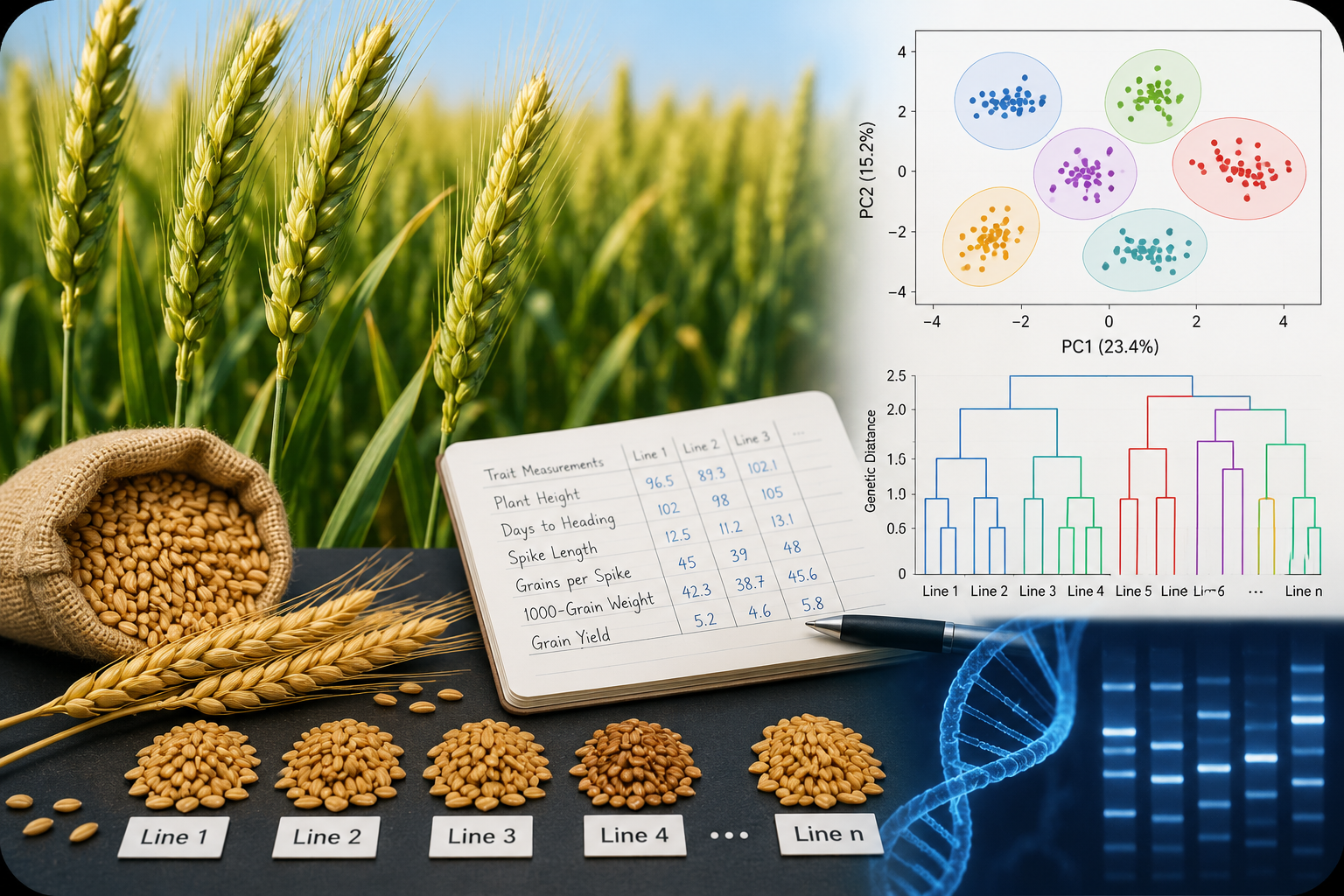
The grouping of 170 wheat genotypes with a variable number of advanced lines into 9 clusters Genetic diversity analysis of 170 genotypes into 9 clusters with variable number of advanced lines on genetic diversity analysis indicated the presence of a considerable amount of genetic diversity in the material. Cluster V was the largest as about 29 advanced lines belonged to this cluster followed by cluster I that possessed 27 RILs whereas cluster 1X was the smallest comprised of 10 advanced lines. The average intra-cluster distance between the advanced lines was maximum for cluster IV followed in descending order by clusters II, VI, VII, IX, VIII, V, III whereas cluster I exhibited the least intra-cluster distance. The inter-cluster distances was maximum between clusters II vs. VII followed by cluster IV vs. VII and VI vs. VII and was least for cluster I vs. II. The identification of promising genotypes for the improvement program in bread wheat revealed that RIL- 91from cluster IV was promising for plant height and number of spikelets per spike. RIL- 31 from cluster VII were found better for the number of grains per spike and grain yield per plant. RIL- 45 from cluster VIII could be explored for maximum hundred hundred-grain weight and minimum days to 50 percent heading as well. The maximum percent contribution towards the total genetic divergence was indicated for grain weight per spike followed by grain yield per plant, hundred hundred-grain weight, and plant height.
References
[1] D. M. Rejesus, M. V. Ginkel and M. Smale (1996). Wheat breeder’s perspectives on genetic diversity and germplasms use: Findings from an international Survey wheat programme special report CIMMYT, Mexico, D.F. Mexico: pp. 40.
[2] P. C. Mahalanobis (1936). On the generalized distance in statistics. National Institute of Science of India.
[3] C. R. Rao (1952). Advanced statistical methods in biometrical research. John Wiley and Sons, New York, USA., 351-382
[4] A. H. Paterson, S. D. Tanksley and M. E. Sorrells (1991). DNA markers in plant improvement. Adv. Agron., 46: 39-90.
[5] J. N. Chapla, K. L. Dobaria, M. D. Khanpara, L. L. Jivani and V. H. Kacchadia (2008). Genetic divergence in bread wheat (Triticum aestivum L.). Natnl. J. Plant Improv., 10: 97-102.
[6] SPSS Inc. (1991). SPSS statistical algorithms. SPSS Incorporated.
[7] J. K. Roy, M. S. Lakshmikumaran, , H. S. Balyan and P. K. Gupta (2004). AFLP based genetic diversity and its comparison with diversity based on SSR, SAMPL and phenotypic traits in bread wheat. Biochem. Genet., 42: 43-59.
[8] S. K. Singh, B. N. Singh, P. K. Singh and C. L. Sharma (2006). Genetic divergence of exotic germplasm lines in wheat (T. aestivum L.). Indian J. Plant Genet. Res., 19: 218-220.
[9] A. Iqubal, A. S. Khan, I. A. Khan, F. S. Awan, A. Ahmad and A. A. Khan (2007). Study of genetic divergence among wheat genotypes through random amplified polymorphic DNA. Genet. Mol. Res., 6: 476-481.
[10] P. N. Verma, B. N. Singh, G. Singh, M. K. Singh and T. L. Setter (2014). Genetic diversity analysis for yield and other agronomic traits in bread wheat under water logged sodic soil condition. J. Wheat Res., 6: 51-58.
[11] C. A. Nimbalkar, P. A. Navale, and A. B. Biradar (2002). Generalized D2 and genetic diversity in wheat. J. Maharashtra Agric. Univ., 27: 43-45.
[12] A. N. Dwivedi and I. S. Pawar (2005). Evaluation of genetic diversity among wheat germplasm lines for yield and quality attributing traits in bread wheat. Haryana Agric. Univ. J. Res., 34: 35-39.
[13] B. Kumar, R. G. M. Lal and A. Upadhyay (2009). Genetic variability, diversity and association of quantitative traits with grain yield in bread wheat (Triticum aestivum L.). Asian J. Agric. Sci., 1: 4-6.
[14] S. K. Yadav, A. K. Singh, S. S. Baghel, M. Jarman and A. K. Singh (2014). Assessment of genetic variability and diversity for yield and its contributing traits among CIMMYT based wheat germplasm. J. Wheat Res., 6: 154-159.
[15] R. Kumar, B. K. Prasad, M. K. Singh, G. Singh and A. Verma (2015). Genetic divergence analysis for morphophysiological traits, under timely and late sown condition in bread wheat (Triticum estivum L.). J. Wheat Res., 7: 27-30.
[16] C. Shyam, P. K. Chandrakar, N. K. Rastogi and U. Banjare (2018). Evaluation of Genetic Divergence Analysis in Wheat for Yield and its Component Characters. Int. J. Agric. Environ. Biotech., 11: 829-834.
[17] D. Hailegiorgis, M. Mesfin and T. Genet (2011). Genetic divergence analysis on some bread wheat genotypes grown in Ethiopia. J. Cent. Europ. Agric., 12: 344-352.
[18] M. K. Pandey, H. N. Bind, S. Kumar and B. N. Singh (2017). Genetic divergence in wheat (Triticum aestivum L. Thell.) under saline sodic condition. Int. J. Curr. Microbiol. App. Sci., 6: 181-189.
[19] S. Bergale, B. Mridula, A. S. Holkar, K. N. Ruwali and S. V. S. Prasad (2001). Pattern of variability, character association and path analysis in wheat (Triticum aestivum L.). Agric. Sci. Digest., 22: 258-260.
Downloads
Published
Issue
Section
License
Copyright (c) 2020 Author (s)

This work is licensed under a Creative Commons Attribution-NonCommercial-NoDerivatives 4.0 International License.
Copyright © The Author(s). This is an open access article distributed under the terms of the Creative Commons Attribution-NonCommercial-NoDerivatives 4.0 International License (CC BY-NC-ND 4.0), which permits unrestricted non-commercial use, distribution, and reproduction in any medium, provided the original author(s) and source are properly credited, and the work is not modified or adapted.