Garden Cress Seeds: chemistry, medicinal properties, application in dairy and food industry: A Review
DOI:
https://doi.org/10.31783/elsr.2020.620104Keywords:
antioxidant, anti-anemic, anti-inflammatory, food application, garden cress seedsAbstract
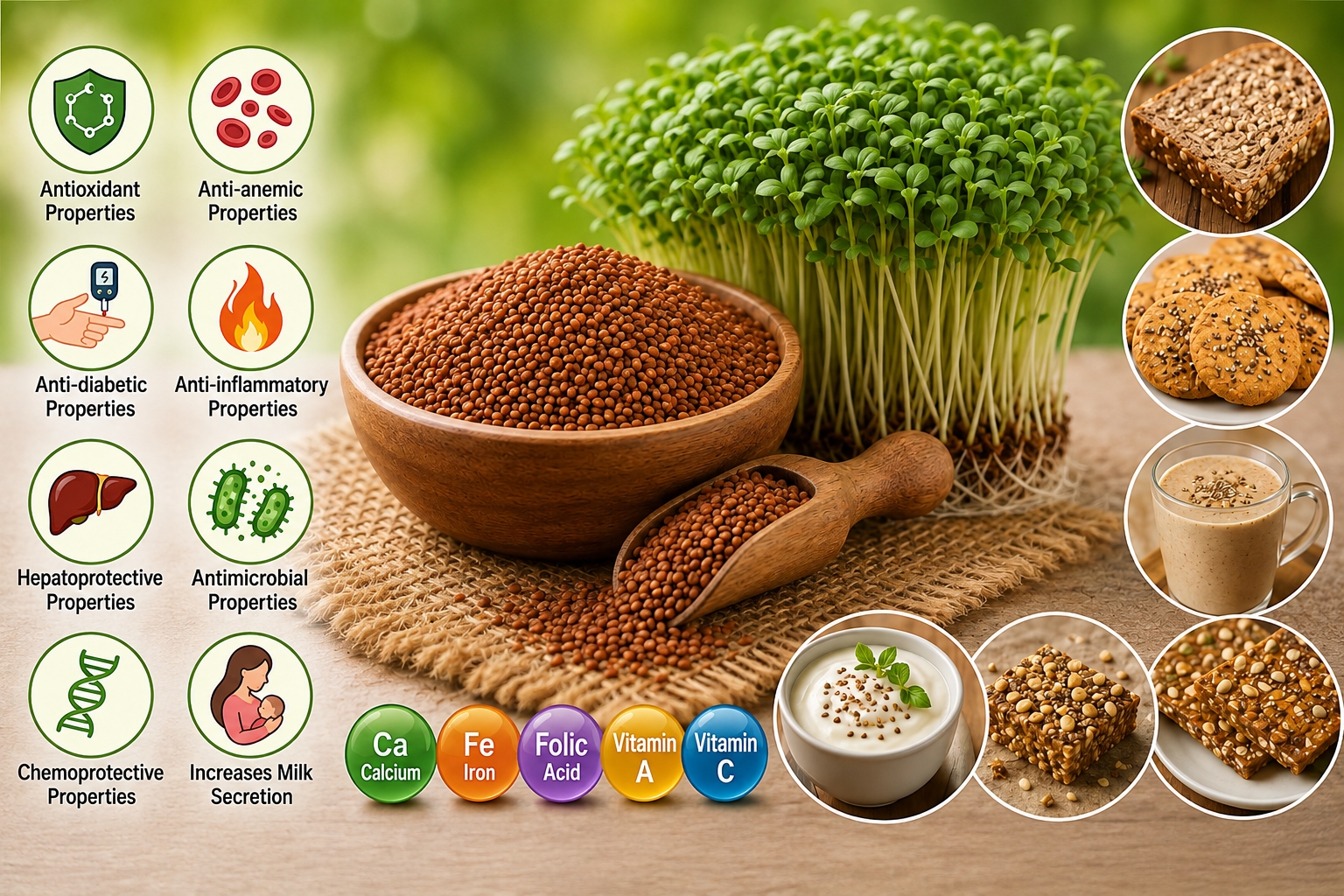
Lepidium sativum also known as Garden Cress seeds contains several medicinal properties such as antioxidant properties, anti-anemic properties, anti-diabetic properties, anti-inflammatory properties, hepatoprotective properties, antimicrobial properties and chemoprotective properties. It can also be used to develop functional foods by fortification. Since the ancient period Garden Cress seeds have been used for medicinal purposes. It also has application in several diseases like asthma, diarrhea, in many skin diseases such as scurvy, etc. It is also useful for increasing the milk secretions in lactating mothers. Garden Cress seeds contain a remarkable amount of calcium, iron, folic acid, Vitamin A, and Vitamin C. Their higher protein and lipid contents indicate that the seeds serve high energy. Its methionine is beneficial in the digestion process as well as plays an important role in the burning of fat and lysine is important in the nitrogen balance. Garden Cress seeds are used in the fortification of food and dairy products like Dahiwala bread, omega-3-fatty acid-rich biscuits, iron-rich biscuits, health drinks, vegetable oils blended with alpha-linoleic acid-rich Garden Cress oil, fortified burfi, fortified chikki etc.
References
[1] S. Sharma and N. Agarwal (2011). Nourishing and healing process of garden cress (Lepidium sativum Linn). Indian J. Natural Prod. Resour., 2: 292-297.
[2] P. N. Tiwari and G. S. Kulmi (2004). Performance of Chandrasur (Lepidium sativum) under different levels of nitrogen and phosphorus. J. Med. Arom. Pl. Sci., 26: 479-481.
[3] S. S. Gokavi, N. G. Malleshi and M. Guo (2004). Chemical composition of garden cress (Lepidium sativum) seeds and its fractions and use of bran as a functional ingredient. Plant Foods Hum. Nutr. 59:105-111.
[4] C. S. Singh and V. H. Pashwan (2017). The Potential of Garden Cress (Lepidium sativum L.) seeds for development of functional foods, Advances in Seed Biology, Jose C. Jimenez-Lopez, IntechOpen, doi: 10.5772/intechopen.70355.
[5] N. U. Rehman, A. U. Khan, K. M. Alkharfy and A. H. Gilani (2012). Pharmacological Basis for the Medicinal Use of Lepidium sativum in Airways Disorders. Evid. Based Complementary Alternat Med., doi:10.1155/2012/596524.
[6] S. Wadhwa, M. S. Panwar, A. A. grawal, N. Saini, L. N. Patidar (2012). A review on pharmacognostical study of Lepidium sativum. Adv. Res. Pharmaceuticals Biologicals, 2: 316-323.
[7] N. D .Raval, B. Ravishankar and B. K. Ashok (2013). Anti-inflammatory effect of chandrashura (Lepidium sativum Linn.) an experimental study. AYU, 34: 302-304.
[8] Shail, M. Dwivedi, N. Kumar and L. N. Gupta (2016). Nutritional importance of Lepidium sativum L. (Garden cress/Chandrashoor). Int. J. Pharm. Anal. Res., 5: 152-160.
[9] M. Raish, A. Ahmad, K. M. Alkharfy, S. R. Ahamad, K. Mohsin, F. I. Jenoobi and A. M. Mohizea (2016). Hepatoprotective activity of Lepidium sativum seeds against D-galactosamine/lipopolysaccharide induced hepatotoxicity in animal model. BMC Complement. Altern. Med., 16: 501. doi: 10.1186/s12906-016-1483-4.
[10] E. S. Al-Sheddi, N. N. Farshori, M. M. Al-Oqail, J. Musarrat, A. A. Al-Khedhairy and M. Siddhiqui (2016). Protective effect of Lepidium sativum seed extract against hydrogen peroxide-induced cytotoxicity and oxidative stress in human liver cells (HepG2). Pharm. Biol., 54: 314-321.
[11] R. B.-Flohe, F. J. Kelly, J. T. Salonem, J. Neuzil, J.-M. Zingg and A. Azzi (2002). The European perspective on vitamin E: Current knowledge and future research. Am. J. Clin. Nutr., 76: 703-716.
[12] J. Malar, K. Chairman, A. R. J. Singh, J. S. Vanmathiand, K. Vasanthi (2014). Antioxidative activity of different parts of the plant Lepidiumsativum Linn. Biotechnol. Rep., 3: 95-98.
[13] M. F. A. El-Maati, S. M. Labib, A. M. A. Al-Gaby and M. F. Ramadan (2016). Antioxidant and antibacterial properties of different extracts of garden cress (Lepidium sativum L.). Zagazig J. Agric. Res., 43: 1685-1697.
[14] M. R. Prajapati and P. H. Dave (2018). Therapeutic and nutritional importance of garden cress seed. J. Pharmacogn. Phytochem., 7: 140-143.
[15] M. Eddouks, M. Maghrani, A. Lemhadri M.-L. Ouahidi and H. Jouad (2002). Ethnopharmacological survey of medicinal plants used for the treatment of diabetes mellitus, hypertension and cardiac diseases in the South-East region of Morocco (Tafilalet). J. Ethnopharmacol., 82: 97-103.
[16] N. Agarwal and S. Sharma (2013). Appraisal of garden cress (Lepidium sativum L.) and product development as an all pervasive and nutrition worthy food stuff. Annals Food Sci. Technol., 14: 77-84.
[17] S. S. Umesha, R. S. Manohar, A. R. Indiramma, S .Akshitha and K. A. Naidu (2015). Enrichment of biscuits with microencapsulated omega-3 fatty acid (alpha-linolenic acid) rich gardencress (Lepidium sativum) seed oil: Physical, sensory and storage quality characteristics of biscuits. LWT-Food Sci. Technol., 60: 654-661.
[18] S. S. Umesha, K. A. Naidu (2012).Vegetable oil blends with α-linolenic acid rich garden cress oil Modulate lipid metabolism in experimental rats. Food Chem., 135: 2845-2851.
[19] S. Gerd and E. Josef (2008). The opposing effects of n-3 and n-6 fatty acids. Prog. Lipid Res., 47: 147-155.
[20] T. Jain, K. Grover and I. S. Grewal (2016). Development and sensory evaluation of ready to eat supplementary food using gardencress (Lepidium sativum) seeds. J. Appl. Nat. Sci., 8: 1501-1506.
Downloads
Published
Issue
Section
License
Copyright (c) 2020 Author (s)

This work is licensed under a Creative Commons Attribution-NonCommercial-NoDerivatives 4.0 International License.
Copyright © The Author(s). This is an open access article distributed under the terms of the Creative Commons Attribution-NonCommercial-NoDerivatives 4.0 International License (CC BY-NC-ND 4.0), which permits unrestricted non-commercial use, distribution, and reproduction in any medium, provided the original author(s) and source are properly credited, and the work is not modified or adapted.