Technologies for Cashew productivity enhancement in Maharashtra
DOI:
https://doi.org/10.31783/elsr.2020.620512Keywords:
cashew, high yielding varieties, processing, technologyAbstract
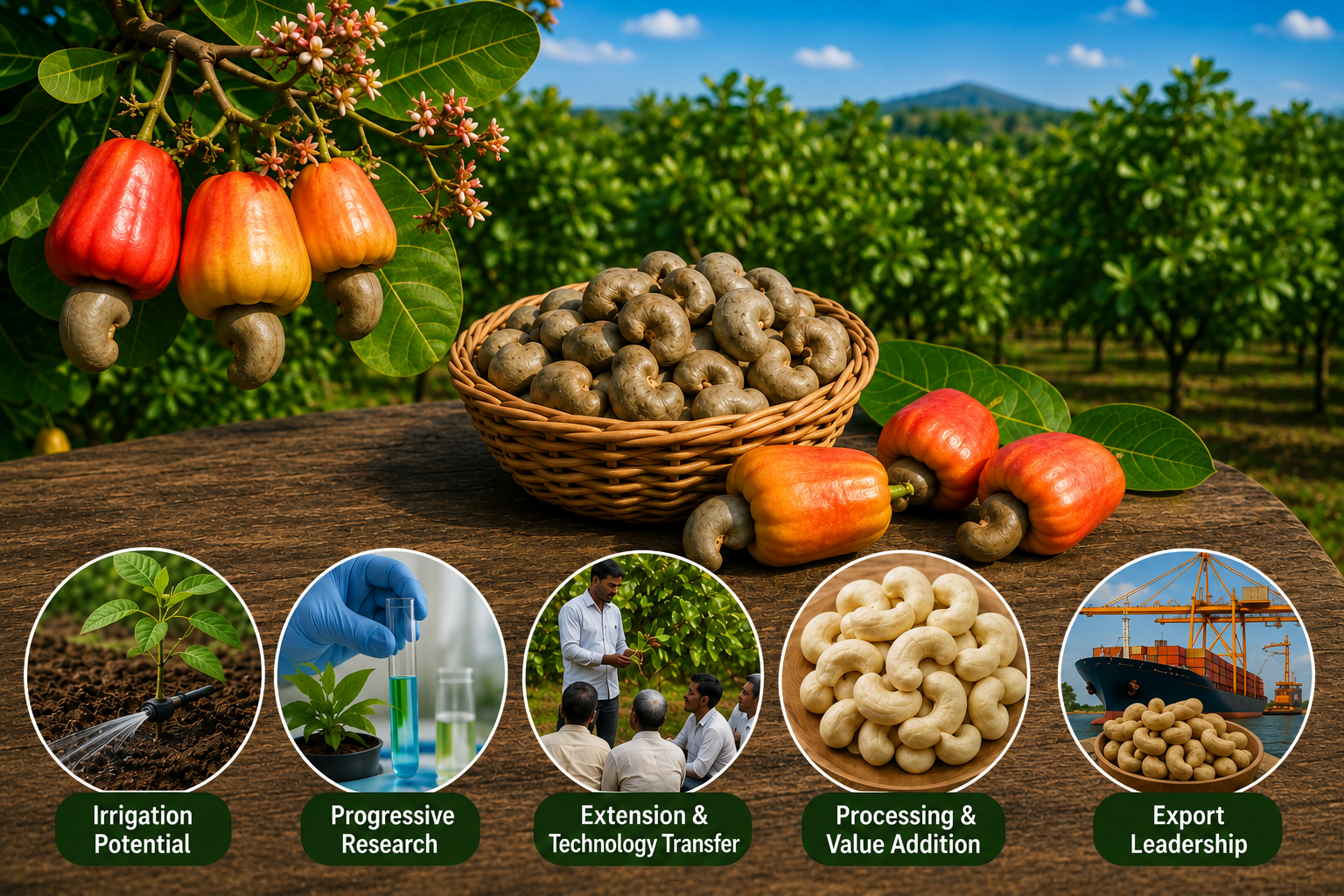
Cashew (Anacardium occidentale L.) is a native of Brazil and was introduced into India by Portuguese during the 16th century with the objective of soil conservation and forestation. However, India is the first country in the world to exploit the international trade of Cashew kernels. Today India is the largest producer, processor, consumer, and exporter of the cashew in the world with 8.55 lakh hectares, and total production of 6.20 lakh MT of raw nuts with the productivity of 800 kg per hectare. Diverse agro-climatic conditions, increasing irrigation potential, progressive research, and innovative farmers receptive to new ideas and technologies are all the factors that combined to offer tremendous scope for commercial horticulture in the Maharashtra state. The ambitious horticulture development program linked with the employment guarantee scheme by the Government of Maharashtra resulted in a substantial increase in the area under various fruit crops. Before the inception of massive horticulture development program in 1990-91, the area under cashew was only 40,000 hectares which has now crossed a level of 1.83 lakh hectares. The average productivity in the state of Maharashtra is 1.5 t/ha. This is due to strong research backup from the State Agriculture University and efforts taken by the extension officers for the transfer of technologies and popularizing the high yielding bold type hybrid varieties developed by Dr. B.S. Konkan Krishi Vidyapeeth, Dapoli. However, still there is a scope for increasing the productivity to the tune of 2 t/ha with little refinements in the management practices.
References
[1] B. R. Salvi, R. C. Gajbhiye, M. S. Gawankar, A.Y. Munj, V. K. Zote and P. D. Patil (2016). Cashew importance, its present status and prospects. Cashew Cultivation Technology Book in Marathi. pp. 2-3.
[2] P. L. Saroj, G. S. Mohana and J. D. Adiga (2016). Crop improvement in Cashew. National Seminar on Strategies for development of cashew.19-20 Feb, 2016, pp.7.
[3] B. B. Sapkal, J. C. Rajput and A. A. Rane (1998). Regionalization of technological Inputs of different agroclimatic tracts of Maharashtra with specific reference to varying economic level of cultivators. The Cashew. 12: 89 92,
[4] Anonymous (1995). Proceeding of the XII Biennial workshop of All India Coordinated Research Project on Cashew held at Bangalore.
[5] R. N. Nawale and M. J. Salvi (1990). Studies on vegetative propagation of cashew. The Cashew 4: 2-5.
[6] D. V. Shingre M. S. Gawankar and B. M. Jamadagni (2001). Effect of nitrogen and irrigation on scions production of cashew variety V-6. The Cashew, 15: 4-7.
[7] D. P. Sawake, R. T. Gunjate and V. P. Limaye (1979). Effect of nitrogen, phosphorous and potash fertilization on growth and production of cashewnut. In International Cashew Symposium 108: pp 96-100.
[8] D. P. Sawke, M. S. Mane, U. V. Mahadkar and T. N. Thorat (2009). Effect of fertilizer regimes and irrigation applied through diffuser on cashewnut yield in lateritic soil of Konkan. The Cashew and Cocoa Journal. 1: 8-12.
[9] P. M. Haldankar, P. C. Haldvnekar, M. S. Gawankar and P.C. Mali (2007). Cashew research and development in Konkan region of Maharashtra. In National seminar on research, development and marketing of cashew, 20th-21st November, held at Association for Coastal Agricultural Research, ICAR Research Complex for Goa, Ela, Old Goa. pp. 33-35.
[10] V. T. Badhe and S. S. Magar (2004). Influence of different conservation measures on runoff soil and nutrient loss under cashew nut in lateritic soils of South Konkan region. Indian J. Soil Cons., 32: 143-147.
[11] M. S. Mane, U. V. Mahadkar, B. L. Ayare and T. N. Thorat (2009). Performance of mechanical soil conservation measures in cashew plantation grown on steep slopes of Konkan Indian J. Soil Cons., 37: 181-184.
[12] R. N. Nawale, D. P. Sawake, M. T. Deshmukh and M. J. Salvi (1985). Effect of black polythene mulch and supplemental irrigation on fruit retention in Cashew. Cashew Causerie, 7: 8-9
[13] V. N. Palsande, M. C. Kasture, V. G. Salvi, P. M. Haldankar, S. E. Shinde and A. L. Shinde et al., (2015). Effect of foliar application of urea and potassium nitrate on cashew Kernel. Bioinfolet-A Quarterly J. Life Sciences, 12: 240-243.
[14] R. C. Gajbhiye, V. N. Jalgaonkar, V. W. Bendale and M. S. Gawankar (2007). Effect of Growth Regulator to Improve Fruit Set and Yield in Cashew. National seminar on Research, Development and Marketing of Cashew." Souvenir and Extended summaries, ICAR Research Complex for Goa. pp136-137.
[15] M. S. Gawankar, R. D. Sawale, S. N. Pawar and S. A. Chavan (2010). Effect of Ethrel on flowering, sex expression and yield in cashew. J. Hortl Sci., 5: 68-70.
[16] K. D. Patil, M. S. Gawankar, S. N. Pawar and S. A. Chavan (2016). Effect of supplementary foliar nutrient application on yield and quality of cashew. National Seminar on Strategies for development of Cashew, 19-20 February.
[17] M. S. Gawankar S. N. Pawar R. D. Sawale and S. A. Chavan (2010). Effect of foliar sprays of nutrients on nut yield of cashew in the Coastal Zone of Maharashtra. J. Indian Soc. Coastal Agric. Research., 28: 25-28.
[18] D. P. Sawake, S. B. Deshpande and R. T. Gunjate (1994). Nutrient management in cashew. Proceedings of the XI symposium on Plantation Crops.
[19] M. S. Gawankar and S. N. Pawar (2013). Intercropping in cashew orchard with tuber crops in the Konkan region of Maharashtra. J. Plantation Crops. 41: 95-97.
[20] P. V. Jadhav, V. V. Shinde, S. S. Chavan and M. M. Mahale, (2015). Sustainable production of cashew with mix cropping of back yard poultry (Giriraja). Acta Horticulturae, 1080: 307-309
[21] G. T. Thirumalaraju (2007). Latest developments on plant protection. In cashew. National seminar on research, development and marketing of cashew. Souvenir and extended summaries, ICAR Research complex for Goa, 20-21, November, pp 69-71.
Downloads
Published
Issue
Section
License
Copyright (c) 2020 Author (s)

This work is licensed under a Creative Commons Attribution-NonCommercial-NoDerivatives 4.0 International License.
Copyright © The Author(s). This is an open access article distributed under the terms of the Creative Commons Attribution-NonCommercial-NoDerivatives 4.0 International License (CC BY-NC-ND 4.0), which permits unrestricted non-commercial use, distribution, and reproduction in any medium, provided the original author(s) and source are properly credited, and the work is not modified or adapted.