Impact of seed priming on water productivity and performances of wheat (Triticum aestivum L) varieties
DOI:
https://doi.org/10.31783/elsr.2020.623237Keywords:
germination, seed priming, water productivity, wheat, yieldAbstract
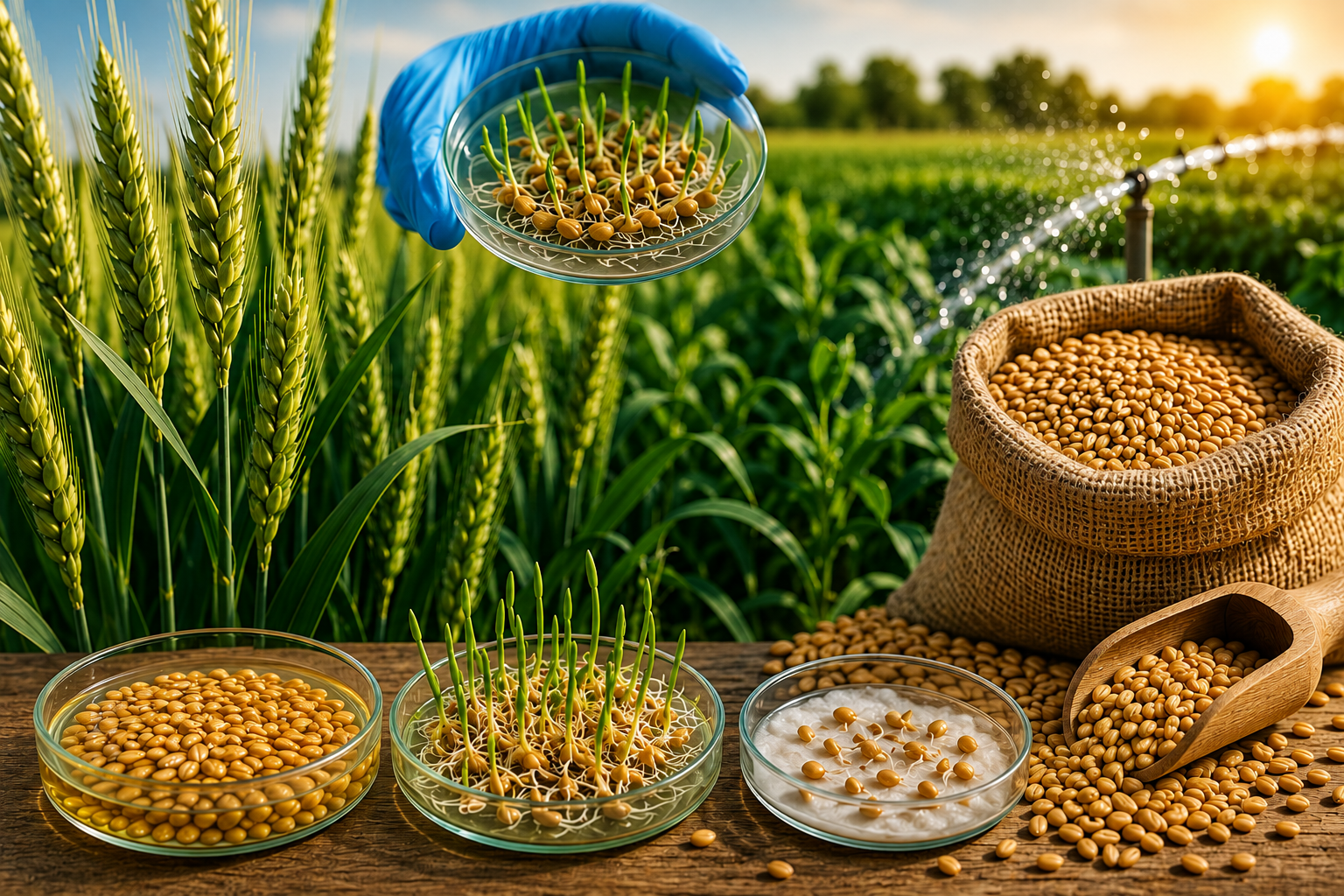
Followed by rice, wheat pays a major portion to the food basket of the country, and it appeared as the second important cereal crop of India. Availability of quality irrigation water determines the economic yield, because wheat production depends on a secure irrigation facility. With the increase in population, the quality and the quantity of irrigation water used for cultivaton is becoming a concern. Therefore, it is the need of the hour to improve water use efficiency for wheat production. In this background, the present investigation was taken to assess the impacts of seed priming on water productivity and performances of wheat. This experiment was conducted for two consecutive years 2017-18 and 2018-19 in factorial random block design (RBD) with three replications. The treatment comprised of five varieties C-306, PBW-343, HD-2967, K-1006, and DBW-39 with three methods of seed priming namely hydro priming, gibberellic acid (GA3) priming, and control. Results of the experiment clearly showed that seed priming with GA3 recorded significantly higher germination count (209 and 196 m-2) in the case of variety PBW-343, which helps in better crop stand and more number of spike m-2 (376.48 and 373.37) and grains spike-1 (38.69 and 36.12) during 2017-18 and 2018-19 respectively. Seed priming with GA3 also registered the highest grain yield irrespective of the variety and the year of experimentation followed by hydro-priming.
References
[1] FAO (2014). Food and Agriculture organization [Online].
Available at http://faostat3.fao.org/download/Q/QC/E [Last consulted on 1st October, 2016].
[2] Anonymous (2016). Progress report of All India coordinated wheat and barley improvement project 2015-16, Director’s report. Ed. G. P. Singh, ICAR-Indian Institute of wheat and barley research, Karnal, India. pp96.
[3] S. Ahmad, R. Ahmad, M. Y. Ashraf, M. Ashraf and E.A. Waraich (2009). Sunflower (Helianthus Annuus L.) response to drought stress at germination and seedling growth stages. Pak. J. Bot., 41: 647-654.
[4] K. J. Bradford (1986). Manipulation of seed water relations via osmoticpriming to improve germination under stress conditions. Hortic. Sci., 21: 1105-1112.
[5] A. Rashid, D. Harris, P. Hollington and S. Ali (2004). On-farm seed priming reduces yield losses of mungbean (Vigna radiata) associated with mungbean yellow mosaic virus in the North West Frontier Province of Pakistan. Crop. Prot., 23: 1119-1124.
[6] M. Janmohammadi, D. P. Moradi and F. Sharifzadeh (2008). Seed invigoration techniques to improve germination and early growth of inbred line of maize under salinity and drought stress. Gen. Appl. Plant Physiol., 34: 215-226.
[7] R. Caseiro, M. A. Bennett and F. J. Marcos (2004). Comparison of three priming techniques for onion seed lots differing in initial seed quality. Seed. Sci. Technol., 32: 365-375.
[8] M. Seo, E. Nambara, E. Choi and S. Yamaguchi (2009). Interaction of light and hormone signals in germinating seeds. Plant Mol. Biol., 69: 463-472.
[9] S. Kaur, A. K. Gupta and N. Kaur (1998). Gibberellic acid and kinetin partially reverse the effect of water stress on germination and seedling growth in chickpea. Plant Growth Regul., 25: 29-33.
[10] B. Kaur, S. Singh, B. R. Garg, J. M. Singh and J. Singh (2012). Enhancing water productivity through on-farm resource conservation technology in Punjab agriculture. Agric. Econ. Res. Rev., 25: 79-85.
[11] B. Mirshekari (2015). Effect of hormonal and physical priming on improvement of seed germination and seedling vigour of wheat (Triticum aestivum L.). Iranian J. Seed Sci. Technol., 4(3): 22–33.
[12] S. Meera and S. Poonam (2010). Response of growth regulators on some physiological traits and yield of wheat (Triticum aestivum L.). Progressive Agric., 10: 387-388.
[13] N. Y. Chaudhry and M. S. Zahur (1992). Effect of growth regulators i.e., IAA and GA3 on Abelmoschus esculentus L. internal structure of hypocotyls and stem internodes. Biol. Sci., 37: 217-244.
[14] N. Y. Chudhary and A. Khan (2000). Effect of growth hormones i.e., GA3, IAA and kinetin on shoot of Cicer arietinum L. Pak. J. Biol. Sci., 3: 1263-1266.
[15] A. Ulfat, A. M. Syed and H. Amjad (2017). Hormonal seed priming improves wheat (Triticum aestivum L.) field performance under drought and non-stress conditions. Pak. J. Bot., 49: 1239-1253.
[16] M. A. K. Shaddad, A. El- S. H. M. and D. Mostafa (2013). Role of gibberellic acid (GA3) in improving salt stress tolerance of two wheat cultivars. Int. J. Plant Physiol. Biochem., 5: 50-57.
[17] Y. Liu, W. Chen, Y. Ding, Q. Wang, G. Li and S. Wang (2012). Effect of Gibberellic acid (GA3) and Naphthalene Acetic Acid (NAA) on the growth of unproductive tillers and the grain yield of rice (Oryza sativa L.). Afr. J. Agric. Res., 7: 534-539.
[18] N. A. Khan, H. R. Ansari and M. Mobin (1996). Effect of gibberellic acid and nitrogen on carbonic anhydrase activity and mustard biomass. Biol. Plant., 38: 601-603.
[19] J. W. Patrick and K. H. Steains (1987). Auxin promoted transport of metabolites in stem of Phaseolus vulgaris L. Auxin dose response curves and effect of inhibitors of polar auxin transport. J. Exp. Bot., 38: 203-210.
Downloads
Published
Issue
Section
License
Copyright (c) 2020 Author (s)

This work is licensed under a Creative Commons Attribution-NonCommercial-NoDerivatives 4.0 International License.
Copyright © The Author(s). This is an open access article distributed under the terms of the Creative Commons Attribution-NonCommercial-NoDerivatives 4.0 International License (CC BY-NC-ND 4.0), which permits unrestricted non-commercial use, distribution, and reproduction in any medium, provided the original author(s) and source are properly credited, and the work is not modified or adapted.