Genetic and environmental basis of processing speed cognitive ability of twins
DOI:
https://doi.org/10.31783/elsr.2020.623843Keywords:
cognitive abilities, dizygotic twins, environment, genetic, heritability estimate, monozygoticAbstract
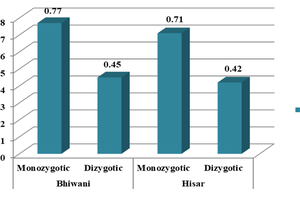
Processing speed is one of the most essential fundamentals of cognitive abilities. The present investigation was formulated with the aim of the basis of genetic and environment on processing speed of cognitive abilities of twins. 100 pairs of twins with the age group 6-8 years were selected from two districts namely, Bhiwani (N=90) and Hisar (N=110) from the Haryana state. The processing speed of the cognitive abilities of twins was measured using the Wechsler Intelligence Scale for Children- Revised (WISC-R). Heritability estimate was used to analyze the genes expression on processing speed cognitive abilities of twins. The result stated that the heritability estimates for processing speed cognitive abilities of twins were 64 percent and 59 percent in Bhiwani and Hisar districts respectively. The correlation coefficient among monozygotic and dizygotic twins for processing speed cognitive ability of twins was r=0.77 and r=0.45 respectively in the Bhiwani district while in the Hisar district the correlation coefficient among the monozygotic twins and dizygotic twins was r=0.71 and r=0.42, respectively. The results also revealed that the monozygotic twins were more correlated in processing speed cognitive abilities as compared to the dizygotic twins. The processing speed cognitive abilities were more influenced by genetic basis as compared to the environmental factors.
References
[1] M. Wright, E. de Geus. J. Ando, M. Luciano, D. Posthuma, Y. Ono and N. Hansell et al., (2001). Genetics of cognition: outline of a collaborative twin study. Twin Res. Hum. Genet., 4: 48-56.
[2] H. Peng, J. Wen, D. Wang and Y. Gao (2012). The impact of processing speed training on working memory in old adults. J Adult Dev., 19:150-157.
[3] T. Lee, A. Thalamuthu, J. D. Henry, J. N. Trollor, D. Ames, M. J. Wright and P. S. Sachdev et al., (2018). Genetic and environmental influences on language ability in older adults: findings from the older Australian twins study. Behav. Genet., 48: 187-197.
[4] N. K. Hansell, G. S. Halford, G. Andrews, D. H. K. Shum, S. E. Harris, G. Davies and S. Franic et al., (2015). Genetic basis of a cognitive complexity metric. Plos one, 10: doi: 10.1371/journal.pone.0123886.
[5] A. E. Reineberg, A. S. Hatoum, J. K. Hewitt, M. T. Banich and N. P. Friedman (2018). Genetic and environmental influence on the human functional connectome. Cereb. Cortex, 30: 2099-2113.
[6] P. Mukherjee and T. K. Samanta (2017). Impact of heredity and environment on IQ: An investigation. I. J. Multidisciplinary Res. Develo., 4: 411-414.
[7] R. Plomin and I. J. Deary (2015). Genetics and intelligence differences: five special findings, Mol. Psychiatry, 20: 98-108.
[8] E. M. Tucker-Drob, D. A. Briley and K. P. Harden (2013). Genetic and environmental influences on cognition across development and context. Curr. Dir. Psychol. Sci., 22: 349-355.
[9] Y. Zhenga, F. Rijsdijkb and R. Ardenc (2018). Differential environmental influences on the development of cognitive abilities during childhood. Intelligence, 66: 72-78.
[10] T. J. C. Polderman, B. Benyamin, C. A. de Leeuw, P. F. Sullivan, A. van Bochoven, P. M Visscher and D. Posthuma (2015). Meta-analysis of the heritability of human traits based on fifty years of twin studies. Nat. Genet., 47: 702-709.
[11] E. B. Robinson, A. Kirby, K. Ruparel, J. Yang, L. McGrath, V. Anttila and B. M. Neale et al., (2015). The genetic architecture of pediatric cognitive abilities in the philadelphia neurodevelopmental Cohort. Mol. Psychiatry, 20: 454-458.
[12] D. Wechsler (1974). Wechsler Intelligence Scale for Children (revised edition). New York: The Psychological Corporation, 1-191.
[13] D. S. Falconer (1996). Introduction to qantitative genetics. Pearson Education India.
[14] S. Ogata, K. Kato, C. Honda and K. Hayakawa (2014). Common Genetic Factors Influence Hand Strength, Processing Speed, and Working Memory. J. Epidemiol., 24: 31-38.
[15] G. A. M. Blokland, R. I. Mesholam-Gately, T. Toulopoulou, E. C. del Re, M. Lam, L. E. DeLisi and G. Donohoe et al., (2017). Heritability of neuropsychological measures in schizophrenia and nonpsychiatric populations: A systematic review and meta-analysis. Schizophr. Bull., 43: 788-800.
[16] E. M. Tucker-Drob, D. A. Briley and K. P. Harden (2013). Genetic and Environmental Influences on Cognition across Development and Context. Curr. Dir. Psychol. Sci., 22: 349-355.
[17] S. L. Hellard and V. M. Steen (2014). Genetic architecture of cognitive traits. Scand. J. Psychol., 55: 255-262.
[18] M. S. Panizzon, E. Vuoksimaa, K. M. Spoon, K. C. Jacobson, M. J. Lyons, C. E. Franz and H. Xian et al., (2014). Genetic and environmental influences of general cognitive ability: Is g a valid latent Construct? Intelligence, 43: 65-76.
[19] M. Trzaskowski, J. Yang, P. M. Visscher and R. Plomin (2014). DNA Evidence for Strong Genetic Stability and Increasing Heritability of Intelligence from Age 7 To 12. Mol Psychiatry, 19: 380-384.
[20] Y. Kovas, C. M. A. Haworth, P. S. Dale, R. Plomin, R. A. Weinberg, J. M. Thomson and K. W. Fischer (2007). The genetic and environmental origins of learning abilities and disabilities in the early school. Monogr. Soc. Res. Child Dev., 72: 1-144.
[21] M. Trzaskowski, O. S. P. Davis, J. C. DeFries, J. Yang, P. M. Visscher and R. Plomin (2013). DNA evidence for strong genome-wide pleiotropy of cognitive and learning abilities. Behav. Genet., 43: 267-273.
Downloads
Published
Issue
Section
License
Copyright (c) 2020 Author (s)

This work is licensed under a Creative Commons Attribution-NonCommercial-NoDerivatives 4.0 International License.
Copyright © The Author(s). This is an open access article distributed under the terms of the Creative Commons Attribution-NonCommercial-NoDerivatives 4.0 International License (CC BY-NC-ND 4.0), which permits unrestricted non-commercial use, distribution, and reproduction in any medium, provided the original author(s) and source are properly credited, and the work is not modified or adapted.