
Dancing bees speak in a code-A Review
DOI:
https://doi.org/10.31783/elsr.2020.624453Keywords:
communication, dance, distance, direction, honeybeeAbstract
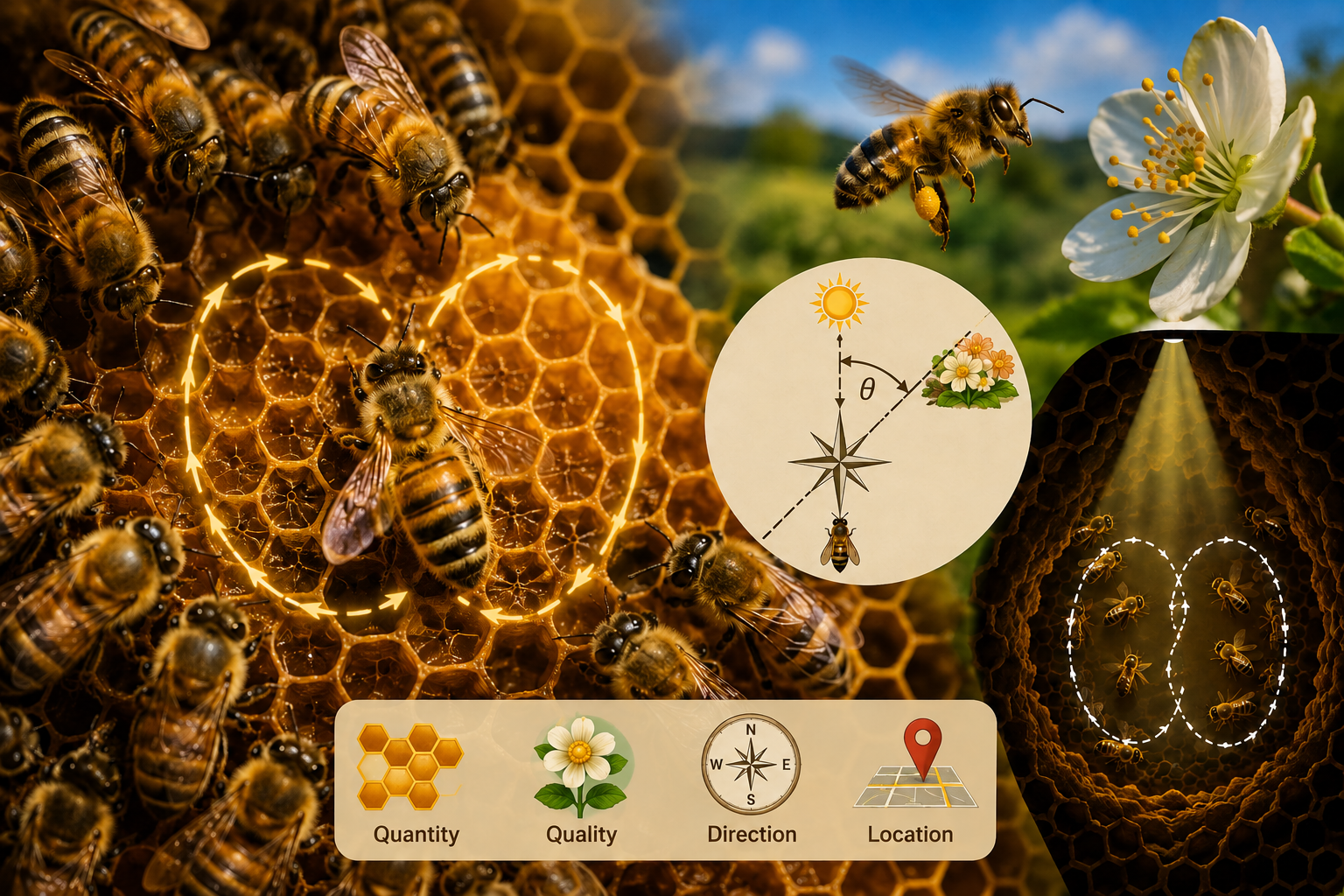
Honeybee foragers dance to communicate the quantity, quality, direction, and spatial location of food and other resources to their nestmates. This remarkable communication system has long served as an important model system for studying the mechanisms and evolution of this complex behavior. I provide a broad overview of the research done on dance communication, earlier theories, and their controversies and solution. Specific issues concentrated in this review are as follows: (a) different types of dances (b) measurement of distance and direction (c) How bees perform dance in dark hive? Various experiments have confirmed that bees perform different types of dance depending upon their specific function. However, detailed information about other types of dances is still lacking which if worked on will help us in solving various queries and would help us in better understanding the significance of different types of dances performed by honeybees in and outside the hive.
References
[1] M. Chagnon, J. Gingras and D. DeOliveira (1993). Complementary aspects of strawberry pollination by honeybees and indigenous bees (Hymenoptera). J. Econ. Entomol., 86: 416-420.
[2] D. Kleijn, R. Winfree, I. Bartomeus, L. G. Carvalheiro, M. Henry, R. Isaacs and A.-M. Klein et al., (2015). Delivery of crop pollination services is an insufficient argument for wild pollinator conservation. Nat. Commun., 6: 7414. doi: 10.1038/ncomms8414
[3] R. Bommarco, L. Marini and B. E. Vaissiere (2012). Insect pollination enhances seed yield, quality, and market value in oilseed rape. Oecologia, 169: 1025-1032.
[4] L. A. Garibaldi, I. Steffan-Dewenter, R. Winfree, M. A. Aizen, R. Bommarco, S. A. Cunningham and C. Kremen et al., (2013). Wild pollinators enhance fruit set of crops regardless of honey bee abundance. Science, 339: 1608-1611.
[5] T. D. Seeley (1995). The Wisdom of the hive: The social physiology of honey bee colonies. Harvard University Press.
[6] P. K. Visscher and T. D. Seeley (1982). Foraging strategy of honeybee colonies in a temperate deciduous forest. Ecology, 63: 1790-1801.
[7] M. Beekman, F. L. W. Ratnieks (2000). Long-range foraging by the honey bee, Apis mellifera L. Funct. Ecol., 14: 490-496.
[8] M. J. Couvillon, R. Schürch and F. L. W. Ratnieks (2014). Waggle dance distances as integrative indicators of seasonal foraging challenges. PLoS ONE, 9: e93495. doi:10.1371/journal.pone.0093495
[9] J. B. Free (1993). Insect Pollination of Crops. Academic Press, London.
[10] M. A. Aizen and L. D. Harder (2009). The global stock of domesticated honey bees is growing slower than agricultural demand for pollination. Curr. Biol., 19: 915-918.
[11] T. D. Breeze, B. E. Vaissière, R. Bommarco, T. Petanidou, N. Seraphides, L. Kozák, J. Scheper and J. C. Biesmeijer et al., (2014). Agricultural policies exacerbate honeybee pollination service supply demand mismatches across Europe. PLOS ONE, 9: e91459. doi: 10.1371/journal.pone.0091459
[12] M. Maeterlinck (1901). The life of the bee. New York: Dodd, Mead and Company.
[13] K .V. Frisch (1919). Uber den Gerusin der Bienen und seine blütenbiologische. Bedeutung. Zool. Jahrb., 97: 1-238.
[14] K. V. Frisch, A. M. Wenner and D. L. Johnson (1967). Honey bees: do they use the direction and distance information provided by their dancers? Science, 158: 1072-1076.
[15] J. L. Gould (1975). Honey bee recruitment: the dance language controversy. Science, 189: 685-693.
[16] T. Landgraf, D. Bierbach, A. Kirbach, R. Cusing, M. Oertel, K. Lehmann and U. Greggers (2018). Dancing honey bee robot elicits dance-following and recruits foragers. arXiv preprint arXiv:1803.07126
[17] K. V. Frisch (1923). Über die “Sprache” der Bienen, eine tierpsychologische Untersuchung. Zool. Jahrb. Abt. Allg. Zool. Physiol., 40: 1-186.
[18] P. Grad (2010). How do bees communicate? They dance bee dances. https://bigislandbees.com/blogs/bee-blog/14137357-bee-dances
[19] W. Kirchner, M. Lindauer and A. Michelsen (1988). Honeybee dance communication. Naturwissenschaften, 75: 629-630.
[20] K .V. Frisch (1974). Decoding the language of the bee. Science, 185: 663-668.
[21] T. Munz (2005). The bee battles: Karl von Frisch, AdrianWenner and the honey bee dance language controversy. J. Hist. Biol., 38: 535-570.
[22] K. V. Frisch (1946). Die Ta¨nze der Bienen. O¨sterr. Zool. Z., 1: 1-148
[23] K .V. Frisch (1967). The dance language and orientation of bees. Harvard University Press, Cambridge,
[24] C. Thom, D. C. Gilley, J. Hooper and H. E. Esch (2007). The scent of the waggle dance. PLoS Biol., 5: e228. doi:10.1371/journal.pbio.0050228
[25] T. D. Seeley, A. S. Mikheyev and G. J. Pagano (2000). Dancing bees tune both duration and rate of waggle run production in relation to nectar source profitability. J. Comp. Physiol., 186: 813-819.
[26] J. Riley, U. Greggers, A. D. Smith, D. R. Reynolds and R. Menzel (2005). The flight paths of honeybees recruited by the waggle dance. Nature, 435: 205-207.
[27] T. D. Seeley, P. K. Visscher and K. M. Passino (2006). Group decision making in honey bee swarms, American Scientist, 94: 220-229.
[28] M. Lindauer (1955). Schwarmbienen auf Wohnungssuche. Zeitschrift für vergleichende Physiol., 37: 263-324.
[29] F. C. Dyer (2002). The biology of the dance language. Ann Rev Entomol, 47: 917-949.
[30] M. J. Couvillon (2012). The dance legacy of Karl von Frisch. Insectes Soc., 59: 297-306. doi:10.1007/s00040-012-0224-z
[31] J. C. Biesmeijer and T. D. Seeley (2005). The use of waggle dance information by honey bees throughout their foraging careers. Behav. Ecol. Sociobiol., 59: 133-142.
[32] C. Grüter and W. M. Farina (2009). The honeybee waggle dance: can we follow the steps? Trends Ecol. Evol., 24: 242-247.
[33] O. Afik, A. Dagt and S. Shafir (2008). Honeybee, Apis mellifera, round dance is influenced by trace components of floral nectar. Anim. Behav., 75: 371-377.
doi:10.1016/j.anbehav.2007.04.012
[34] K. D. Waddington and W. H. Kirchner (2010). Acoustical and Behavioral correlates of profitability of food sources in honey bee round dances. Ethology, 92: 1-6.
[35] K. Waddington (1982). Honey bee foraging profitability and round dance correlates. J. Comp. Physiol., 148: 297-301.
[36] F. C. Dyer (1987). Memory and sun compensation by honey bees. J. Comp. Physiol., 160: 621-633.
[37] F. C. Dyer (1991). Bees acquire route based memories but not cognitive maps in a familiar landscape. Anim. Behav., 41: 239-246.
[38] F. C. Dyer (1991). Bees acquire route based memories but not cognitive maps in a familiar landscape. Anim. Behav., 41: 239-246.
[39] D. E. Schmitt and H. E. Esch (1993). Magnetic orientation of honeybees in the laboratory. Naturwissenschaften, 80: 41-43.
[40] H. Esch and J. Burns (1996). Distance estimation by foraging honey bees. J Exp. Biol., 199: 155-162.
[41] M. V. Srinivasan, S. W. Zhang, M. Lehrer and T. S. Collett (1996). Honeybee navigation en route to the goal: Visual flight control and odometry. J. Exp. Biol., 199: 237-244.
[42] A. Si, M. V. Srinivasan and S. Zhang (2003). Honeybee navigation: properties of the visually driven ‘odometer’. J. Exp. Biol., 206: 1265-1273.
[43] M. Dacke and M. V. Srinivasan (2008). Two odometers in honeybees? J. Exp. Biol., 211: 3281- 3286.
[44] C. Grüter, E. Leadbeater and F. L. W. Ratnieks (2010). Social learning: the importance of copying others. Curr. Biol., 20: R683-R685.
[45] J. S. Pettis and T. Pankiw (1998). Grooming behavior by Apis mellifera L. in the presence of Acarapis woodi (Rennie) (Acari: Tarsonemidae). Apidologie, 29: 241-253.
[46] E. Guzman-Novoa, B. Emsen, P. Unger, L. G. Espinosa-Montaño and T. Petukhova (2012). Genotypic variability and relationships between mite infestation levels, mite damage, grooming intensity, and removal of Varroa destructor mites in selected strains of worker honey bees (Apis mellifera L.). J. Invertebr. Pathol., 110: 314-320.
[47] D. J. Pritchard (2016). Grooming by honey bees as a component of varroa resistant behavior. J. Apic. Res., 55: 38-48.
[48] B. B. Land and T. D. Seeley (2004). The grooming invitation dance of the honey bee. Ethology, 110: 1-10.
[49] T. D. Seeley (1992). The tremble dance of the honey bee: message and meanings. Behav. Ecol. Sociobiol., 31: 375-383.
[50] C. Thom (2003). The tremble dance of honey bees can be caused by hive-external foraging experience. J. Exp. Biol., 206: 2111-2116.
[51] T. D. Seeley, S. Kühnholz and A. Weidenmüller (1996). The honey bee’s tremble dance stimulates additional bees to function as nectar receivers. Behav. Ecol. Sociobiol., 39: 419-427.
[52] A. Stabentheiner and K. Hagmuller (1991). Sweet food means ‘Hot Dancing’ in honeybees. Naturwissenschaften, 78: 471-473.
[53] K. Rohrseitz and J. Tautz (1999). Honeybee dance communications: waggle run direction coded in antennal contacts? J. Comp. Physiol. A, 184: 463-470.
[54] A. Michelsen, W. H. Kirchner and M. Lindauer (1986). Sound and vibrational signals in the dance language of the honeybee, Apis mellifera. Behav. Ecol. Sociobiol., 18: 207-212.
[55] A. Michelsen, W. F. Towne, W. H. Kirchner and P. Kryger (1987). The acoustic near field of a dancing honeybee. J. Comp. Physiol. A, 161: 633-643.
[56] W. F. Towne and W. H. Kirchner (1989). Hearing in honey bees: detection of air-particle oscillations. Science, 244: 686-688.
[57] W. H. Kirchner, C. Dreller and W. F. Towne (1991). Hearing in honeybees: operant conditioning and spontaneous reactions to airborne sound. J. Comp. Physiol. A, 168: 85-89.
[58] C. Dreller and W. H. Kirchner (1993). Hearing in honeybees: localization of the auditory sense organ. J. Comp. Physiol, 173: 275-279.
[59] J. Tautz, J. Casas and D. Sandeman (2001). Phase reversal of vibratory signals in honeycomb may assist dancing honeybees to attract their audience. J. Exp. Biol., 204: 3737-3746.
[60] O. Kilpinen and J. Storm (1997). Biophysics of the subgenual organ of the honeybee, Apis mellifera. J. Comp. Physiol A, 181: 309-318.
[61] Y. Hasegawa and H. Ikeno (2011). How do honey bees attract nestmates using waggle dances in dark and noisy hives? PLoS One, 6: e19619. doi: 10.1371/journal.pone.0019619.
Downloads
Published
Issue
Section
License
Copyright (c) 2020 Author (s)

This work is licensed under a Creative Commons Attribution-NonCommercial-NoDerivatives 4.0 International License.
Copyright © The Author(s). This is an open access article distributed under the terms of the Creative Commons Attribution-NonCommercial-NoDerivatives 4.0 International License (CC BY-NC-ND 4.0), which permits unrestricted non-commercial use, distribution, and reproduction in any medium, provided the original author(s) and source are properly credited, and the work is not modified or adapted.