Evaluation of yield potential and nutritional quality of various cultivars of barnyard millet (Echinochloa frumentacea L.) grown under subtropical India
DOI:
https://doi.org/10.31783/elsr.2020.625459Keywords:
barnyard millet, germplasm, NDS-6, nutritional quality, yieldAbstract
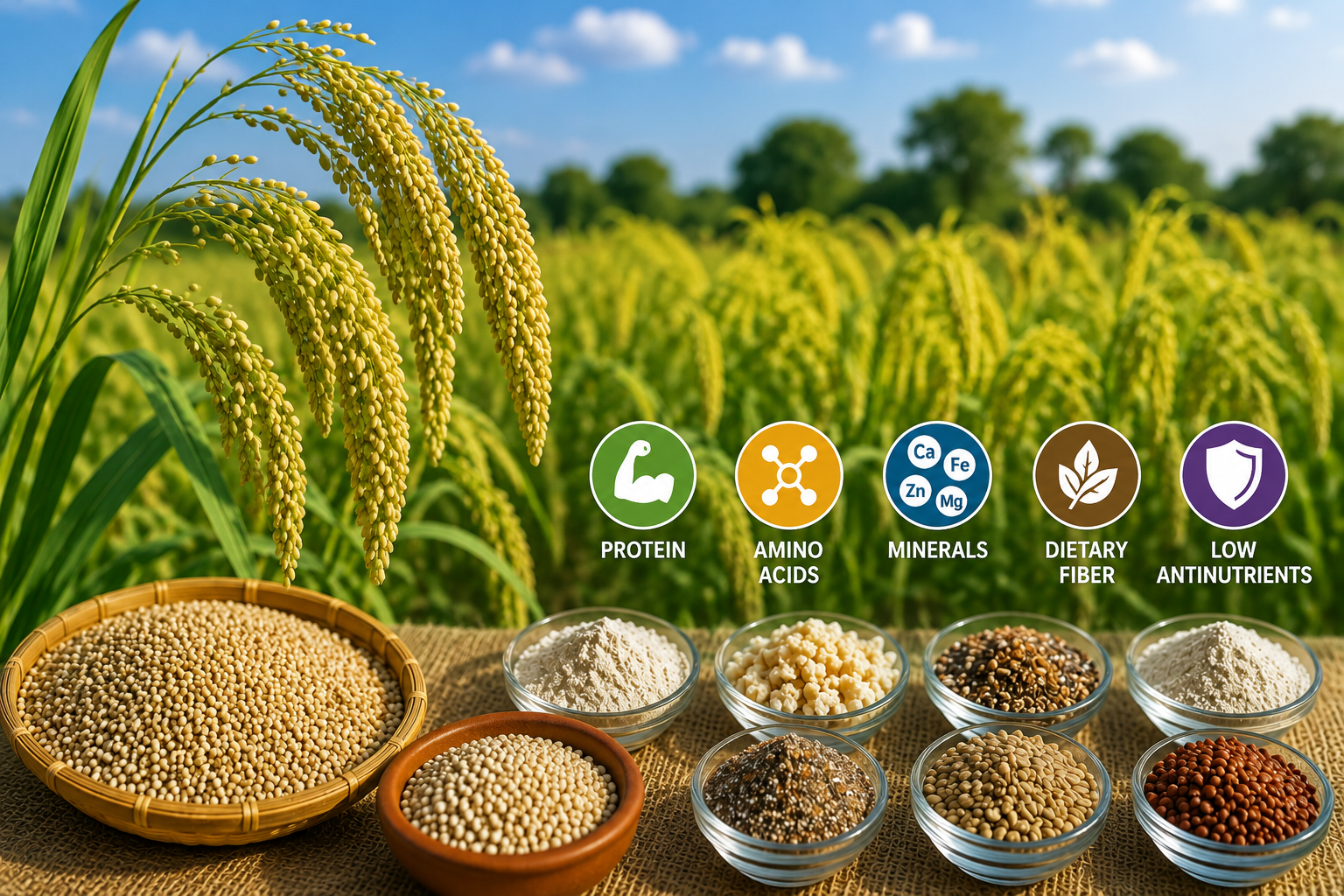
A field experiment was carried out during kharif season 2013 at Acharya Narendra Deva University of Agriculture and Technology, Kumarganj, Faizabad to study the performance of different cultivars of sawan millet with respect to yield and nutritional quality. The experiment was laid out in a randomized complete block design with three replicates. The treatments comprised of 10 germplasms viz., NDS-1, NDS-2, NDS-3, NDS-4, NDS-5, NDS-6, NDS-7, NDS-8, NDS-9, NDS-10 and one control i.e., T-46 (Popular variety of eastern U.P). Results revealed that the germplasm NDS-9 recorded significantly higher grain yield followed by NDS-10. The highest protein content was recorded in germplasm NDS-6 followed by NDS-2. The highest tryptophan was recorded in germplasm NDS-6 followed by NDS-3 and the highest lysine was reported in germplasm NDS-6 followed by NDS-5 and NDS-3. The total mineral content was highest in NDS-8 followed by NDS_7 and NDS-1. The higher crude fiber was recorded in germplasm NDS-9 followed by NDS-10 and NDS-7. The lowest values of phytic acid and tannin content were also noticed in NDS-6 followed by NDS-3.
References
[1] A. Gupta, V. Mahajan, M. Kumar and H. S. Gupta (2009). Biodiversity in the barnyard millet (Echinochloa frumentacea Link, Poaceae) germplasm in India. Genet. Resour. Crop Evol., 56: 883-889.
[2] A. K. Trivedi, L. Arya, S. K. Verma, R. K. Tyagi and A. Hemantaranjan (2017). Evaluation of barnyard millet diversity in central Himalayan region for environmental stress tolerance. J. Agric. Sci., 155: 1497-1507.
[3] D. Prabha, Y. K. Negi, and V. K. Khanna (2010). Morphological and isozyme diversity in the accessions of two cultivated species of barnyard millet. Nature and Sci., 8: 71-76.
[4] Veena Bharati, B., V. Chimmad, R. K. Naik, and G. Shanthakumar (2010). Physico-Chemical and Nutritional Studies in Barnyard Millet. Karnataka J. Agril. Sci., 18: 101-105.
[5] L. R. Kulkarni, R. K. Naik and P. A. Katarki (1992). Chemical composition of minor millets. Karnataka J Agricl. Sci., 5: 255-258.
[6] F.A.O., Faostat (2014). Available online: http://www. fao. org/faostat/en/# data. QC (accessed on January 2018).
[7] V. Joshi (2013). Assessment of genetic variability and identification of genotypes for different traits in barnyard millet (Echinochloa spp.). Int. J. Agri.Food Sci., 4: 65-67.
[8] P. V. Sateesh (2010). Millets: future of food and farming. Hyderabad: Millet Network of India Deccan Development Society FIAN, pp2-9.
[9] R. Ugare (2008). Health benefits, storage quality and value addition of barnayrd millet (Echinochloa frumentacaea Link.). M. Sc. Thesis, Department of Food Science and Nutrition, College of Rural Home Science, University of Agricultural Sciences, Dharwad.
[10] O. H. Lowry, N. J. Rosenberg, A. L. Farr and R. J. Randall (1951). Estimation of protein by Lowry’s method. J. Biol. Chem., 193: 265-275.
[11] J. R. Spies and D. C. Chambers (1949). Chemical determination of tryptophan in proteins. Anal. Chem., 21: 1249-1266.
[12] M. J. Horn, D. B. Jones and A. E. Blum (1946). Colorimetric determination of methionine in proteins and foods. J. biol. Chem., 166: 313-320.
[13] P. Felker, C. K. Labanauskas and G. Waines (1978). A colorimetric screening assay for lysine in wheat using Trinitrobenzesulfonic Acid 1. Crop Sci., 18: 489-490.
[14] F. L. Hart and H. J. Fisher (2012). Modern food analysis. Springer Science and Business Media.
[15] E. L. Wheeler and R. E. Ferrel (1971). A method for phytic acid determination in wheat and wheat fractions. Cereal Chem., 48: 312-320.
[16] S. Ranganna (1986). Handbook of analysis and quality control for fruit and vegetable products. Tata McGraw-Hill Education.
[17] D. Gomez (1984). Method for preparing a fibrous sheet. U.S. Patent 4,487,657.
[18] D. K. Nager and G. L. Sharma (2005). Effect of nitrogen and phosphorus on growth, yield attributes and yield of barnyard millet (Echinochloa frumentacaea L.) varieties. Haryana J. Agronomy. 21:
[19] W.-J. L. Chen, J. W. Anderson and D. Jennings (1984). Propionate may mediate the hypocholesterolemic effects of certain soluble plant fibers in cholesterol-fed rats. Proc. Soc. Exp. Biol. Med., 175: 215-218.
[20] C. Gopalan, B. V. R. Sastri, S. C. Balasubramanian, B. S. N. Rao, Y. G. Deosthale and K. C. Pant (2002). Nutritive value of Indian foods, revised ed. Hyderabad: National Institute of Nutrition, Indian Council of Medical Research.
[21] J. P. Ruiz-Santaella, F. Bastida, A. R. Franco and R. De Prado (2008). Morphological and molecular characterization of different Echinochloa spp. and Oryza sativa population. J. Agric. Food Chem. 54: 1166-1172.
[22] N. A. Hadimani and N. G. Malleshi (1993). Studies on milling, physico-chemical properties, nutrient composition and dietary fibre content of millets. J. Food Sci. Technol. (India), 30: 17-20.
[23] J. M. Chesworth, T. Stuchbury and J. R. Scaife (2012). An introduction to agricultural biochemistry. Springer Science and Business Media.
[24] P. M. Dey and J. B. Harborne (1997). Plant biochemistry. Elsevier.
Downloads
Published
Issue
Section
License
Copyright (c) 2020 Author (s)

This work is licensed under a Creative Commons Attribution-NonCommercial-NoDerivatives 4.0 International License.
Copyright © The Author(s). This is an open access article distributed under the terms of the Creative Commons Attribution-NonCommercial-NoDerivatives 4.0 International License (CC BY-NC-ND 4.0), which permits unrestricted non-commercial use, distribution, and reproduction in any medium, provided the original author(s) and source are properly credited, and the work is not modified or adapted.