Effect of spacing and rhizome diameter on different growth parameters and oil content of Bergenia ciliata L. under temperate conditions of Kashmir Valley
DOI:
https://doi.org/10.31783/elsr.2020.628289Keywords:
Bergenia ciliate, diameter, essential oil, spacing, yieldAbstract
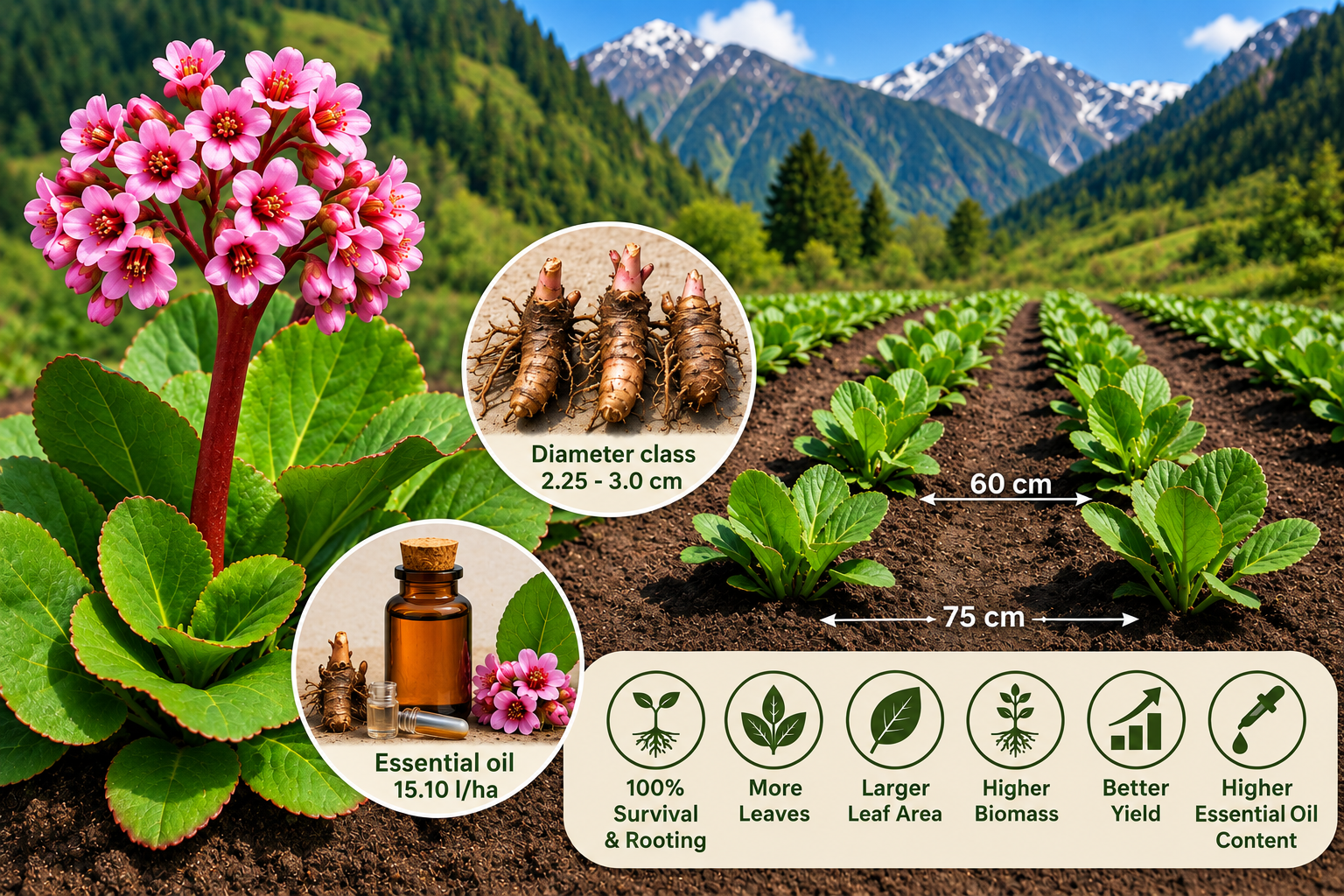
Bergenia ciliata L. is a rhizomatic herb with fleshy leaves, growing up to 30 cm tall has medicinal values, and is used for the treatment of different diseases under traditional and ayurvedic systems since ages. Although Bergenia ciliata is found growing at an altitude of 1200-3000 m in the natural forests of Kashmir Valley. An attempt was made to propagated it in open nursery beds using different diameter classes and spacings. Rhizomes planted in open nursery beds rooted and survived 100 percent during the first growing season, but there was a difference in their growth characteristics. Growth parameters showed an increasing trend with the increase in diameter class and spacing. Rhizomes of higher diameter class 2.25-3.0 cm showed better performance under field conditions at a spacing of 60 cm × 75 cm in terms of survival percentage, rooting percentage, number of leaves per plant, leaf area (cm2), leaf fresh weight (g/plant), root length (cm), rhizome diameter (mm), above-ground biomass (g/plant), below-ground biomass (g/plant) and total biomass (g/plant). Also maximum essential oil content of (15.10 l/ ha, was extracted from leaves and Rhizomes of the harvested material planted in open from the diameter class of (2.25 to 3 cm) and planted at a spacing of ( 60 x 75 cm) D4S4 respectively. It is recommended that the diameter class (2.25-3.0 cm) and spacing of (60 cm × 75) cm should be followed to cultivate Bergenia to get a better yield of the crop and essential oil.
References
[1] G. H. Dar, R. C. Bhagat and M. A. Khan (2002). Biodiversity of the Kashmir Himalaya. Valley Book House, Srinagar, India.
[2] I. Akbar, P. Jahangeer, A. Baba, A. R. Malik and K. Lamo (2011). Traditional and underutilized vegetables of Western Himalayan region of India. Int. J. Curr. Agric. Sci., 1: 15-18.
[3] M. K. Thakur, R. Chauhan and B. Dutt (2010). Effect of Different propagation and planting Techniques on the performance of Picrorhiza kurroa. J. Hill Agric., 1: 43-46.
[4] S. K. Yau and M. Nimah (2004). Spacing effects on corm and flower production of saffron (Crocus sativus). Lebanese Sci. J., 5: 1-8.
[5] R. Nida (2018). Ethno medicinal practices and standardization of propagation techniques of Bergenia ciliata L., in Kashmir. M. Sc. thesis submitted to Faculty of Forestry, Sher-e-Kashmir University of Agricultural Science & Technology of Kashmir, Shalimar.
[6] R. K. S. Tiwari, K. Das, D. Pandey, R. B. Tiwari and J. Dubey (2012). Rhizome yield of Sweet Flag (Acorus calamus L.) as influenced by planting season, harvest time and spacing. Int. J. Agronomy. 10, doi:10.1155/2012/731375.
[7] G. R. Singh, R. L. Meena, V. K. Kaul and B. Singh (2013). Influence of manure and plant spacing on growth and yield of Dioscorea deltoidea wall: an Endangered Species. J. Med. Plants Studs., 1: 184-190.
[8] A. Nigussie, B. Lule and A. Gebre (2015). Effect of Plant population density on growth and yield of Artemisia (Artemisia annua L.). Int. J. Adv. Biol. Biomed. Res., 3: 384-390.
[9] A. Sajad (2017). Standardization of cultivation, harvesting and processing techniques of Artemisia absinthium in Kashmir. M. Sc. thesis submitted to Faculty of Forestry, Sher-e-Kashmir University of Agricultural Science & Technology of Kashmir, Shalimar.
[10] Rayees (2019). Ethno medicinal practices and standardization of propagation techniques of Acorus calmus in Kashmir. M. Sc. thesis submitted to Faculty of Forestry, Sher-e-Kashmir University of Agricultural Science & Technology of Kashmir, Shalimar.
[11] B. R. R. Rao (2002). Biomass yield, essential oil yield and essential oil composition of rose-scented geranium (Pelargonium species) as influenced by row spacing’s and intercropping with corn mint (Mentha arvensis L.f. piperascens Malinv. ex Holmes). Ind. Crops Prod., 16: 133-144.
Downloads
Published
Issue
Section
License
Copyright (c) 2020 Author (s)

This work is licensed under a Creative Commons Attribution-NonCommercial-NoDerivatives 4.0 International License.
Copyright © The Author(s). This is an open access article distributed under the terms of the Creative Commons Attribution-NonCommercial-NoDerivatives 4.0 International License (CC BY-NC-ND 4.0), which permits unrestricted non-commercial use, distribution, and reproduction in any medium, provided the original author(s) and source are properly credited, and the work is not modified or adapted.