Study of heritability, genetic advancement, variability and character association for yield contributing characters in pigeon pea [Cajanus cajan (L.) Millspaugh]
DOI:
https://doi.org/10.31783/elsr.2021.720104Keywords:
genetic advancement, heritability, pigeonpea, variabilityAbstract
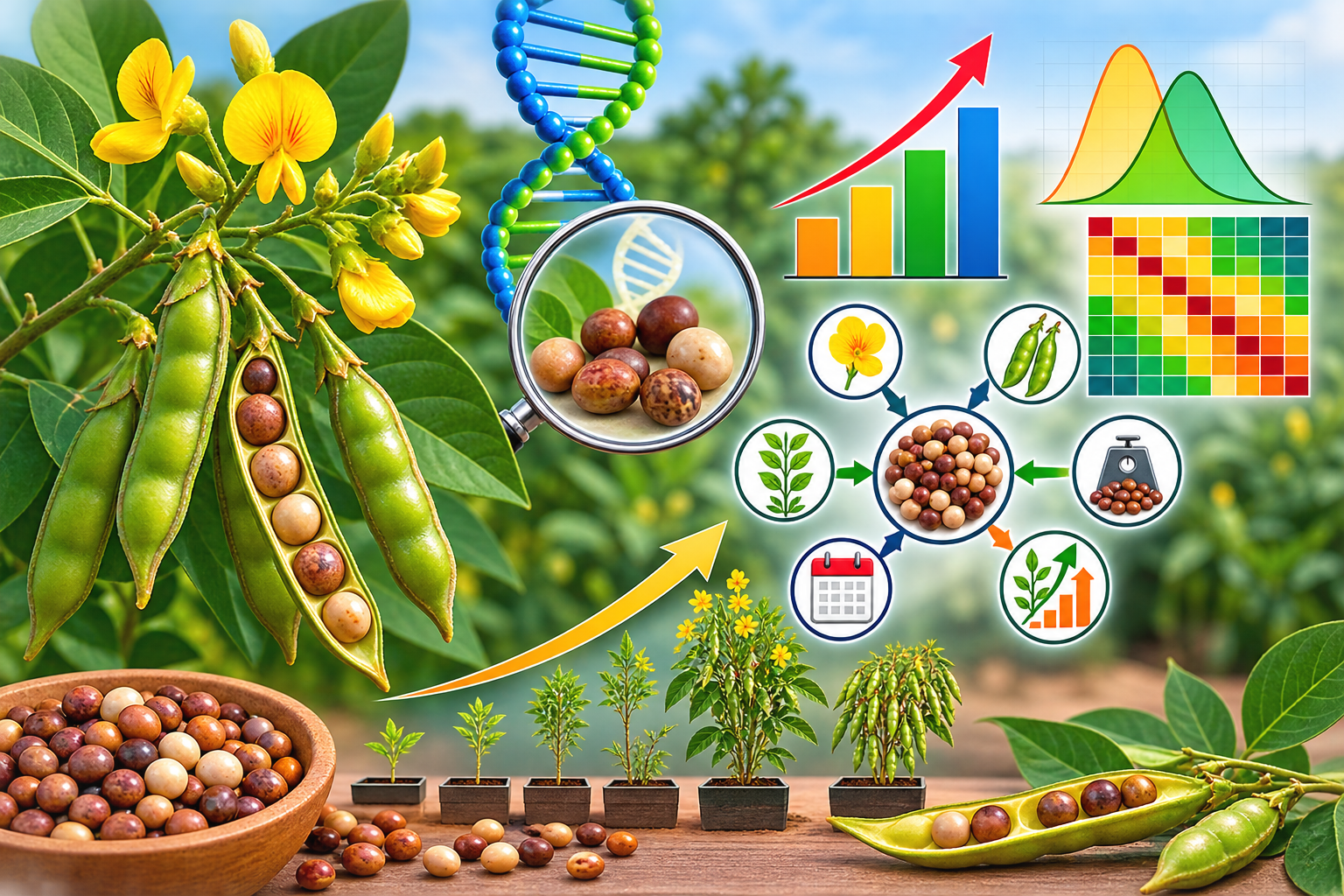
Genetic parameters for yield and its attributes in pigeon pea were estimated in a trial conducted during Kharif 2019 with 23 genotypes of pigeon pea. Genotypes were obtained from S.D.A.U., Sardarkrushinagar, JAU, Junagadh, NAU, Navsari and AAU, Vadodara for evaluation of nine characters related to yield. Low, moderate, and high genotypic and phenotypic coefficients of variations were observed. High genotypic and phenotypic coefficients of variations were expressed by seed yield kg/ha, the number of seeds per pod, pod length, and the number of pods per plant. High heritability coupled with high genetic advancement was observed in the traits such as days to flowering, the number of seeds per pod, pod length, seed yield kg/ha, test weight, and plant height. Based on the obtained results, the selection may be effective for these variable characters. Character association for studied traits indicated that the number of pods per plant, days to flowering, and days to maturity are strongly associated with the seed yield. Hence, due emphasis should be given to the number of pods per plant for the improvement of seed yield in pigeon pea.
References
[1] G. W. Burton (1952). Quantitative inheritance in grasses. Proc. 6th Int. Grassland Cong., 1: 277-283.
[2] J. L. Lush (1940). Intra - sire correlation and regression of offspring on dams as a method of estimating heritability of characters. J. Anim. Sci., 1940: 293 - 301.
[3] H. W. Johnson, H. F. Robinson and R. E. Comstock (1955). Estimation of genetic variability and environmental variability in soybean. Agron. J., 47: 314 - 318.
[4] D. Bhadru (2008). Genetic variability, heritability and genetic advance in pigeon pea
[Cajanus cajan (L.) Millsp.]. Abs. Res. on Crops., 9: 661- 662.
[5] S. S. Sarsamkar, S. B. Borgaonkar, S.V. Kalyankar, B. P. Kadam and G. R. Kadam (2008). Genetic variability studies in pigeon pea [Cajanus cajan (L.) Millsp.]. Int. J. Plant Sciences, 3: 502-503.
[6] V. Shunyu, H. P. Chaturvedi, S. Changkija and J. Singh (2013). Genetic variability in pigeon pea [Cajanus cajan (L) Millsp.] genotypes of Nagaland. Indian Res. J. Genet. Biotech., 5: 165-171.
[7] C. P. Bal, S. G. Bhave, B. L. Thaware and S. S. Desai (2018). Correlation and path analysis studies in pigeon pea (Cajanus cajan). Global J. Biosci. Techn., 7: 70-73
[8] K. Ram, S. Kanak, T. M. Shrimali and B. Geeta (2016). A study on genetic variability, correlation and path analysis in pigeon pea [Cajanus cajan (L.) Millspaugh]. Int. J. Agri. Sci., 8: 2287- 2289.
[9] J. Singh (1999). Correlation coefficient analysis for seed yield in pigeon pea. Crop Res., 17: 381-385.
[10] C. R. Bainiwal, N. Mehrotra and D. S. Jatasra (1981). Studies on variability and correlation in pigeon pea. Indian J. Agric. Res., 15: 161-165.
Downloads
Published
Issue
Section
License
Copyright (c) 2021 Author (s)

This work is licensed under a Creative Commons Attribution-NonCommercial-NoDerivatives 4.0 International License.
Copyright © The Author(s). This is an open access article distributed under the terms of the Creative Commons Attribution-NonCommercial-NoDerivatives 4.0 International License (CC BY-NC-ND 4.0), which permits unrestricted non-commercial use, distribution, and reproduction in any medium, provided the original author(s) and source are properly credited, and the work is not modified or adapted.