A Review on concerns about soil quality and innovative methods for improving soil health
DOI:
https://doi.org/10.31783/elsr.2021.720513Keywords:
microbes, PGPR, soil, soil conservationAbstract
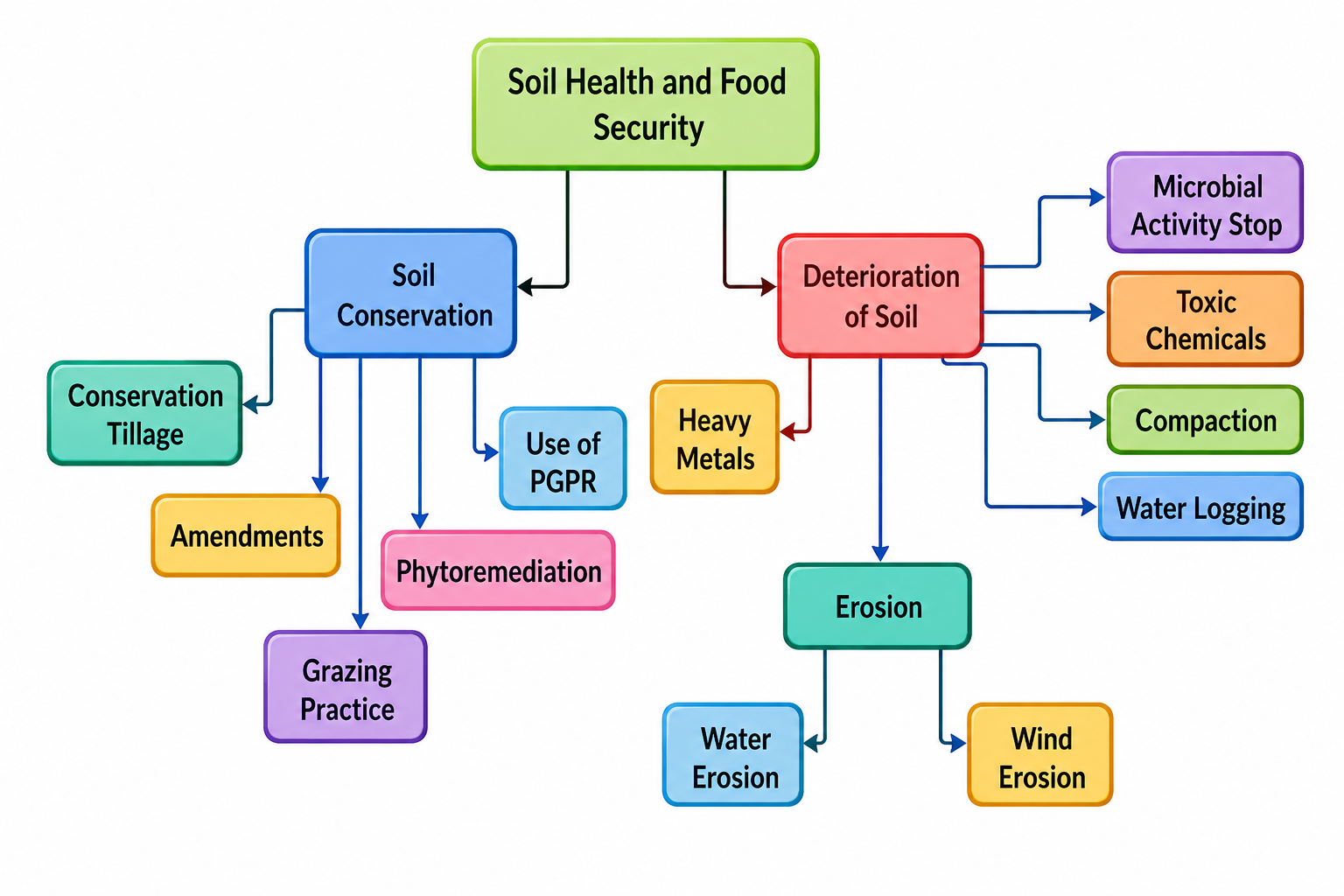
Soil health is a major concern of the agriculture sector, instead of playing a critical role in food production healthy soil encompasses multifunctional capacity viz ecosystem services, nutrient cycling. Rapidly increasing population and urbanization enhance pressure on the farming system which severely affects soil fertility and health. Addressing challenges related to food security has often led to agricultural practices that neglect the soil's multifunctionality and health, resulting in reduced ecosystem service, degraded soils, and eventually, crop failure. Hence, to overcome soil degradation, the use of the innovative method is an effective approach that ameliorates the soil depleted pool against conventional method, have own setbacks. In this review, we have highlighted some innovative methods viz soil amendment, phytoremediation, PGPR as a biocontrol agent, grazing management, and adaption of conservation tillage. In this literature, all these methods have shown efficient results for addressing the soil health conservation and food security challenges from the degraded soils with economic feasibility.
References
[1] M. M. Tahat, M. K. Alananbeh, A. Y. Othman and I. D. Leskovar (2020). Soil health and sustainable agriculture. Sustainability, 12: 4859.
[2] R. Lal (2016). Soil health and carbon management. Food Energy Sec., 5: 212-222.
[3] R. Brackin, S. Schmidt, D. Walter, S. Bhuiyan, S. Buckley and J. Anderson (2017). Soil biological health-what is it and how can we improve it. In Proceedings of the Australian Society of Sugar Cane Tech. 2017, January, Vol. 39, pp. 141-154).
[4] R. D. Bardgett and W. H. Van Der Putten (2014). Belowground biodiversity and ecosystem functioning. Nature, 515: 505-511.
[5] FAO. (2015). Healthy soils are the basis for healthy food production. Rome, Italy: Food and Agriculture Organization of United Nations.
[6] FAO and ITPS (2015). Status of the World’s Soil Resources (SWSR)— Technical Summary. Rome: Food and Agriculture Organization of the United Nations and Intergovernmental Panel on Soils.
[7] N. Labrière, B. Locatelli, Y. Laumonier, V. Freycon and M. Bernoux (2015). Soil erosion in the humid tropics: A systematic quantitative review. Agri. Ecosyst. Enviro., 203: 127-139.
[8] M. A. Oliver and P. J. Gregory (2015). Soil, food security, and human health: a review. Eur. J. Soil Sci., 66(2), 257-276.
[9] K. S. Are (2019). Biochar and soil physical health. Biochar-An Imperative Amendment for Soil and the Environment; IntechOpen: London, UK, pp21-33.
[10] P. C. Baveye, J. Baveye and J. Gowdy (2016). Soil “ecosystem” services and natural capital: critical appraisal of research on uncertain ground. Front. Envir. Sci., 4, 41. https://doi.org/10.3389/fenvs.2016.00041.
[11] P. Smith, M. F. Cotrufo, C. Rumpel, K. Paustian, P. J. Kuikman, J. A. Elliott and M. C. Scholes et al., (2015). Biogeochemical cycles and biodiversity as key drivers of ecosystem services provided by soils. Soil, 1: 665-685.
[12] R. P. Larkin (2015). Soil health paradigms and implications for disease management. Ann. Rev. Phytopathol., 53: 199-221.
[13] M. Livingston, M. J. Roberts and Y. Zhang (2015). Optimal sequential plantings of corn and soybeans underprice uncertainty. Am. J. Agri. Eco., 97: 855-878.
[14] R. Taylor and D. Zilberman (2017). Diffusion of drip irrigation: the case of California. Appl. Econ. Perspect. Policy, 39: 16-40.
[15] J. R. Reeve, L. A. Hoagland, J. J. Villalba, P. M. Carr, A. Atucha, C. Cambardella and K. Delate (2016). Organic farming, soil health, and food quality: considering possible links. Advan. Agron., 137: 319-367.
[16] E. C. Brevik and L. C. Burgess (2012). Soil: influence on human health. Ency. Environ. Manage. CRC Press, pp1-13.
[17] R. Mendes, P. Garbeva and J. M. Raaijmakers (2013). The rhizosphere microbiome: significance of plant beneficial, plant pathogenic, and human pathogenic microorganisms. FEMS microbio. Rev., 37: 634-663.
[18] M. Mihajlović, E. Rekanović, J. Hrustić, M. Grahovac and B. Tanović (2017). Methods for management of soilborne plant pathogens. Pestic. Phytomed., 32: 9-24.
[19] Y. Zhang, C. Ruyter-Spira and H. J. Bouwmeester (2015). Engineering the plant rhizosphere. Curr. Opin. Biotechnol., 32: 136-142.
[20] E. N. Morrison, R. N. Emery and B. J. Saville (2015). Phytohormone involvement in the Ustilago maydis–Zea mays pathosystem: relationships between abscisic acid and cytokinin levels and strain virulence in infected cob tissue. PLoS One, 10: e0130945.
[21] R. M. M. del Rocío, M. A. Pérez-Huitrón, J. L. Ocaña-Monroy, M. G. Frías-De-León, E. H. Martínez, R. Arenas and E. Duarte-Escalante (2016). The habitat of Coccidioides spp. and the role of animals as reservoirs and disseminators in nature. BMC Infect. Dis., 16: 550. https://doi.org/10.1186/s12879-016-1902-7.
[22] D. J. Bays and G. R. Thompson (2021). Coccidioidomycosis. Infect. Dis. Clin. North Am., 35: 453-469. https://doi.org/10.1016/j.idc.2021.03.010.
[23] S. E. Obalum, G. U. Chibuike, S. Peth and Y. Ouyang (2017). Soil organic matter as sole indicator of soil degradation. Environ. Monitor. Syst., 189: 176.
https://doi.org/10.1007/s10661-017-5881-y.
[24] P. Borrelli, D. A. Robinson, L. R. Fleischer, E. Lugato, C. Ballabio, C. Alewell and K. Meusburger et al., (2013). An assessment of the global impact of 21st-century land-use change on soil erosion. Nat. Commun., 8: 2013 (2017). https://doi.org/10.1038/s41467-017-02142-7.
[25] Q. Ji, Y. Wang, X. N. Chen and X. D. Wang (2015). Tillage effects on soil aggregation, organic carbon fractions and grain yield in Eum‐Orthic Anthrosol of a winter wheat–maize double‐cropping system, Northwest China. Soil Use and Manage., 31: 504-514.
[26] J. M. García‐Ruiz, S. Beguería, N. Lana‐Renault, E. Nadal‐Romero and A. Cerdà (2017). Ongoing and emerging questions in water erosion studies. Land Degrad. Dev., 28: 5-21.
[27] A. Khan, S. Khan, M. A. Khan, Z. Qamar and M. Waqas (2015). The uptake and bioaccumulation of heavy metals by food plants, their effects on plants nutrients, and associated health risk: a review. Environ. Sci. Pollut. Res. Int., 22: 13772-13799.
[28] A. Yan, Y. Wang, S. N. Tan, M. L. Y. Mohd, S. Ghosh and Z. Chen (2020). Phytoremediation: a promising approach for revegetation of heavy metal-polluted land. Front. Plant Sci., 11, 359.
[29] S. R. Awad, Z. M. El Fakharany (2020). Mitigation of waterlogging problem in El-Salhiya area, Egypt. Water Sci., 34: 1-12.
[30] S. R. Chowdhury, A. K. Nayak, P. S. Brahmanand, R. K. Mohanty, S. Chakraborty, A. Kumar, and S. K. Ambast (2018). Delineation of Waterlogged Areas using Spatial Techniques for Suitable Crop Management in Eastern India. ICAR Res Bull 79.
[31] M. Simonin and A. Richaume (2015). Impact of engineered nanoparticles on the activity, abundance, and diversity of soil microbial communities: a review. Environ. Sci. Pol. Res., 22: 13710-13723.
[32] L. Zhang, Z. Xie, R. Zhao and Y. Zhang (2018). Plant, microbial community, and soil property responses to an experimental precipitation gradient in a desert grassland. Appl. Soil Eco., 127: 87-95. https://doi.org/10.1016/j.apsoil.2018.02.005.
[33] T. You, D. Liu, J. Chen, Z. Yang, R. Dou, X. Gao and L. Wang (2018). Effects of metal oxide nanoparticles on soil enzyme activities and bacterial communities in two different soil types. J. Soils Sed., 18: 211-221.
[34] A. Manyevere, L. Munjonji, C. Bangira, J. Gotosa and E. Chikwari (2015). Characteristics and management options of crusting soils in a smallholder farming area of the Zambezi metamorphic belt in northern Zimbabwe. S. Afr. J. Plant Soil, 32: 157-164.
[35] K. W. T. Goulding (2016). Soil acidification and the importance of liming agricultural soils with reference to the United Kingdom. Soil Use Manag., 32: 390-399.
[36] P. I. Devi, J. Thomas and R. K. Raju (2017). Pesticide consumption in India: A spatiotemporal analysis. Agri. Econ. Res. Rev., 30: 163-172.
[37] S. Saha, B. N. Saha, G. C. Hazra, S. Pati, B. Pal, D. Kundu and A G. Bag (2018). Assessing the suitability of sewage-sludge produced in Kolkata, India for their agricultural use. Proc. Indian. Natn. Sci. Acad., 84: 781-792.
[38] Y. S. Shivay and A. A. Shahene (2021). Soil Health and Its Improvement through Novel Agronomic and Innovative Approaches. Front. Agron., 3: 680456. https://doi.org/10.3389/fagro.2021.680456.
[39] R. A. Ansari, I. Mahmood, R. Rizvi, A. Sumbul and Safiuddin (2017). Siderophores: Augmentation of Soil Health and Crop Productivity. In: Kumar V., Kumar M., Sharma S., Prasad R. (eds) Probiotics in Agroecosystem. Springer, Singapore. https://doi.org/10.1007/978-981-10-4059-7_15.
[40] M. Akram, R. Rizvi, A. Sumbul, R. A. Ansari and I. Mahmood (2016). Potential role of bioinoculants and organic matter for the management of root-knot nematode infesting chickpea. Cogent. Food Agric., 2: 1183457. https://doi.org/10.1080/23311932.2016.1183457.
[41] R. Rizvi, R. A. Ansari, G. Zehra and I. Mahmood (2015). A farmer friendly and economic IPM strategy to combat root-knot nematodes infesting lentil. Cogent. Food Agric., 1: 1053214. https://doi.org/10.1080/23311932.2015.1053214.
[42] Y. Hadarand R. Mandelbaum (1992). Suppressive compost for biocontrol of soilborne plant pathogens. Phytoparas., 20: S113-S116.
[43] R. M. Muchovej and R. S. Pacovsky (1997). Future directions of by-products and wastes in agriculture.
[44] A. Tränkner (1992). Use of Agricultural and Municipal Organic Wastes to Develop Suppressiveness to Plant Pathogens. In: Tjamos E.C., Papavizas G.C., Cook R.J. (eds) Biological Control of Plant Diseases. NATO ASI Series (Series A: Life Sciences), vol 230. Springer, Boston, MA. https://doi.org/10.1007/978-1-4757-9468-7_4.
[45] J. Wang, H. Liu, X. Wu, C. Li and X. Wang (2017). Effects of different types of mulches and legumes for the restoration of urban abandoned land in semi-arid northern China. Ecol. Eng., 102: 55-63.
[46] T. Pardo, M. P. Bernal and R. Clemente (2017). Phytostabilisation of severely contaminated mine tailings using halophytes and field addition of organic and inorganic amendments. Chemosphere, 178: 556-564.
[47] B. V. Aken and S. L. Doty (2011). Transgenic plants and associated bacteria for phytoremediation of chlorinated compounds. Biotechnol. Genet. Eng. Rev., 26: 43-64.
[48] A. Yan, Y. Wang, S, N. Tan, M.L. Yusof, F. Ghosh and Z. Chen. (2020). Phytoremediation: a promising approach for revegetation of heavy metal-polluted land. Front. Plant Sci., 11: 359. https://doi.org/10.3389/fpls.2020.00359.
[49] P. Kaur and L. Kaur (2019). Effects of dangerous chemicals present in the environment on the health of rural peoples in the southwestern region of Punjab. J. Pharmacogn. Phytochem., 8: 159-162.
[50] S.C. Kiran, C. Nagarajaiah, M. M. Murthy and P.C Ranjith. (2020). Effect of municipal solid waste open dumping on soil, water, crop, human health and its prospective. Int. J. Environ. Clim. Change, 10: 36-45.
[51] D. Kumar, Y.S Shivay, D. Shiva, C. Kumar and R. Prasad (2013). RPhizospheric flora and influence of agronomic practices on them: a review. Proc. Natl. Acad. Sci. India Sect. B Biol. Sci., 83: 1-14.
[52] S. Jamuna and C. M. Noorjahan (2009). Treatment of Sewage WasteWater Using Water Hyacinth - Eichhornia spp. and Its Reuse for Fish Culture., Toxicol. Int., 16: 103-106.
[53] H. Xia and X. Ma (2006). Phytoremediation of ethion by water hyacinth (Eichhornia crassipes) from water., Bioresour. Technol., 97: 1050-1054.
[54] G. S. Raupach and J. W. Kloepper (2000). Biocontrol of cucumber diseases in the field by plant growth promoting rhizobacteria with and without methyl bromide fumigation. Plant Dis., 84: 1073-1075.
[55] S. Compant, B. Duffy, J. Nowak, C. Clément and E. A. Barka (2005). Use of plant growth-promoting bacteria for biocontrol of plant diseases: principles, mechanisms of action, and future prospects. Appl. Environ. Microbio., 71: 4951-4959.
[56] F.C. Pérez-Montaño, Alías-Villegas, R. A. Bellogín, P. Del Cerro, M. R. Espuny, I. Jiménez-Guerrero and F.J.López-Baena et al., (2014). Plant growth promotion in cereal and leguminous agricultural important plants: from microorganism capacities to crop production. Microbiol. Res., 169: 325-336.
[57] A. J. A. Y. Kumar, R. S. Vandana, M. O. I. K. A. Singh and K. D. Pandey (2015). Plant growth promoting rhizobacteria (PGPR). A promising approach for disease management. Microbes and environ. Manage. Studium Press, New Delhi, 195-209.
[58] A. Heydari and M. Pessarakli (2010). A review on biological control of fungal plant pathogens using microbial antagonists. J. biolgical. Sci., 10: 273-290.
[59] G. Shobha and B. S. Kumudini. (2012). Antagonistic effect of the newly isolated PGPR Bacillus spp. on Fusarium oxysporum. Int. J. Appl. Sci. Eng. Res., 1: 463-474.
[60] A. Kassam, T. Friedrich and R. Derpsch. (2019). Global spread of conservation agriculture. Int. J. Environ. Stud., 76: 29-51.
[61] M. A. Busari, S. S. Kukal, A. Kaur, R. Bhatt and A. A. Dulazi (2015). Conservation tillage impacts on soil, crop and the environment. Int. Soil Water Conserv. Res., 3: 119-129.
[62] J. G. Davis (1994). Managing plant nutrients for optimum water use efficiency and water conservation. Advan. In Agron., 53: 85-120.
[63] F. R. Boone and B. W. Veen (1994). Mechanisms of crop responses to soil compaction. In Devel in Agri. Engin. Vol. 11, pp. 237-264. Elsevier.
[64] R. Lal (1993). Tillage effects on soil degradation, soil resilience, soil quality, and sustainability. Soil Tillage Res., 27: 1-8.
[65] R. T. Conant, C. E. P. Cerri, B. B. Osborne and K. Paustian (2017). Grassland management impacts on soil carbon stocks: a new synthesis. Ecol. Appl., 27: 662-668.
[66] J. F. Soussana, T. Tallec and V. Blanfort (2010). Mitigating the greenhouse gas balance of ruminant production systems through carbon sequestration in grasslands. Animal, 4: 334-350.
[67] EPA (2019). Inventory of U.S. Greenhouse Gas Emissions and Sinks 1990-2017. U.S. Environ. Protect. Agency.
[68] K. A. Beauchemin, H. H. Janzen, S. M. Little, T. A. McAllister and S. M. McGinn (2011). Mitigation of greenhouse gas emissions from beef production in western Canada–evaluation using farm-based life cycle assessment. Anim. Feed Sci. Technol., 166-167: 663-677.
[69] P. L. Stanley, J. E. Rowntree, D. K. Beede, M. S. DeLonge and M.W. Hamm (2018). Impacts of soil carbon sequestration on life cycle greenhouse gas emissions in Midwestern USA beef finishing systems. Agric. Syst., 162: 249-258.
[70] J. D. Derner and G.E. Schuman (2007). Carbon sequestration and rangelands: a synthesis of land management and precipitation effects. J. Soil Water Conserv., 62: 77-85.
[71] R. Lal (2004). Soil carbon sequestration to mitigate climate change. Geoderma, 123: 1-22.
[72] G. Pan, P. Smith and W. Pan (2009). The role of soil organic matter in maintaining the productivity and yield stability of cereals in China. Agric. Ecosyst. Environ., 129: 344-348.
[73] P. Smith, S. J. Davis, F. Creutzig, S. Fuss, J. Minx, B. Gabrielle and E. Kato (2016). Biophysical and economic limits to negative CO2 emissions. Nat. Clim. Change, 6: 42-50.
[74] S. Wang, A. Wilkes, Z. Zhang, X. Chang, R. Lang, Y. Wang and H. Niue (2011). Management and land use change effects on soil carbon in northern China’s grasslands: a synthesis. Agric. Ecosyst. Environ., 142: 329–340.
[75] W. Chen, D. Huang, N. Liu, Y. Zhang, W. B. Badgery, X. Wang and Y. Shen (2015). Improved grazing management may increase soil carbon sequestration in temperate steppe. Sci. Rep. 5:10892. https://doi.org/10.1038/srep10892.
[76] S.D. Fuhlendorf, W. C. Harrell, D. M. Engle, R. G. Hamilton, C. A. Davis and D. M. Leslie. (2006). Should heterogeneity be the basis for conservation?Grassland bird response to fire and grazing. Ecol. Appl., 16: 1706–1716.
[77] R. Teague, F. Provenza, U. Kreuter, T. Steffens and M. Barnes (2013). Multipaddock grazing on rangelands: why the perceptual dichotomy between research results and rancher experience. J. Environ. Manage., 128: 699-717.
Downloads
Published
Issue
Section
License
Copyright (c) 2021 Author (s)

This work is licensed under a Creative Commons Attribution-NonCommercial-NoDerivatives 4.0 International License.
Copyright © The Author(s). This is an open access article distributed under the terms of the Creative Commons Attribution-NonCommercial-NoDerivatives 4.0 International License (CC BY-NC-ND 4.0), which permits unrestricted non-commercial use, distribution, and reproduction in any medium, provided the original author(s) and source are properly credited, and the work is not modified or adapted.