Effect of period on service period and dry days length of Jersind crosses
DOI:
https://doi.org/10.31783/elsr.2022.813542Keywords:
dry days length, Jersind, service periodAbstract
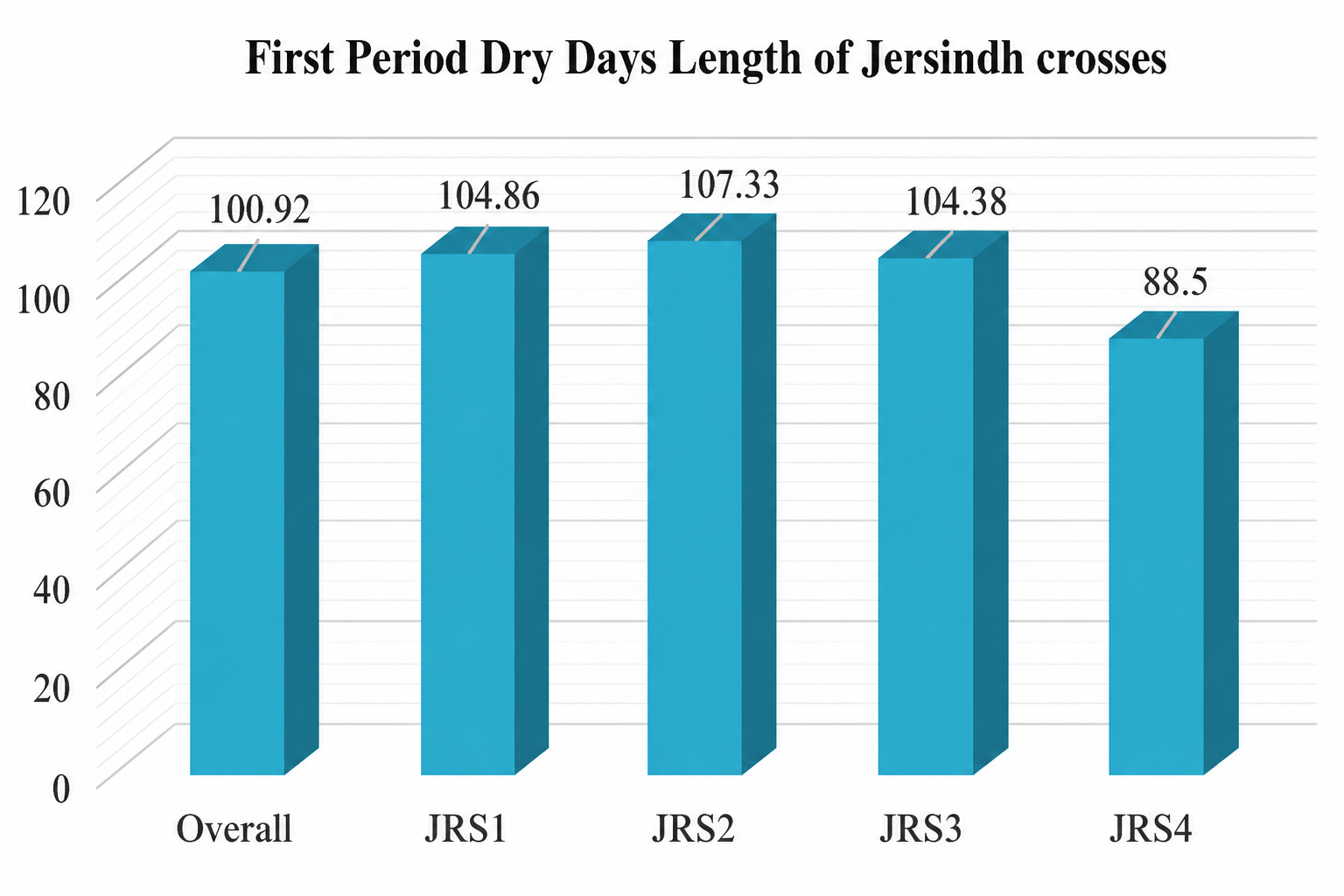
The study was carried out in the Department of Animal Husbandry and Dairying, Dairy Farm, SHUATS, District – Prayagraj, Utter Pradesh. The objective of the study was to evaluate the effect of periods on service period and dry days length of Jersind crosses. All the data were collected from the history records of Jersind crosses. Four Cross Groups were selected for the study 1/2 J X 1/2 RS - (JRS1), 3/8 J X 5/8 RS - (JRS2), 1/4 J X 3/4 RS - (JRS3), and 1/8 J X 7/8 RS - (JRS4). It was observed that the mean first period, service period was 104.86 ± 3.8 days, 107.33 ± 8.25 days, 104.38 ± 3.12 days, and 88.50 ± 5.1 days in JRS1, JRS2, JRS3, and JRS4. The mean second period, service period was 110.00 ± 4.76 days, 84.75 ± 4.2 days, 109.30 ± 3.5 days, and 85.20 ± 7.55 days in JRS1, JRS2, JRS3, and JRS4. The mean third period, service period was 107.00 ± 6.99 days, 113.33 ± 2.88 days, 84.57 ± 5.79 days, and 116.83 ± 4.57 days in JRS1, JRS2, JRS3, and JRS4. The mean first period, dry days length was observed 62.14 ± 1.13 days, 60.33 ± 0.98 days, 65.88 ± 1.72 days, and 62.00 ± 1.4 days in JRS1, JRS2, JRS3, and JRS4. The mean second period, the dry days' length was 59.60 ± 1.88 days, 60.50 ± 2.84 days, 62.20 ± 1.56 days, and 63.60 ± 1.08 days in JRS1, JRS2, JRS3, and JRS4. The mean third period, dry days length was 61.60 ± 1.40 days, 62.00 ± 0.94 days, 63.14 ± 2.86 days, and 65.50 ± 2.12 days in JRS1, JRS2, JRS3, and JRS4. In reproductive traits period indicated a significant effect on the second and third period service period, whereas indicated a non-significant on first, second, and third period dry days length of Jersind crosses (JRS1, JRS2, JRS3, and JRS4).
References
[1] S. K. M. A. Islam, M. A. Zhoque, M. R. Alam, M. M. Hassan and M. A. Rehman (2006). A cross – sectional study on productive performance of stall fed dairy cattle at central cattle breeding station (CCBS), Savar, Dhaka, Bangl. J. Vet. Med. 4: 61-63.
[2] K. P. Japheth, R. K. Mehla, M. Singh, A. K. Gupta, R. Das, P. Bharti and T. Chandrasekar (2016). Optimizing of dry period in Karan Fries Cow. Vet. World. 9: 648-652.
[3] L. R. Schafer and C. R. Henderson (1972). Effect of days dry and days open on Holstein milk production. Int. J. Dairy Sci., 55: 107-112.
[4] H. K. Kunbhar, S. M. Sharif, A. A. Memon, S. H. Abro, R. Abro, V. Suthar and G. A. Mughal (2016). Reproductive performance of Bhagnari cattle breed managed under semi-intensive management condition. Pure Appl. Biol., 5: 615-621.
[5] M. Chaudhari, R. Kumar, A. K. Khanna., D. S. Dalal and A. Jakhar (2013). Genetic studies on reproduction traits in crossbred cattle. Haryana Vet., 52: 75-78.
[6] P. S. Dangi, R. Singh, R. K. Pundir, A. Singh, V. Choudhary and N. K. Varma (2013). Study on various performance traits in Rathi cattle. Indian J. Animal Res., 47: 321-326.
[7] S. S. Bhutkar., B. M. Thombre and D. V. Bainwad (2014). Studied on effect of non-genetic factors on reproduction traits in Holstein Friesian x Deoni Cows. IOSR J. Agric. Vet. Sci., 7: 15-19.
[8] K. Kishor, R. K. Joshi, P. Kumar and R. S. Pal (2016). Genetic and non-genetic factors affecting some productive and reproductive traits in Tharparkar cattle. Vet. Pract., 17: 38-40.
[9] J. Ur Rahman; D. Kumar, Bijendra N. Shahi, A. K. Ghosh., S. P. Singh., R. K. Sharma and A. Kumar et al., (2021). Assessment of non-genetic factors affecting production and reproduction traits in Badri cattle, Journal Animal Res., 11: 375-380.
[10] A. Sarkar, K. C. Dhara, N. Ray, A. Goswami and S. K. Ghosh (2007). Physical characteristics, productive and reproductive performances of comparatively high yielding Deshi Cattle of West Bengal, India. Livest. Res. Rur. Dev., 19: Article #122. http://www.lrrd.org/lrrd19/9/sark19122.htm.
[11] S. R. Zol; U. Y. Bhoite, S. T. Pachpute and D. K. Deokar (2009). Reproduction and production performance and breeding efficiency of Phule Triveni Triple crossbred cows. J. Maharashtra agric. Univ., 34: 208- 210.
[12] Japheth, K.P.; Mehla, R.K.; Imtiwati and S. A. Bhat (2015). Effect of non-genetic factors on various economic traits in Karan Fries crossbred cattle. Indian J. Dairy Sci., 68: 163-169.
[13] P. P. Dubey and C. V. Singh (2005). Estimates of genetic and phenotypic parameters considering first lactation and lifetime traits in Sahiwal and crossbred cattle. Indian J. Animal Sci., 75: 1289-1294.
[14] Md. A. Islam.; Md. J. U. Sarder, S. S. Jahan, Md. R. Islam and Md. H. Islam (2015). Effect of management factors on the productive and reproductive performance of dairy cows. Bangladesh livestock J., 1: 5-9.
[15] M. J. A. Mamun, M. A. S. Khan, M. A. H. Sarker, M. N. Islam (2015). Productive and reproductive performance of Holstein Friesian crossbred and indigenous cow under small holder farming system. Bang. J. Anim. Sci., 44: 166-170.
[16] T. V. Raja and R. S. Gandhi (2015). Factors influencing productive and reproductive performance of Sahiwal cattle maintained under organized farm conditions. Indian J. Animal Sci., 85: 628-633.
[17] W. Zewdu., B. M. Thombre, D. V. Bainwad (2015). Studies on some non-genetic factors affecting reproductive performance of Holstein Friesian × Deoni crossbred cows. Afr. J. Agric. Res., 10: 1508-1516.
Downloads
Published
Issue
Section
License
Copyright (c) 2022 Author (s)

This work is licensed under a Creative Commons Attribution-NonCommercial-NoDerivatives 4.0 International License.
Copyright © The Author(s). This is an open access article distributed under the terms of the Creative Commons Attribution-NonCommercial-NoDerivatives 4.0 International License (CC BY-NC-ND 4.0), which permits unrestricted non-commercial use, distribution, and reproduction in any medium, provided the original author(s) and source are properly credited, and the work is not modified or adapted.