Popularization of Bivoltine sericulture among tribal folk of Jammu and Kashmir with special reference to Poonch District
DOI:
https://doi.org/10.31783/elsr.2022.814349Keywords:
cocoons, sericulture, tribal folks, yieldAbstract
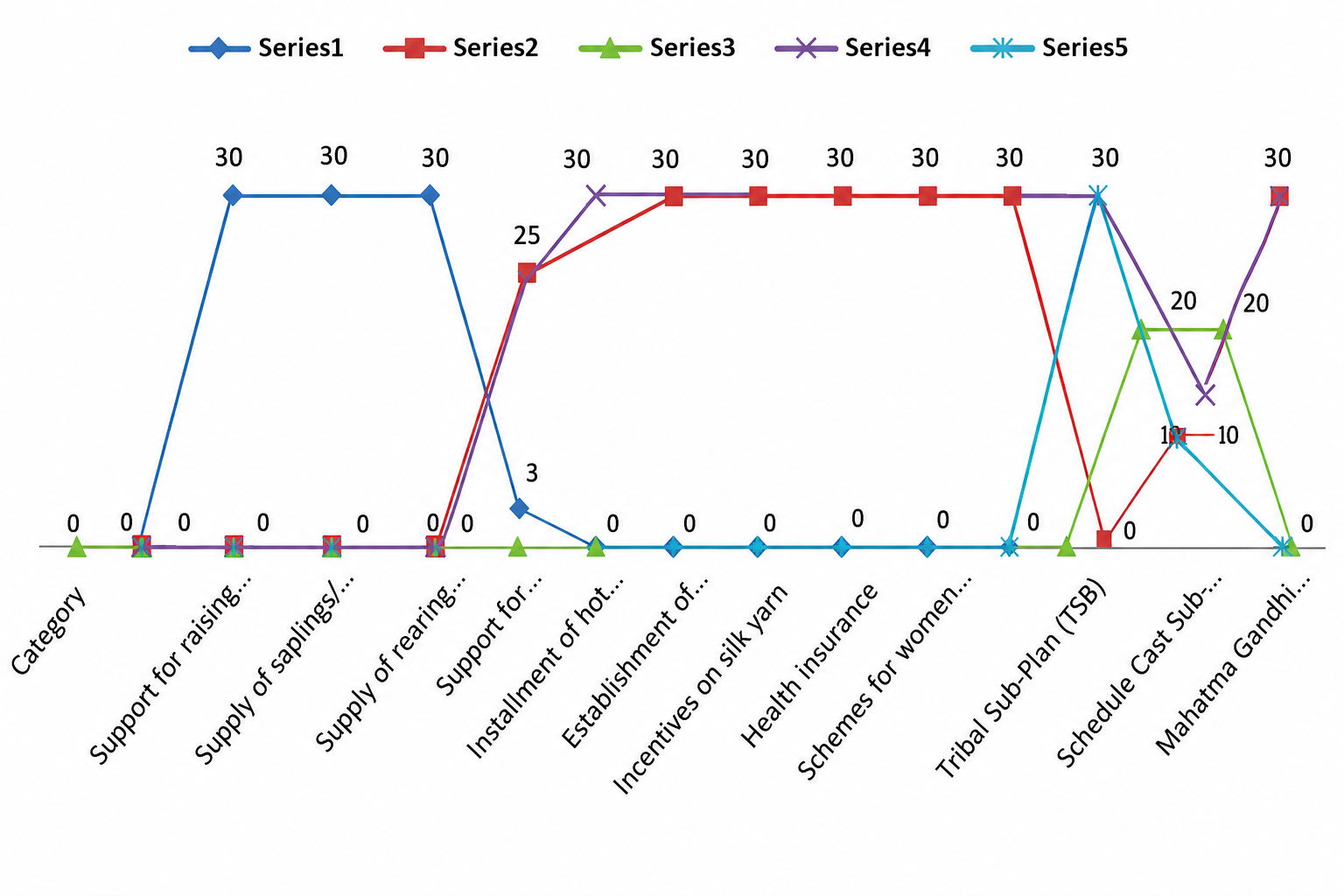
Sericulture is the living culture among the rural and tribal folks of Jammu and Kashmir having world-class quality characteristics. Due to various reasons, silk farming has received an unfortunate decline during the last few years. The current survey study was formularized to evaluate the constraints responsible for the expected yield gap and for formulating future strategies to popularize the concept of silkworm rearing among the tribal folks for strengthening their livelihood. The results depicted the total production to be highest for the year 2019 with234 kg of cocoon yield followed by 2017 with 221kg of cocoons and least for the year 2015 with 155kg cocoons and the net income and profit to the farmers was reported to be highest in the year 2015 as Rs. 27700 and Rs. 14200 respectively. The survey indicated that the majority of the sericulture farmers belong to the general category constituting 86.6 percent of the total number of farmers followed by schedule caste and schedule tribe both constituting only three percent of the total respondents indicating the need for the popularization of this agro-enterprise among the marginal farmers belonging to various underprivileged communities. Therefore, considering the utmost significance of sericulture in boosting the rural livelihood, an attempt has been carried out to emphasize the role of sericulture among tribal folks hailing in Poonch District, for the revitalization of the bivoltine silk industry in Jammu and Kashmir specifically among marginal farmers.
References
[1] B. T. Sreenivas, A. Umesha, M. T. Himantharaj, Jaishankar, S. M. H. Qadri and C. K. Kamble. (2009). Impact of IVLP on mulberry leaf and cocoon yield at farmer’s level. J. Ext. Management, 10: 93-98.
[2] B. T. Sreenivas, A. Umesha, M. T. Himantharaj, Jaishankar, S. M. H. Qadri, and C. K. Kamble (2010). Institute village linkage programme in sericulture and its impact on productivity and adoption of sericulture technologies at farmers level. J. Exp. Zool. India, 13: 143-146.
[3] C. E. Girish, K.S. Kadian, B.S. Meena and K. Mandi (2020). Knowledge assessment of farmers regarding sericulture based Dairy Farming in Karnataka State. Asian J. Agric. Ext. Economics Sociol., 38: 16-20.
[4] G. A. Khan, S N. Ah. Saheb, A. Ah. Shabnam, H. Rashid and M. K. Ghos (2018). Institute village linkage programme- A participatory approach for the development of sericulture in India. Int. J. Adv. Eng. Res. Sci., 7: 2155-2162.
[5] H. Singh and R. H. Andrabi (2015). Spatial differentiation in agricultural development in Jammu and Kashmir: a geographical approach. Int. J. Sci. Res. Publications, 5: 1-9.
[6] Jaishankar and S. B. Dandin (2005). Socio economic attributes in the adoption of improved sericultural technologies by farmers in Kolar district. Indian J. Seric., 47: 155-160.
[7] K. Fatima (2013). Trends in cocoon and silk production in Jammu and Kashmir state- A case of concern. Int. J. Recent Sci. Res., 4: 1826-1830.
[8] B. K. Neelaboina, G. A. Khan, M. Gani, S. Ahmed, M. N. Ahmed and M. K. Ghosh. (2018). Exploration of sericulture in unexplored region of Jammu and Kashmir. J. Entomol. Zool. Stud., 6: 1922-1925.
[9] L. Ali, S. K. Kher, P. S. Slathia, L. K. Sharma, P. K. Sharma and S. Kumar (2017). Sericulture in hills: contribution to economy of small and marginal farmers in hills of Jammu (J&K). Maharashtra Jn. of Agril. Economics. 20: 150-153.
[10] M. A. Khan, A. Dhar and N. A. Mir (2010). Constraints and strategies for multiple cocoon crops in J&K State. Work shop on multiple cocoon crops for sustainable sericulture in J&K state organized by Directorate of sericulture, Sericulture Development Department J&K and CSRTI, Pampore on October 18, 2010, 4-8.
[11] M. C. Langerodi, I. Malakmohammad, M. Chizari and M. Seidavi (2012). Sericulture extension structural equation modeling to revitalizing silkworm cocoon production in Iranian sericulture view. Afr. J. Agric. Res., 7: 607-615.
[12] N. Ahmed, M. Abbas, A. Malik, A. H. Akhand, B. A. Lone and L. Ali (2017). Traditional handloom of Kargil District, Ladakh. British J. Economics, Management Trade, 17: 1-8.
[13] S. Chanotra, K. Bali and R. K. Bali (2019). Sericulture: an opportunity for the upliftment of rural livelihood. J. Entomol. Zool. Stud., 7: 1100-1103.
[14] S. Chanotra, S. Devi and M. A. Bhat (2021). Sericulture as an important agro-enterprise for the marginal farmers. Guj. J. Ext. Edu., 32: 195-201.
[15] S. Chouhan, V. Mittal, Babular, S. P. Sharma and M. Gani (2016). Situation analysis of sericulture industry in Jammu and Kashmir. Bio Bulletin, 2: 52-57.
[16] S. A. Dar, R. Akhter and S. M. Geelani (2017). Impact of sericulture industry of Jammu and Kashmir economy: (With Special reference to District Baramulla). Int. J. Multi. Edu. Res., 2: 60-64.
[17] A. Sharma, S. Chanotra, R. Gupta, R and R. Kumar (2020). Influence of climate change on cocoon crop loss under subtropical conditions. Int. J. Curr. Microbiol. App. Sci., 9: 167-171.
[18] M. Aslam, D. Mohammad and D. Singh (2020). Organizational setup, status and prospect of sericulture Industry in Haryana. EPRA Int. J. Res. Dev., 5: 2455-7838.
Downloads
Published
Issue
Section
License
Copyright (c) 2022 Author (s)

This work is licensed under a Creative Commons Attribution-NonCommercial-NoDerivatives 4.0 International License.
Copyright © The Author(s). This is an open access article distributed under the terms of the Creative Commons Attribution-NonCommercial-NoDerivatives 4.0 International License (CC BY-NC-ND 4.0), which permits unrestricted non-commercial use, distribution, and reproduction in any medium, provided the original author(s) and source are properly credited, and the work is not modified or adapted.