Spatial variability assessment and mapping of soil properties for sustainable agricultural production using remote sensing technology and Geographic Information Systems (GIS)
DOI:
https://doi.org/10.31783/elsr.2022.815059Keywords:
crop rotations, kharif crop, soil propertiesAbstract
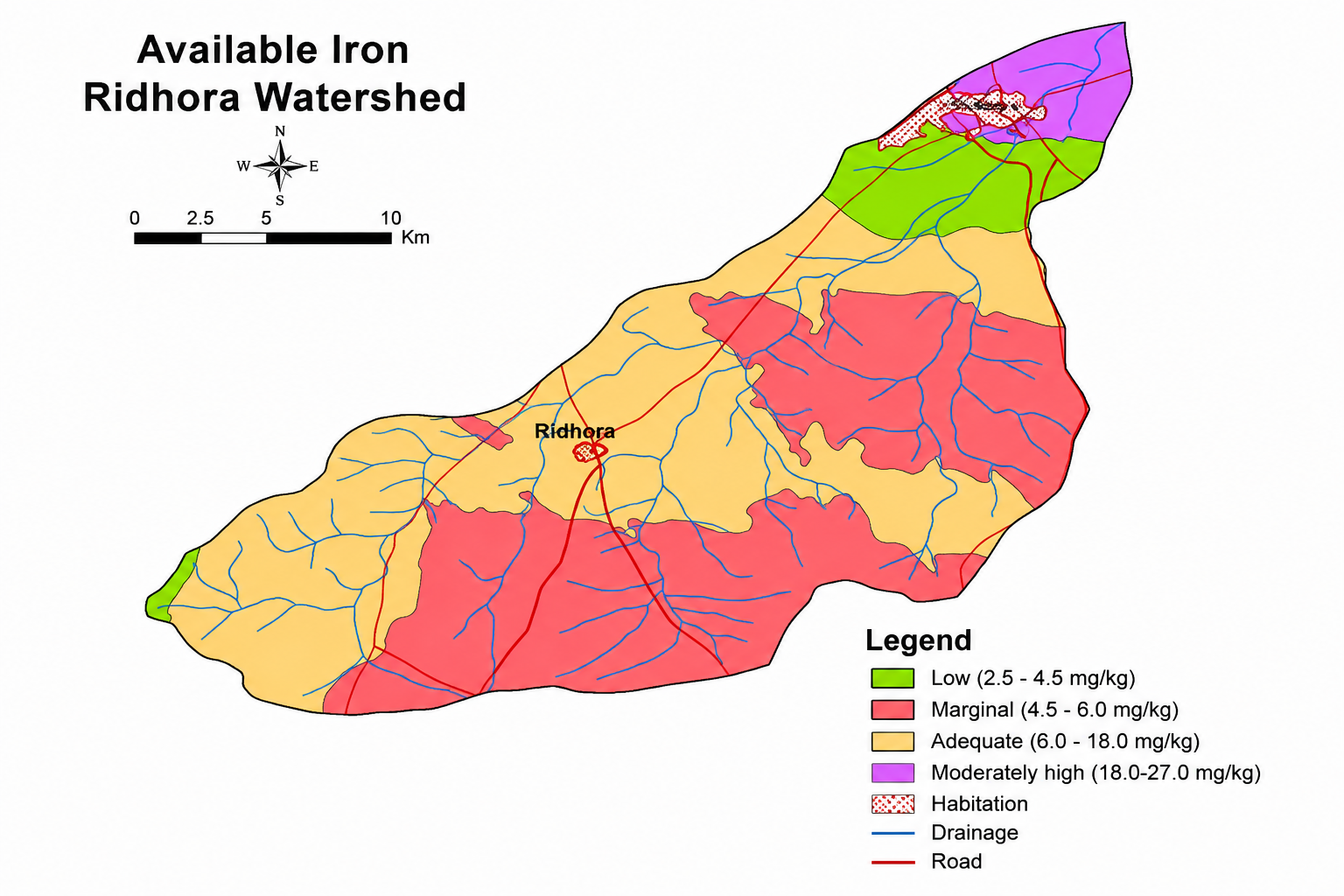
Low knowledge of the suitability of land in agricultural production is a major problem for land users. To better assess soil distribution structures, remote sensing and the use of geographic information systems (GIS) are considered the most effective tools to achieve this goal. In this paper, we investigated the spatial variability of some soil chemical and fertility properties in the Ridhora watershed of Nagpur, Maharashtra region, India. From the study area 59 Soil samples were collected using a systematic sampling strategy from 0 to 15 cm below the surface at a regular grid spacing of 1km× 1km with different vegetation cover and all the samples were transported to the laboratory After the creation of standard data, Statistical analysis was used to describe the soil structure, geostatistical statistical analysis was used to describe the spatial correlation of soil properties, and the spatial distribution of these structures was adjusted using mapping techniques. The results showed that in the study area the variability of soil fertility was low to moderate N; Available P ranges from low to high and available K ranges from moderately high to very high. Available Zn and Fe showed deficiency in 60.9% and 7.40% of the study area, respectively.
References
[1] D. Vasu, S. K. Singh, S. K. Ray, V. P. Duraisami, P. Tiwary, P. Chandran and A. M. Nimkar et al., (2016). Soil quality index as a tool to evaluate crop productivity in semi-arid Deccan plateau, India. Geoderma, 282: 70-79.
[2] C. S. Rao, R. Lal, Jasti V. N. S. Prasad, K. A. Gopinath, R. Singh, V. S. Jakkula and K. L. Sahrawat et al., (2015). Potential and challenges of rainfed farming in India." In Advances in agronomy. pp113-181. Academic Press.
[3] C. A. Cambardella and E. T. Elliott (1992). Particulate soil organic-matter changes across a grassland d cultivation sequence. Soil Sci. Soc. Am. J., 56: 777-783.
[4] R. Lal, A. A. Mahboubi and N. R. Fausey (1994). Long-term tillage and rotation effects on properties of a central Ohio soil. Soil Sci. Soc. Am. J., 58: 517-522.
[5] I. A. Jaiyeoba (2003). Changes in soil properties due to continuous cultivation in Nigerian semiarid savannah. Soil Tillage Res., 70: 91-98.
[6] S. A. Materechera and T. S. Mkhabela (2001). Influence of land-use on properties of a ferralitic soil under low external input farming in southeastern Swaziland. Soil Tillage Res., 62: 15-25.
[7] A. Paz-Gonzalez, S. R. Vieira and M. T. T. Castro (2000). The effect of cultivation on the spatial variability of selected properties of an umbric horizon. Geoderma, 97: 273-292.
[8] G. Dunjo, G. Pardini and M. Gispert (2003). Land use change effects on abandoned terraced soils in a Mediterranean catchment. NE Spain. Catena, 52: 23-37.
[9] K. Y. Chan and N. R. Hulugalle (1999). Changes in some soil properties due to tillage practices in rainfed hardsetting Alfisols and irrigated Vertisols of eastern Australia. Soil Tillage Res., 53: 49-57.
[10] C. A. Cambardella and D. L. Karlen (1999). Spatial analysis of soil fertility parameters. Precis. Agric, 1: 5-14.
[11] S. W. Buol, R. J. Southard, R. C. Graham and P. A. McDaniel (2011). Soil Genesis and Classification. Iowa State University Press, John Wiley & Sons.
[12] G. Brown A. C. D. Newman J. H. Rayner and A. H. Weir (1978). The structure and chemistry of soil clay minerals: in The Chemistry of Soil Constituents, D. J. Greenland and M. H. B. Hayes, eds., Wiley, New York, pp. 29-178.
[13] D. Liu, Z. Wang, B. Zhang, K. Song, X. Li, J. Li and F. Li et al., (2006). Spatial distribution of soil organic carbon and analysis of related factors in croplands of the black soil region, Northeast China. Agric. Ecosyst. Environ., 113: 73-81.
[14] W. Wilcke (2000). Small-Scale variability of metal concentrations in soil Leachates. Soil Sci. Soc. Am. J., 64: 138-143.
[15] M. Qu W. Li and C. Zhang (2014). County-Scale spatial variability of macronutrient availability ratios in Paddy soils. Applied Environ. Soil Sci., 10: 482-492.
[16] A. Walkley and I. A. Black (1934). An examination of the Degtjareff method for determining soil organic matter, and a proposed modification of the chromic acid titration method. Soil Sci., 37: 29-38.
[17] B. V. Subbaiah G. L. Asija (1956). Rapid procedure for estimation of available nitrogen in soil. Current Sci., 25:259-260.
[18] G. W. Olsen (1981). Soil and Environment– A guide to soil surveys and their applications. Chapman and Hall, New York.
[19] W. L. Lindsay and W. A. Norvel (1978). Development of DTPA soil test zinc, iron, manganese and copper. Soil Sci. Soc. Am. J., 42: 421-448.
[20] P. D. K. V (2008). Krishi Samwadini, Annual Diary, The Panjabrao Deshmukh Krishi Vidyapeeth, Akola (M.S.).
[21] M. V. Singh (2006). Micro and Secondary Nutrients and Pollutants Elements Research in India. Co-ordinator Report AICRP Micro and Secondary Nutrients and Pollutants Elements in Soil and Plants. IIss, Bhopal.
[22] P. N. Takkar, I. M. Chhibba and S. K. Mehta (1989). Twenty years of coordinated research on micronutrients in soil and plant. Bull., Indian Institute of Soil Science, Bhopal.
[23] S.N. Ingle M.S.S. Nagaraju N. Sahu R. Srivastava P. Tiwary T.K. Sen and R.A. Nasre (2018). Mapping of spatial variability in soil properties and soil fertility for site specific nutrient management in Bareli Watershed, Seoni District of Madhya Pradesh using Geostatistics and GIS. Int. J. Curr. Microbiol. App. Sci., 7: 2299-2306.
[24] J. C. Katyal and N. S. Randhawa (1983). In: Micronutrients. FAO fertilizer and plant nutrition bulletin, Rome 5: 92.
[25] S. S. Sharma, K. L. Totawat and R. L. Shyampura (1996). Characterization and classification of soils in toposequence over basaltic terrain. J. Indian Soc. Soil Sci., 44: 470-475.
Downloads
Published
Issue
Section
License
Copyright (c) 2022 Author (s)

This work is licensed under a Creative Commons Attribution-NonCommercial-NoDerivatives 4.0 International License.
Copyright © The Author(s). This is an open access article distributed under the terms of the Creative Commons Attribution-NonCommercial-NoDerivatives 4.0 International License (CC BY-NC-ND 4.0), which permits unrestricted non-commercial use, distribution, and reproduction in any medium, provided the original author(s) and source are properly credited, and the work is not modified or adapted.