Genetic diversity analysis of Pearl Millet germplasm by cluster analysis
DOI:
https://doi.org/10.31783/elsr.2022.817074Keywords:
cluster analysis, intra and inter cluster distance, pearl millets, RBDAbstract
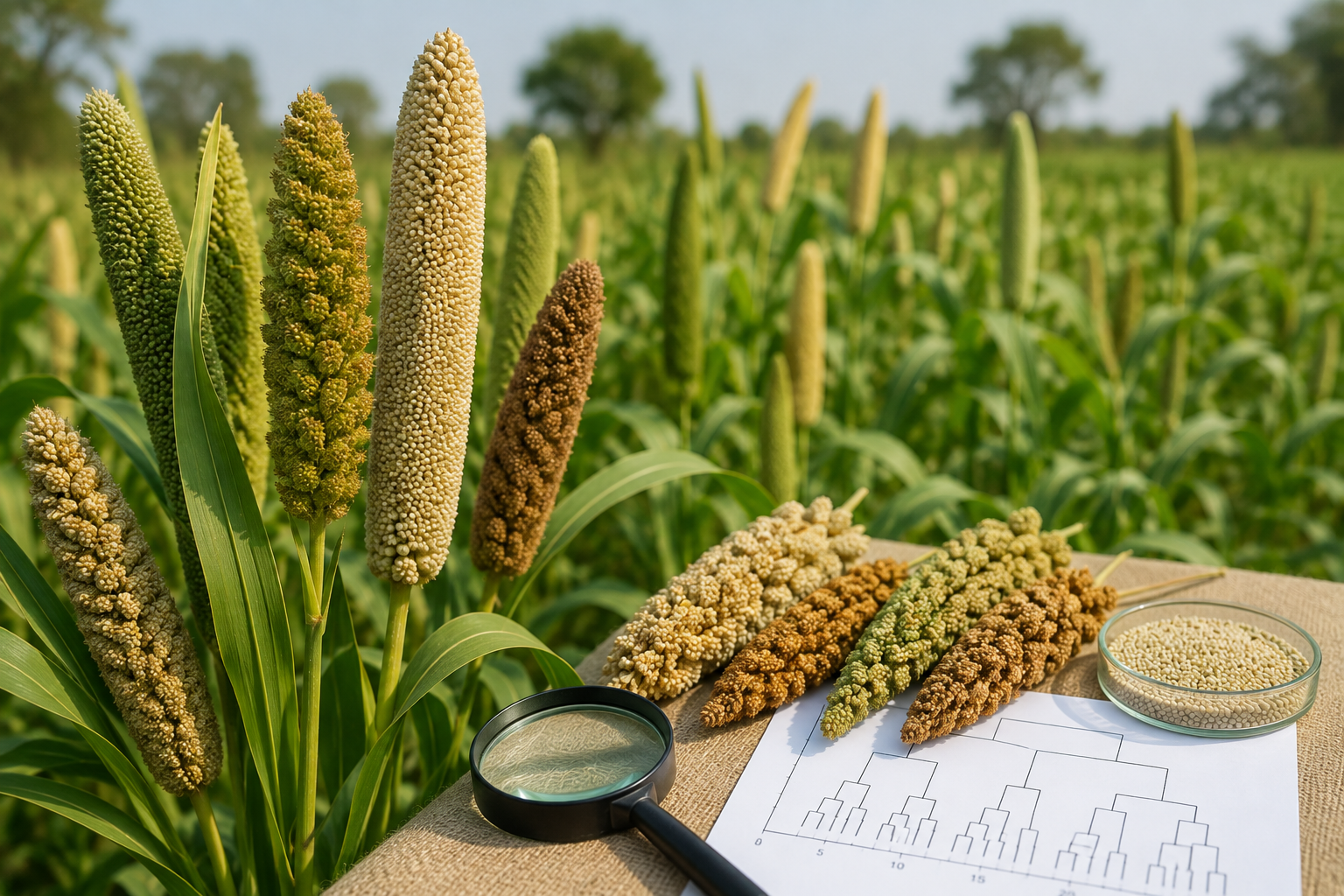
There are 40 genotypes of pearl millet that were gathered from ICRISAT in Hyderabad for the study. The experiment was performed in triplicate using Randomized Block Design. With an average D2 value of 398.08, the experimental material was divided into seven clusters, indicating the presence of diversity across the lines for the attributes being studied. Among different clusters the maximum cluster lines i.e., ten lines were observed in cluster V followed by cluster IV, cluster III, cluster I, cluster II, cluster VII, and cluster VI. Cluster V has the greatest intra cluster distance, followed by Cluster II, Cluster IV, and Cluster I. As a result, within these clusters, selection might be based on the greatest mean for desirable characteristics. The relative divergence shows the degree to which each cluster differs. The highest order of divergence was observed in cluster VIII and cluster X, followed by cluster V and cluster VIII. The results revealed that the parents are genetically heterogeneous in these clusters. The high heterotic response may have been achieved when used in a hybridization programme. Cluster VI and Cluster VII had the shortest inter-cluster distance, indicating low genetic diversity. Plant height had the highest cluster value in cluster VIII and the lowest in cluster X, whereas phenological parameters like days to flowering and days to maturity had the highest cluster value in cluster II. Days to flowering were the most important factor in genetic divergence, followed by the number of panicle length, fodder yield per plot, and productive tillers per plant.
References
[1] I. A. Shah, H.-U. Rahman, S. M. A. Shah, Z. Shah, S. Rahman, Ihteramullah and M. Noor (2012). Characterization of pearl millet germplasm for various morphological and fodder yield parameters. Pakistan J. Bot., 44: 273-279.
[2] J. P Wilson, M. D Sanogo, S. K Nutsugah, I. Angarawai, A. Fofana, H. Traore and I. Ahmadou et al., (2008). Evaluation of Pearl millet for yield and downy mildew resistance across seven countries in sub-Saharan Africa. Afr. J. Agric. Res., 3: 371-378.
[3] B. K. Joshi, A. Mudwari, M. R. Bhatta and G. O. Ferrara (2004). Genetic diversity in Nepalese wheat cultivars based on agromorphological traits and coefficients of parentage. Nepal Agric. Res. J., 5: 7-17.
[4] I. J. Anand and B. R. Murrty (1968). Genetic divergence and hybrid performance in linseed. Indian J. Genet. Plant Breed., 28: 178-85.
[5] M. R Islam, M. A. B Faruquei, M. A. R Bhuiyan, P. S Biswas and M. A Salam (2004). Genetic diversity in irrigated rice. Pak. J. Biol. Sci., 2: 226-229.
[6] A. R. Eivazi, M. R. Naghavi, M. Hajheidari, S. M. Pirseyedi, M. R. Ghaffari, S. A. Mohammadi and I. Majidi et al., (2008). Assessing wheat (Triticum aestivum L.) genetic diversity using quality traits, amplified fragment length polymorphisms, simplesequence repeats and proteome analysis. Ann. Appl. Biol., 152: 81-91.
[7] I. Drabo, R. G Zangre, M. Sawadogo and M. Ouedraogo (2013). Genetic variability and estimates of genetic parameters in Burkina faso’s pearl millet landraces. Int. J. Agric. For., 3: 367-373.
[8] M. Govindaraj, B. Selvi and I. S. Kumar (2011). Genetic diversity studies in indigenous pearl millet (Pennisetum glauccum (L.) R. Br.) Accessions based on biometrical and nutritional quality traits. Indian J. Plant Genet. Resour., 24: 186–193.
[9] R. Kumar, U. Verma, V. Malik and D. Vart (2015). Multivariate analysis for selection of diverse genotypes in pearl millet germplasm. Forage Res., 41: 73-77.
[10] S. M. Sankar, C. T. Satyavathi, S. P. Singh, M. P. Singh, C. Bharadwaj and S. Barthakur (2014). Genetic diversity analysis for high-temperature stress tolerance in pearl millet [Pennisetum glaucum (L.) R. Br]. Indian J. Plant Physiol., 19: 324-329.
[11] M. Sathya, N. K. Vinodhana and P. Sumathi (2013). Hierarchial clustering of pearl millet (Pennisetum glaucum (L.) R.Br) inbreds for morpho-physiological traits. Int. J. Curr. Microbiol. App. Sci., 2: 647-653.
[12] M. Shanmuganathan, A. Gopalan and K. Mohanraj (2006). Genetic variability and multivariate analysis in pearl millet (Pennisetum glaucum (L.) R. Br.) germplasm for dual purpose. J. Agric. Sci., 2: 73-80.
[13] H. D. Upadhyaya, K. N Reddy, S. Singh, C. L. L Gowda, M. I Ahmed and S. Ramachandran (2014). Latitudinal patterns of diversity in the world collection of pearl millet landraces at the ICRISAT genebank. Plant Genet. Resour. Characterisation Util., 12: 91-102
[14] B. Vidhyadhar and I. S. Devi (2007). Evaluation of germplasm for genetic diversity in pearl millet. J. Res. ANGRAU., 35: 119-123.
Downloads
Published
Issue
Section
License
Copyright (c) 2022 Author (s)

This work is licensed under a Creative Commons Attribution-NonCommercial-NoDerivatives 4.0 International License.
Copyright © The Author(s). This is an open access article distributed under the terms of the Creative Commons Attribution-NonCommercial-NoDerivatives 4.0 International License (CC BY-NC-ND 4.0), which permits unrestricted non-commercial use, distribution, and reproduction in any medium, provided the original author(s) and source are properly credited, and the work is not modified or adapted.