Study of phytochemicals, antioxidant activity and antimicrobial properties of Catharanthus roseus (L.) G. Don
DOI:
https://doi.org/10.31783/elsr.2022.817579Keywords:
cluster analysis, intra and inter cluster distance, pearl millets, RBDAbstract
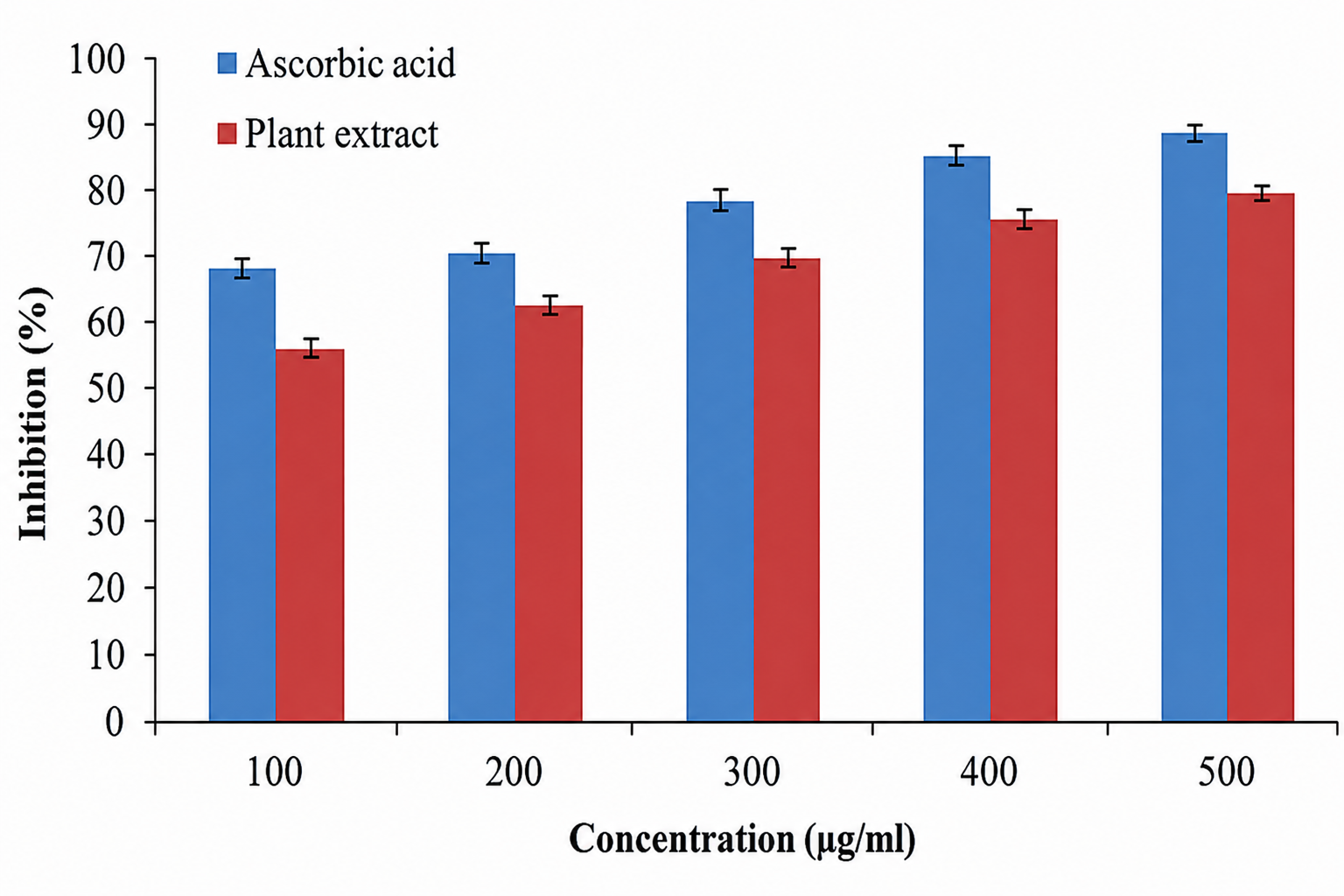
Several anticancer medicines have been developed by using plant-derived compounds in the last few decades. Catharanthus roseus (L.) G. Don is a valuable therapeutic plant belonging to the Apocynacae family. C. roseus leaves are exploited in the research of cancer treatment. Free radicals have a significant part in pathophysiology; natural substances that inhibit free radical accumulation can assist to prevent diseases and the ageing process. The antioxidant activity and total phenolic content (TPC) of C. roseus leaf extract were evaluated using DPPH free radical and the Folin-Ciocalteu method. Antioxidant activity increased with an increase in dose, roughly 80.21% inhibition at 500 µg/ml. The TPC is 2344.65 mM GAE g-1 FW and a maximum inhibition zone of 12 mm was shown against E. coli. A qualitative study of leaf extract revealed the existence of flavonoids, alkaloids, phenols, and proteins.
References
[1] M. Sottomayor, I. Lopes Cardoso, L. G. Pereira and A. R Barceló (2004). Peroxidase and the biosynthesis of terpenoid indole alkaloids in the medicinal plant Catharanthus roseus (L.) G. Don. Phytochem. Rev., 3: 159-171.
[2] J. Aslam, S. H. Khan, Z. H. Siddiqui, Z. Fatima, M. Maqsood, M. A. Bhat and S. A. Naseem et al., (2010). Catharanthus roseus (L.) G. Don. An important drug: it’s applications and production. Int. J. Comprehensive. Pharma, 4: 1-16.
[3] D. I. Jacobs, W. Snoeijer, D. Hallard and R. Verpoorte (2004). The Catharanthus alkaloids: pharmacognosy and biotechnology. Curr. Med. Chem., 11: 607-628.
[4] N. Salah, N. J. Miller, G. Paganga, L. Tijburg, G. P. Bolwell and C. Riceevans (1995). Polyphenolic flavanols as scavengers of aqueous phase radicals and as chain-breaking antioxidants. Arch. Biochem. Biophys., 322: 339-346.
[5] S. Kaur, and P. Mondal (2014). Study of total phenolic and flavonoid content, antioxidant activity and antimicrobial properties of medicinal plants. J Microbiol Exp., 1:1-5.
[6] K. R. Brain and T. D. Turner, (1975). The practical evaluation of phytopharmaceuticals. Bristol: Wright-Scientechnica.
[7] N. Zieslin and R. Ben Zaken (1993). Peroxidase activity and presence of phenolic substances in peduncles of rose flowers. Plant Physiol. Biochem., 31: 333-9.
[8] V. T. Aparadh, V. V. Naik, and B. A. Karadge (2012). Antioxidative properties (TPC, DPPH, FRAP, metal chelating ability, reducing power and TAC) within some Cleome species. Annali. Di Botanica., 2: 49-56.
[9] M. R. S. Zaidan, A. N. Rain, A. R. Badrul, A. Adlin, A. Norazah and I. Zakiah (2005). In vitro screening of five local medicinal plants for antibacterial activity using disc diffusion method. Trop. Biomed., 22: 165-170.
[10] E. Bendary, R. R. Francis, H. M. G. Ali, M. I. Sarwat and S. El-Hady (2013). Antioxidant and structure–activity relationships (SARs) of some phenolic and anilines compounds. Ann. Agric. Sci., 58: 173-181.
[11] Bhutkar M. A and Bhise S. B. (2011). Comparative studies on antioxidant properties of Catharanthus roseus and Catharanthus. Int. J. PharmTech Res., 3: 1551-1556
[12] S. H. Tiong, C. Y. Looi, H. Hazni, A. Arya, M. Paydar, W. F. Wong, S. C. Cheah and et al., (2013). Antidiabetic and antioxidant properties of alkaloids from Catharanthus roseus (L.) G. Don. Molecules, 18: 9770-9784.
[13] P. J. Patil and J. S. Ghosh (2010). Antimicrobial activity of Catharanthus roseus–a detailed study. Br. J. Pharmacol., 1: 40-44.
Downloads
Published
Issue
Section
License
Copyright (c) 2022 Author (s)

This work is licensed under a Creative Commons Attribution-NonCommercial-NoDerivatives 4.0 International License.
Copyright © The Author(s). This is an open access article distributed under the terms of the Creative Commons Attribution-NonCommercial-NoDerivatives 4.0 International License (CC BY-NC-ND 4.0), which permits unrestricted non-commercial use, distribution, and reproduction in any medium, provided the original author(s) and source are properly credited, and the work is not modified or adapted.