Population structure and marker-trait association study for kernel quality traits in sweet corn (Zea mays var. saccharata)
DOI:
https://doi.org/10.31783/elsr.2022.8195103Keywords:
marker trait association, reducing sugar, SSR markers, sweet cornAbstract
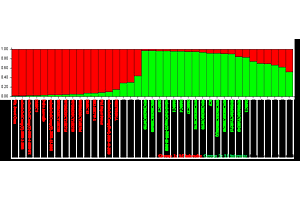
The study utilized 63 microsatellite markers linked with QTLs affecting different seed quality traits viz., pericarp thickness, soluble sugar, dextrose, sucrose, and amylose content, for validation in 39 sweet corn inbred lines. Observations were recorded on two quality traits viz., total soluble solids (TSS) and reducing sugar. Out of 63 SSR markers, 30 showed polymorphism and were subjected to population structure study and, single marker analysis for detecting their association with TSS and reducing sugar. The estimate of the likelihood of ΔK (where K= 2), classified the 39 sweet corn inbreds into two genetically distinct groups. The single factor ANOVA revealed five SSR markers, having P-value ≤ 0.05, had a high association with each of the quality traits. The markers viz., phi027, umc2056, umc1633, bnlg1265, and umc1031, located on chromosome number 9, 6, 2, and 4, were found to have a significant association with TSS. Likewise, five markers viz., umc1465, umc1633, umc1492, bnlg1079, and umc1320 had a significant association with reducing sugar. The marker, umc1633, had a significant association with both TSS and reducing sugar and can play a significant role in the selection of inbred lines superior in terms of TSS and reducing sugar for use in sweet corn breeding program.
References
[1] W. F. Tracy (1994). Sweet corn. In: G. Kalloo and B.O. Bergh (eds.) Genetic improvement of vegetable crops. Pergamon Press, Oxford, England.
[2] K. Lertrat and T. Pulam (2007). Breeding for Increased Sweetness in Sweet Corn. Int. J. Plant Breed., 1: 27-30.
[3] X. Qi, Y. Zhao, L. Jiang, Y. Cui, Y. Wang and B. Liu (2009). QTL analysis of kernel soluble sugar content in super-sweet corn. Afr. J. Biotech., 8: 6913-6917.
[4] K. J. Park, K. J. Sa, H.-J. Koh and J. K. Lee (2013). QTL analysis for eating quality-related traits in an F2:3 population derived from waxy corn × sweet corn cross. Breed Sci., 63: 325-332.
[5] S. K. Jha, N. K. Singh and P. K. Agrawal (2016). Complementation of sweet corn mutants: a method for grouping sweet corn genotypes. J. Genet., 95: 183-187.
[6] K. Yu, S. J. Park and V. Poysa (2000). Marker-assisted selection of common beans for resistance to common bacterial blight: efficacy and economics. Plant Breed., 119: 411-415
[7] H. M. Collins, J. F. Panozzo, S. J. Logue, S. P. Jefferies and A. R. Barr (2003). Mapping and validation of chromosome regions associated with high malt extract in barley (Hordeum vulgare L.). Aust. J. Agric. Res., 54: 1223-1240.
[8] B. C. Y. Collard, M. Z. Z. Jahufer, J. B. Brouwer and E. C. K. Pang (2005). An introduction to markers, quantitative trait loci (QTL) mapping and marker-assisted selection for crop improvement: The basic concepts. Euphytica, 142: 169-196.
[9]. P. Langridge, E. S. Lagudah, T. A. Holton, R. Appels, P. J. Sharp and K. J. Chalmers (2001). Trends in genetic and genome analyses in wheat: A review. Aust. J. Agric. Res., 52: 1043-1077.
[10] Z. Li, L. Jakkula, R. S. Hussey, J. P. Tamulonis and H. R. Boerma (2001). SSR mapping and confirmation of the QTL from PI96354 conditioning soybean resistance to southern root-knot nematode. Theor. Appl. Genet., 103: 1167-1173.
[11] P. J. Sharp, S. Johnston, G. Brown, R. A. McIntosh, M. Pallotta, M. Carter and H. S. Bariana et al., (2001). Validation of molecular markers for wheat breeding. Aust. J. Agric. Res., 52: 1357-1366.
[12] S. Mikic, A. Kondic-Spika, L. Brbaklic, D. Stanisavljevic, D. Trkulja, M. Tomicic and A. Nastasic et al., (2016). Multiple marker-traits associations for maize agronomic traits. Chil. J. Agric. Res., 76: 301-306
[13] J. Yu, G. Pressoir, W. H. Briggs, I. V. Bi, M. Yamasaki, J. F. Doebley and M. D. McMullen et al., (2006). A unified mixed-model method for association mapping that accounts for multiple levels of relatedness. Nature Gent., 38: 203-208.
[14] V. V. Nachimuthu, R. Muthurajan, S. Duraialaguraja, R. Sivakami, B.A. Pandian and G. Ponniah et al., (2015). Analysis of Population Structure and Genetic Diversity in Rice Germplasm Using SSR Markers: An Initiative Towards Association Mapping of Agronomic Traits in Oryza Sativa. Rice, 8: 30. doi: https://doi.org/10.1186/s12284-015-0062-5.
[15] J. K. Pritchard, M. Stephens and P. Donnelly (2000). Inference of population structure using multilocus genotype data. Genetics, 155: 945-959.
[16] A. Mahato, J. P. Shahi, P. K. Singh and M. Kumar (2018). Genetic diversity of sweet corn inbreds using agro-morphological traits and microsatellite markers. 3 Biotech, 8: 332. doi: https://doi.org/10.1007/s13205-018-1353-5.
[17] L. Alhusain and A. M. Hafez (2018). Nonparametric approaches for population structure analysis. Genomics, 12: 25. doi: https://doi.org/10.1186/s40246-018-0156-4.
[18] M. C. G Vidigal and L.B. Rubiano (2011). Development and application of microsatellites in plant breeding. Crop Breed. Appl. Biotech., S1: 66-72.
[19] A. I. Shehata, H. A. Al-Ghethar and A. A. Al-Homaidan (2009). Application of simple sequence repeat (SSR) markers for molecular diversity and heterozygosity analysis in maize inbred lines. Saudi J. Biol. Sci., 16: 57-62.
[20] P. J. Balint-Kurti and G. S. Johal (2008). Maize disease resistance. In: Bennetzen JL, Hake SC (eds) Maize genetics handbook: its biology. Springer, New York.
[21] Y. Chai, X. Hao, X. Yang, W.B. Allen, J. Li, J. Yan and B. Shen et al., (2012). Validation of DGAT1-2 polymorphisms associated with oil content and development of functional markers for molecular breeding of high-oil maize. Mol. Breed., 29: 939-949.
[22] F. Hossain, T. Nepolean, A. K. Vishwakarma, N. Pandey, B. M. Prasanna and H. S. Gupta (2015). Mapping and validation of microsatellite markers linked to sugary1 and shrunken2 genes in maize (Zea mays L.). J. Plant Biochem. Biotechnol., 24: 135-142.
[23] J. J. Doyle and J. L. Doyle (1987). A rapid DNA isolation procedure for small quantities of fresh leaf tissue. Photochem. Bull., 19: 11-15
[24] D. A. Earl and B. M. vonHoldt (2012). STRUCTURE HARVESTER: a website and program for visualizing STRUCTURE output and implementing the Evanno method. Conserv. Genet. Resour., 4: 359-361.
[25] M. L. Senior, J. P. Murphy, M. M. Goodman and C. Stuber (1998). Utility of SSRs for determining genetic similarities and relationships in maize using an agarose gel system. Crop Sci., 38: 1088-1098.
[26] R. Contreras-Soto, A. Salvatierra, C. Maldonado and J. Mashilo (2021). The genetic diversity and population structure of different geographical populations of bottle gourd (Lagenaria siceraria) accessions based on genotyping-by-sequencing. Agronomy. 11: 1677. doi: https://doi.org/10.3390/agronomy11081677.
[27] F. Breseghello and M. E. Sorrells (2006). Association mapping of kernel size and milling quality in wheat (Triticum aestivum L.) cultivars. Genetics, 172: 1165-1177.
[28] E. S. Buckler and J. M. Thornsberry (2002). Plant molecular diversity and applications to genomics. Curr. Opin. Plant Biol., 5: 107-111.
[29] G. Acquaah (2009). Principles of plant genetics and breeding. John Wiley & Sons..
[30] A. Mahato, J. P. Shahi, P. K. Singh, M. Kumar and A. Singamsetti (2021). Heterotic grouping of sweet corn (Zea mays var. sachharata) genotypes based on their combining ability and molecular diversity. Indian J. Gent., 81: 410-421
[31] R. Edema and L. Amoding (2015). Validating simple sequence repeat (SSR) markers for introgression of stay-green quantitative trait loci (QTLs) into elite sorghum lines. Afr. J. Biotech., 14: 3101-3111.
[32] D. Langade, J. P. Shahi, K. Srivastava and A. Sharma (2017). Validation of parents and estimation of molecular diversity through SSR markers in maize (Zea mays L.). Electron. J. Plant Breed., 8: 1035-1045.
Downloads
Published
Issue
Section
License
Copyright (c) 2022 Author (s)

This work is licensed under a Creative Commons Attribution-NonCommercial-NoDerivatives 4.0 International License.
Copyright © The Author(s). This is an open access article distributed under the terms of the Creative Commons Attribution-NonCommercial-NoDerivatives 4.0 International License (CC BY-NC-ND 4.0), which permits unrestricted non-commercial use, distribution, and reproduction in any medium, provided the original author(s) and source are properly credited, and the work is not modified or adapted.