
Impact of traditional home garden on socio-economy across altitudinal gradient of Mon District in Nagaland
DOI:
https://doi.org/10.31783/elsr.2022.81104113Keywords:
distribution, home garden, Mon District, socio-economicAbstract
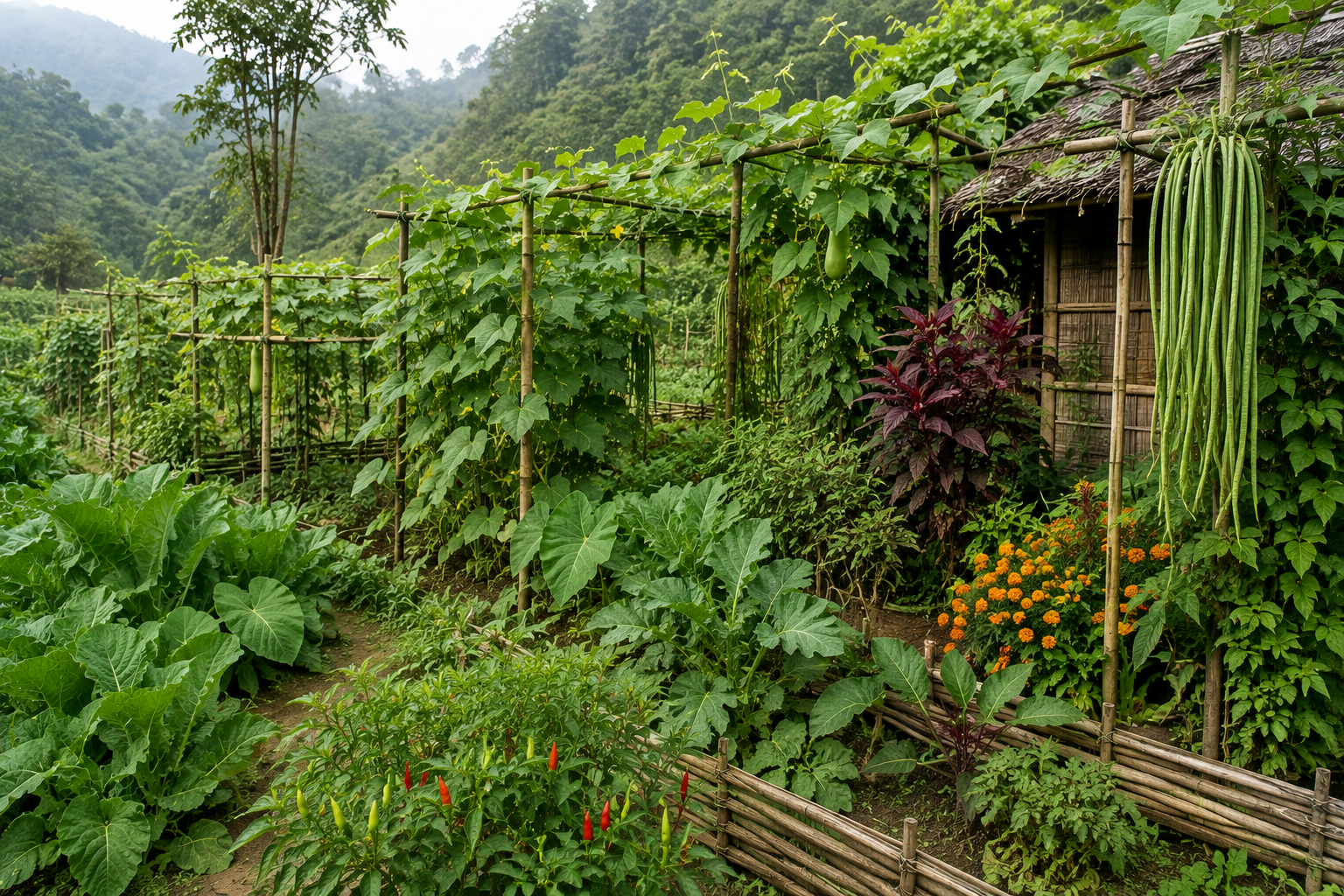
Concept of home garden is very common in the hilly area of north eastern part of India and play a crucial role in livelihood, economy and biological diversity conservation. The present study aims to study of the home garden in three different altitudinal ranges in Mon district of Nagaland with the prime objective about the socioeconomic status of existing home garden, distribution and the variety of products and their local uses. The household was selected as a sampling unit of study. Data was gathered through a structured interview covering 60 households, 20 from each village. The home gardens across the altitudes were studied in detail in order to ascertain the roles played by these gardens in the socio-economic context. The survey comprises of 47 plant species from 29 different families. Cucumis sativa (28%) was recorded to contribute the highest to the total annual income in the high altitude followed by Capsicum chinensis (25%) whereas; Abelmoschus esculentus (5%) contributed the least. Parkia timoriana (33%) was recorded to contribute the highest to the total annual income in the high altitude followed by Sechium edule (21%) whereas; Rhus semialata (2%) contributed the least. Camellia sinensis (40%) was recorded to contribute the highest to the total annual income in the high altitude followed by Areca catechu (31%) whereas, Zingiber officinale (5%) contributed the least. The economic analysis of home gardens across varying altitudes shows that home gardens in low altitudes were valued more than the ones in the mid hills and highlands.
References
[1] J. E. M. Arnold (1987). Economic considerations in agroforestry. In Agroforestry: a decade of development, 173-190.
[2] U. K. Sahoo (2009). Traditional home gardens and livelihood security in North-East India. J. Food Agric Environ., 7: 665-670.
[3] A. M. S. Ali (2005). Homegardens in smallholder farming systems: examples from Bangladesh. Hum Ecol., 33: 245-270.
[4] C. R. Vogl and B. Vogl-Lukasser (2003). Tradition, dynamics and sustainability of plant species composition and management in homegardens on organic and non-organic small scale farms in Alpine Eastern Tyrol, Austria. Biol. Agric. Hortic., 21: 349-366.
[5] T. Das and A. K. Das (2005). Inventorying plant biodiversity in homegardens: A case study in Barak Valley, Assam, North East India. Curr. Sci., 89: 155-163.
[6] N. L. Devi and A. K. Das (2010). Plant species diversity in the traditional homegardens of Meitei community: a case study from Barak Valley, Assam. J. Trop. Agric., 48: 45-48.
[7] E. C. M. Fernandes and P. K. R. Nair (1986). An evaluation of the structure and function of tropical homegardens. Agric. Syst., 21: 279-310.
[8] S. Mohan (2004). An assessment of the ecological and socioeconomic benefits provided by homegardens: a case study of Kerala, India; Dissertation, University of Florida.
[9] S. Mohan, P. R. Nair and A. J. Long (2007). An assessment of ecological diversity in home gardens: a case study from Kerala State, India. J. Sustain. Agric., 29: 135-153.
[10] D. Jose and N. Shanmugaratnam (1993). Traditional homegardens of Kerala: a sustainable human ecosystem. Agrofor. Syst., 24: 203-213.
[11] M. E. Kabir and E. L. Webb (2009). Household and homegarden characteristics in southwestern Bangladesh. Agrofor. Syst., 75: 129-145.
[12] I. Karyono (1990). Homegardens in Java; their structure and function. 138-146. In: Landauer K. and Brazil M. (eds), Tropical Homegardens, United Nations University Press, Tokyo.
[13] Z. Konyak and E. P. Konyak (2020). Documentation of wild edible fruits (WEFs) from mon District of Nagaland, India. J. Med. Plant Res., 8: 101-106.
[14] E. Torquebiau (1992). Are tropical agroforestry home gardens sustainable? Agric. Ecosyst. Environ., 41: 189-207.
[15] A. N. Wangcha, Z. Konyak (2021). Survey of ethnomedicinal plants and its uses by the konyak tribe in Mon district, Nagaland, India. Int. J. ecol. environ. sci., 3: 280-285.
[16] B. M. Kumar (2003). Homegardens as a livelihood security system in the humid tropics with special reference to Kerala. In: Pathak PS, Ram N (eds) Agroforestry: potentials and opportunities, Agrobios, Jodhpur, pp121-142.
[17] B. M. Kumar and P. K. R. Nair (2004). The enigma of tropical homegardens. Agrofor. Syst., 61: 135-152.
[18] B. M. Kumar, S. J. George and S. Chinnamani (1994). Diversity, structure and standing stock of wood in the homegardens of Kerala in peninsular India. Agrofor. Syst., 25: 243-262.
[19] M. A. S. Kumari, K. Kansuntisukmongkol and W. Y. Brockelman (2009). Plant diversity in home gardens and its contribution to household economy in suburban areas in Sri Lanka. Environ. Nat. Resour. J., 7: 12-29.
[20] E. Linger (2014). Agro-ecosystem and socio-economic role of homegarden agroforestry in Jabithenan District, North-Western Ethiopia: implication for climate change adaptation. SpringerPlus, 3: 1-9.
[21] R. K. Maikhuri and A. K. Gangwar (1991). Fuelwood use by different tribal and non‐tribal communities in north‐east India. Nat Resour Forum., 15: 162-165.
[22] F. Montagnini (2006). Homegardens of Mesoamerica: Biodiversity, food security, and nutrient management. In: Kumar, B.M., Nair, P.K.R. (eds) Tropical Homegardens. Advances in Agroforestry 3. Springer, Dordrecht, pp61-84.
[23] M. M. Rahman, Y. Furukawa, I. Kawata, M.M. Rahman and M. Alam (2005). Homestead forest resources and their role in household economy: A Case Study in the villages of Gazipur sadar upazila of central Bangladesh. Small scale forestry, 4: 359-376.
[24] B. N. Okigbo (1990). Homegardens in tropical Africa. In: Landauer K and Brazil M (eds) Tropical Home Gardens, pp41-65. United Nations University Press, Tokyo, Japan.
[25] U. K. Sahoo, P. Rocky, K. Vanlalhriatpuia and K. Upadhyaya (2012). Species composition, production and energetic sustainability of homegardens in the highlands of eastern Mizoram, India. Forest Restoration. Tree and Forestry Science and Biotechnol., 6 (SI 1): 81-92..
[26] R. M. Motiur, Y. Furukawa, I. Kawata, M. M. Rahman and M. Alam (2006). Role of homestead forests in household economy and factors affecting forest production: a case study in southwest Bangladesh. J. For. Res., 11: 89-97.
[27] V. E. Méndez, R. Lok and E. Somarriba (2001). Interdisciplinary analysis of homegardens in Nicaragua: micro-zonation, plant use and socioeconomic importance. Agrofor. Syst., 51: 85-96.
[28] M. Millat-e-Mustafa, Z. Teklehaimanot and A. K. O. Haruni (2002). Traditional uses of perennial homestead garden plants in Bangladesh. For. Trees Livelihoods., 12: 235-256.
[29] K. C. Dhawan and J. P. Mittal (1988). Research manual on energy requirements in agricultural sector. All India Co-ordinated Research. Agricultural Sector., Ludhiana : A.C.R.I.P.,
[30] J. Major, C. R. Clement and A. DiTommaso (2005). Influence of market orientation on food plant diversity of farms located on Amazonian dark earth in the region of Manaus, Amazonas, Brazil. Econ. Bot., 59: 77-86.
[31] M. A. Nair and C. Sreedharan (1986). Agroforestry farming systems in the homesteads of Kerala, Southern India. Agrofor. Syst., 4: 339-363.
[32] S. O. Odebode (2006). Assessment of home gardening as a potential source of household income in Adinyele Local Government are of Oyo State. Niger. J. Hortic. Sci., 11: 47-55.
[33] H. Tynsong and B. K. Tiwari (2010). Plant diversity in the homegardens and their significance in the livelihoods of war khasi community of Meghalaya, North-east India. Biodivers. J., 1: 1-11.
[34] S. I. Unofia, P. W. Owoh, E. E. Ukpong and I. E. Ekpo (2012). Assessment of plant species of socio-economic importance conserved in homegarden of Nsit ubium local government area of Akwa Ibom state, Nigeria. Nigerian J Food Agric Environ., 8: 99-108.
Downloads
Published
Issue
Section
License
Copyright (c) 2022 Author (s)

This work is licensed under a Creative Commons Attribution-NonCommercial-NoDerivatives 4.0 International License.
Copyright © The Author(s). This is an open access article distributed under the terms of the Creative Commons Attribution-NonCommercial-NoDerivatives 4.0 International License (CC BY-NC-ND 4.0), which permits unrestricted non-commercial use, distribution, and reproduction in any medium, provided the original author(s) and source are properly credited, and the work is not modified or adapted.