
Microbiological quality of panipuri sold in and around Greater Hyderabad municipal corporation, Telangana
DOI:
https://doi.org/10.31783/elsr.2022.81127133Keywords:
GHMC, microbial quality, panipuri, street vended foods, TelanganaAbstract
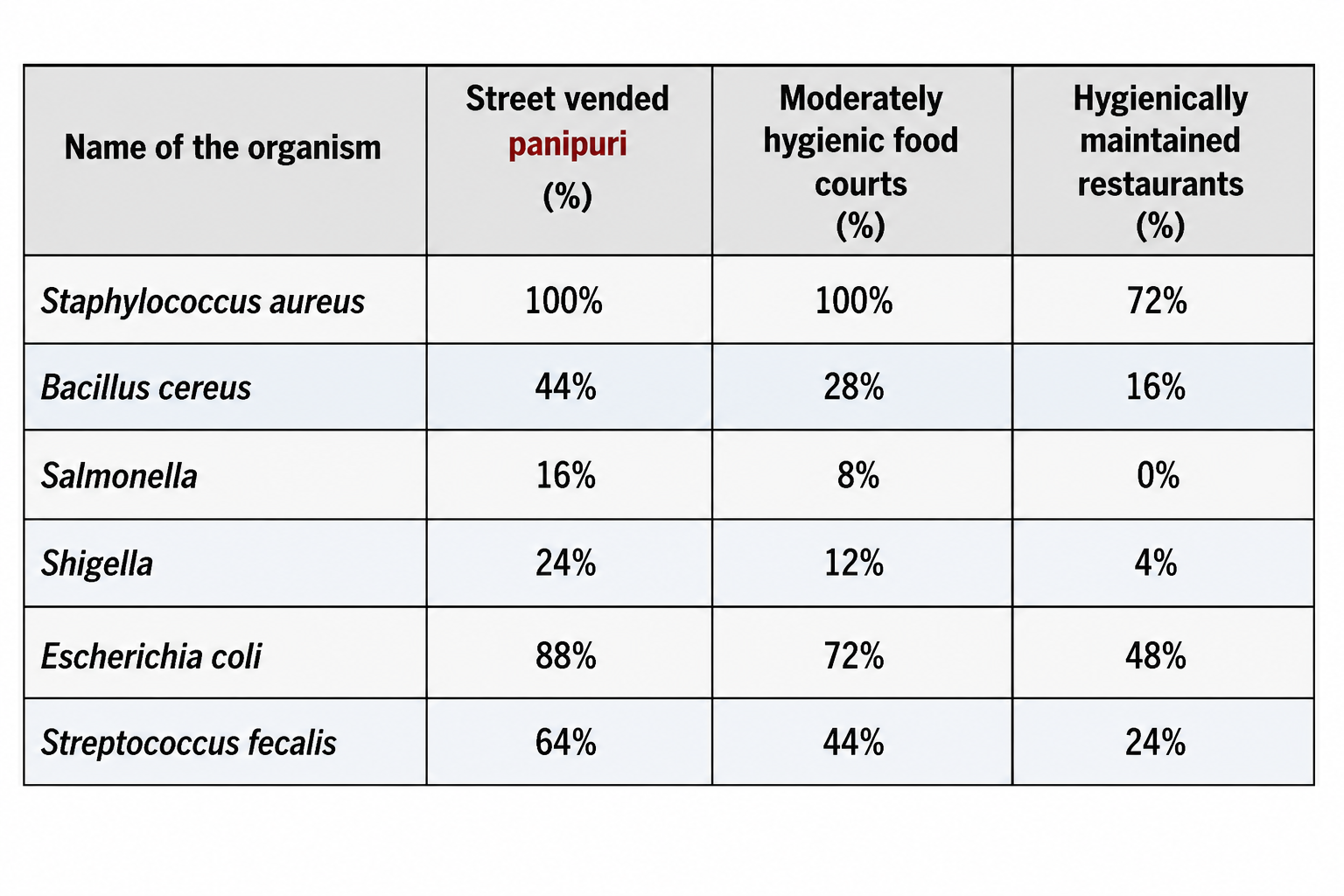
The microbiological quality of panipuri sold at street vended panipuri, moderately hygienic food courts, and hygienically maintained restaurants in and around Greater Hyderabad Municipal Corporation, Telangana State was studied. Twenty-five samples from each source were collected and analyzed. The total viable count, Total coliform count, Fecal coliform count, and Yeast and mold counts in the samples collected from street vended panipuri were 3.6×10⁹ cfu/gm, 5.2× 10⁷ cfu/gm, 3.8×10⁶ cfu/gm, and 3.2×10³ cfu/gm respectively, 1.7×10⁷cfu/gm, 4.3×10⁵ cfu/gm, 1.2×10⁵ cfu/gm, 7.2×10² cfu/gm respectively in the samples collected from the moderately hygienic food courts and 2.8×10⁵cfu/gm, 3.6×10⁴cfu/gm, 4.7×10³ cfu/gm, and 1.2×10²cfu/gm respectively from hygienically maintained restaurants. The incidence of staphylococcus aureus was 100%, 100% and 72%, Bacillus cereus of 44%, 28% and 16%, Salmonella of 16%, 8% and 0% (Nil), Shigella of 24% 12%, and 4%, Escherichia coli of 88%, 72% and 48%, Streptococcus fecalis of 64%, 44%, and 24% respectively from the street vended panipuri, moderately hygienic food courts and hygienically maintained restaurants. The counts of staphylococcus aureus were 2.6×10⁶, 5.2×10⁵, and 2.3×10³, Bacillus cereus of (3.8×10³), (4.9×10²), 2.5×10², Salmonella of 3.9×10², 9.5×10¹, Nil, Shigella of 8.6×10³, 3.9×10², 5.8×10¹, Escherichia coli of 3.6×10², 2.9×10³, 4.2×10⁴ and Streptococcus fecalis of 8.6×10¹, 8.7×10², 2.6×10³ cfu/gm respectively from the samples collected from street vended panipuri, moderately hygienic food courts and hygienically maintained restaurants.
References
[1] D. Maxwell, C. Levin, M. A. Klemesu, M. Ruel, S. Mouris, and C. Ahiadeke (2000). Urban livelihood and food and nutrition security in greater Accra, Ghana. Intl. Food Policy Res. Inst., 112.
[2] F. L. Bryan (1998). Risks associated with practices, procedures, and processes that lead to outbreaks of foodborne diseases. J. Food. Prot., 51: 663-673.
[3] P. Mensah, D. Yeboah-Manu, K. Owusu-Darko and A. Ablorde (2002). Street foods in Accra, Ghana: how safe are they? Bull. World Health Organ., 80: 546-554.
[4] K. Khalil, G. B. Lindblom, K. Mazhar and B. Kaijser (1994). Flies and water as reservoirs for bacterial enteropathogens in urban and rural areas in and around Lahore, Pakistan. Epidemiol Infect., 113: 435-444.
[5] E. Nwachukwu, C. F. Ezeama and B. N. Ezeanya (2008). Microbiology of polyethylene-packaged sliced watermelon (Citrullus lanatus) sold by street vendors in Nigeria. Afr. J. Microbial. Res., 2: 192-195.
[6] G. Saxena and M. Agarwal (2013). Microbial quality assessment of street-vended golgappa and bhelpuri sold in Jaipur city of Rajasthan. Int. J. Food Sci. Nutr.,2: 71-77.
[7] N. Kharel, U. Palni and J. P. Tamang (2016). Microbiological assessment of ethnic street foods of the Himalayas. J. Ethn. Foods, 3: 235-241.
[8] A. Das, G. S. Nagananda, S. Bhattacharya and S. Bhardwaj (2010). Microbiological quality of street vended Indian chaats sold in Bangalore. J. Biol. Sci.,10: 255-260.
[9] V. Teegala, K. B. C. Pavan and A. V. Kumar (2021). Microbiological quality of street vended Panipuri in Jagtial district of Telangana, India. J. Food Hyg. Saf., 6: 127-132.
[10] A. M. Garode and S. M. Waghode (2012). Bacteriological status of street-vended foods and public health significance: a case study of Buldana District, MS, India. Int. Res. J. Biol. Sci.,1: 69-71.
[11] N. Barro, A. R. Bello, A. Savadogo, C. A. T Ouattara, A. J. Iiboudo and A. S. Traore (2006). Hygienic status assessment of dish washing waters, utensils, hands and pieces of money from street food processing sites in Ouagadougou (Burkina Faso). Afr. J. Biotechnol., 5: 1107-12.
[12] D. H. Tambekar, R. V. Kulkarni, S. D. Shirsat and D G Bhadange (2011). Bacteriological quality of street vended food panipuri: A case study of Amravati City (MS) India. Biosci. Discover., 2: 350-354.
[13] D. K. Chavan, T. S. Channappa and S. M. Gaddad (2015). Incidence of Staphylococcus aureus in street vended panipuri around the Gulbarga city. J. Biotechnol. Biosaf., 3:303-307.
[14] M. Das, C. C. Rath and U. B. Mohapatra (2012). Bacteriology of a most popular street food (Panipuri) and inhibitory effect of essential oils on bacterial growth. J Food Sci Technol., 49: 564-571.
[15] R. S. Tomar, M. Gupta, S. Kaushik and R. K. Mishra (2018). Bacteriological Quality of Panipuri in Historical Gwalior City (MP), India. Asian J. Pharmaceut., 12: S328-S332.
[16] A. Hanashiro, M. Morita, G. R. Matte, M. H. Matte and E. A. F. S. Torres (2013). Microbiological quality of selected foods from a restricted area of Sao Paulo city, Brazil. Food Control., 16: 439-444.
[17] M. Ghosh, S. Wahi, M. Kumar and A. Ganguli (2007). Prevalence of enterotoxigenic Staphylococcus aureus and Shigella spp. in some raw street vended Indian foods. Int. J. Environ. Health Res., 17: 151-156.
[18] F. M. Mosupye and A. Van Holy (2000). Microbiological hazard identification and exposure assessment of street food vending in Johannesburg, South Africa. Int. J. Food Microbiol., 61: 137-145.
Downloads
Published
Issue
Section
License
Copyright (c) 2022 Author (s)

This work is licensed under a Creative Commons Attribution-NonCommercial-NoDerivatives 4.0 International License.
Copyright © The Author(s). This is an open access article distributed under the terms of the Creative Commons Attribution-NonCommercial-NoDerivatives 4.0 International License (CC BY-NC-ND 4.0), which permits unrestricted non-commercial use, distribution, and reproduction in any medium, provided the original author(s) and source are properly credited, and the work is not modified or adapted.