Migration and storage study of food products packed in biodegradable films (LDPE and Modified Corn Starch)
DOI:
https://doi.org/10.31783/elsr.2022.81134140Keywords:
biodegradable film, food package, food safety, modified corn starchAbstract
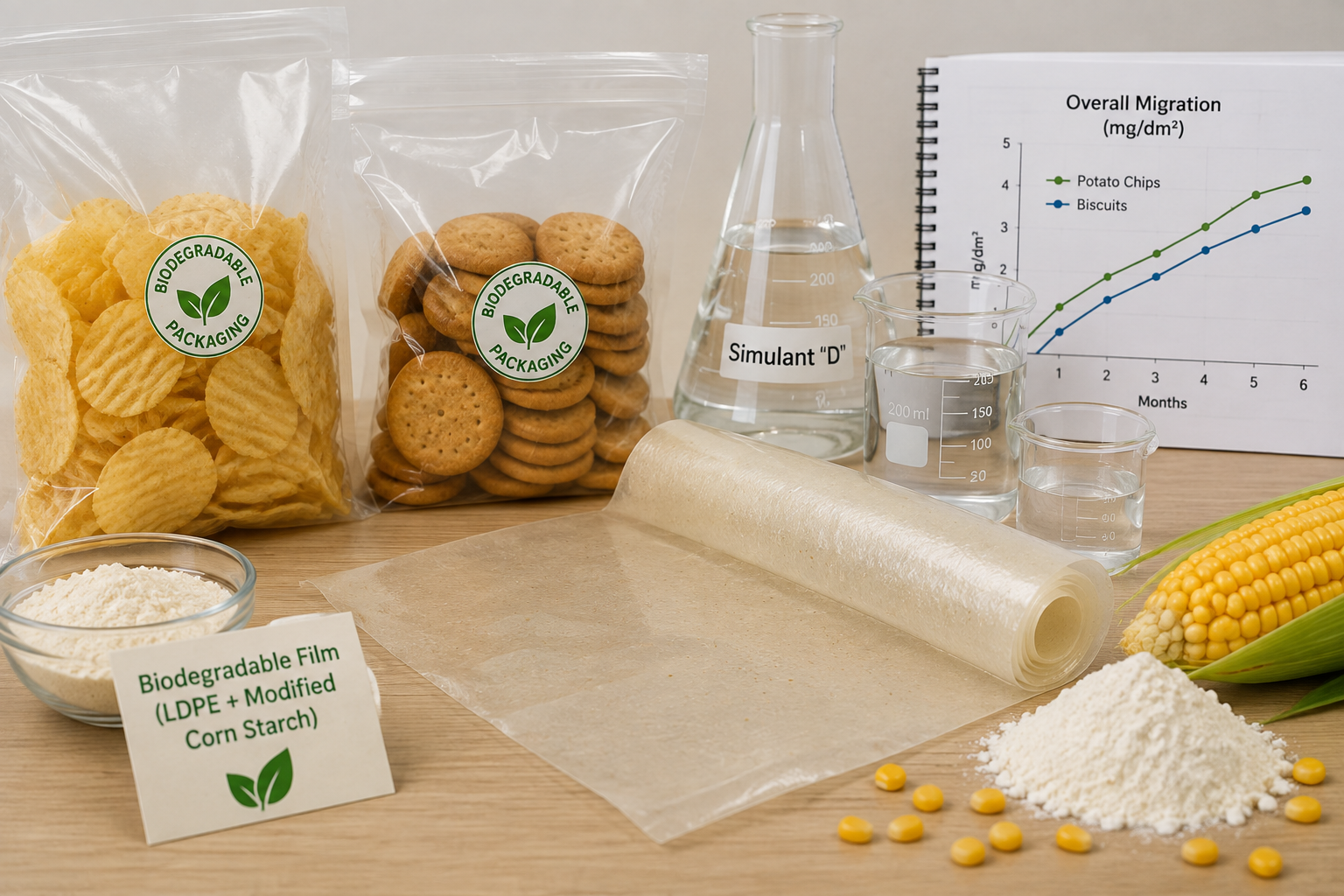
This study focuses on the migration and storage properties of biodegradable films made from a blend of Low-Density Poly Ethylene (LDPE) and modified corn starch with food products. The overall migration (OM) from the biodegradable film in contact with food products such as potato chips and biscuits were investigated for six months using simulant ‘D’ as per IS 9845:1988. During the migration study, the highest OM was 3.94 mg/dm2 for potato chips and 3.47 mg/dm2 for biscuits, respectively within the permissible limit as per standards. The moisture content of the biodegradable films (T1 and T2) containing potato chips remained consistent with the product standard specification for up to four months. When biodegradable films containing biscuits T1 and T2 were compared to T0 up to four months, they showed 3.61% and 4.02% moisture content, respectively, indicating suitability as a packaging material. Results showed that the peroxide value (PV) of potato chips packed in films of all treatments increased from 1.91 to 6.87 meq kg-1 from 1 to 3 months which indicates the suitability of biodegradable film as a food packaging material. The findings revealed that the OM rate was affected by the type of food packed, duration of contact, and the type of packaging material, well within specifications of the Bureau of Indian Standards. Hence, this biodegradable film can be used for packing food products (Biscuits, Chips) safely.
References
[1] A. S. Silva, J. M. Cruz, R. S. García, R. Franz and P. P. Losada (2007). Kinetic migration studies from packaging films into meat products. Meat Sci., 77: 238-245.
[2] I. S. Arvanitoyannis and L. Bosnea (2004). Migration of substances from food packaging materials to foods. Crit. Rev. Food Sci. Nutr., 44: 63-76.
[3] I. S. Arvanitoyannis and K. V. Kotsanopoulos (2014). Migration phenomenon in food packaging. Food-package interactions, mechanisms, types of migrants, testing and relative legislation-a review. Food Bioprocess Technol., 7: 21-36.
[4] R. S. Jagadish, B. Raj and M. R. Asha (2009). Blending of low-density polyethylene with vanillin for improved barrier and aroma-releasing properties in food packaging. R. J. Appl. Polym. Sci., 113: 3732-3741.
[5] S. Romani, S. Tappi, F. Balestra, M. T. Rodriguez Estrada, V. Siracusa, P. Rocculi and M. D. Rosa (2015). Effect of different new packaging materials on biscuit quality during accelerated storage. J. Sci. Food Agric., 95: 1736-1746.
[6] V. I. Triantafyllou, K. Akrida-Demertzi and P. G. Demertzis (2007). A study on the migration of organic pollutants from recycled paperboard packaging materials to solid food matrices. Food Chem., 101: 1759-1768.
[7] C. Nerín, E. Contín and E. Asensio (2007). Kinetic migration studies using Porapak as solid-food simulant to assess the safety of paper and board as food-packaging materials. Anal. Bioanal. Chem., 387: 2283-2288.
[8] K. K. Kuorwel, M. J. Cran, K. Sonneveld, J. Miltz and S. W. Bigger (2013). Migration of antimicrobial agents from starch-based films into a food simulant. LWT - Food Sci. Technol., 50: 432-438.
[9] A. H. A. Tarmizi and K. Niranjan (2013). Combination of moderate vacuum frying with high vacuum drainage-relationship between process conditions and oil uptake. Food Bioprocess Technol., 6: 2600-2608.
[10] K. Tiefenbacher (2003). Biscuits, cookies, and crackers. Encycl. Food Sci. Nutr., 539-545.
[11] L. Stoll, A. M. da Silva, A. O. e. S. Iahnke, T. M. H. Costa, S. H. Flôres and A. de O. Rios (2017). Active biodegradable film with encapsulated anthocyanins: Effect on the quality attributes of extra-virgin olive oil during storage. J. Food Process. Preserv., 41: 1-8.
Downloads
Published
Issue
Section
License
Copyright (c) 2022 Author (s)

This work is licensed under a Creative Commons Attribution-NonCommercial-NoDerivatives 4.0 International License.
Copyright © The Author(s). This is an open access article distributed under the terms of the Creative Commons Attribution-NonCommercial-NoDerivatives 4.0 International License (CC BY-NC-ND 4.0), which permits unrestricted non-commercial use, distribution, and reproduction in any medium, provided the original author(s) and source are properly credited, and the work is not modified or adapted.