Pollinator diversity and foraging behavior of Apis mellifera Linnaeus and Apis cerana Fabricius on Chinese cabbage (Brassica rapa Linnaeus subspecies chinensis) grown under different farming systems
DOI:
https://doi.org/10.31783/elsr.2022.81165174Keywords:
Chinese cabbage, honey bees, pollinatorsAbstract
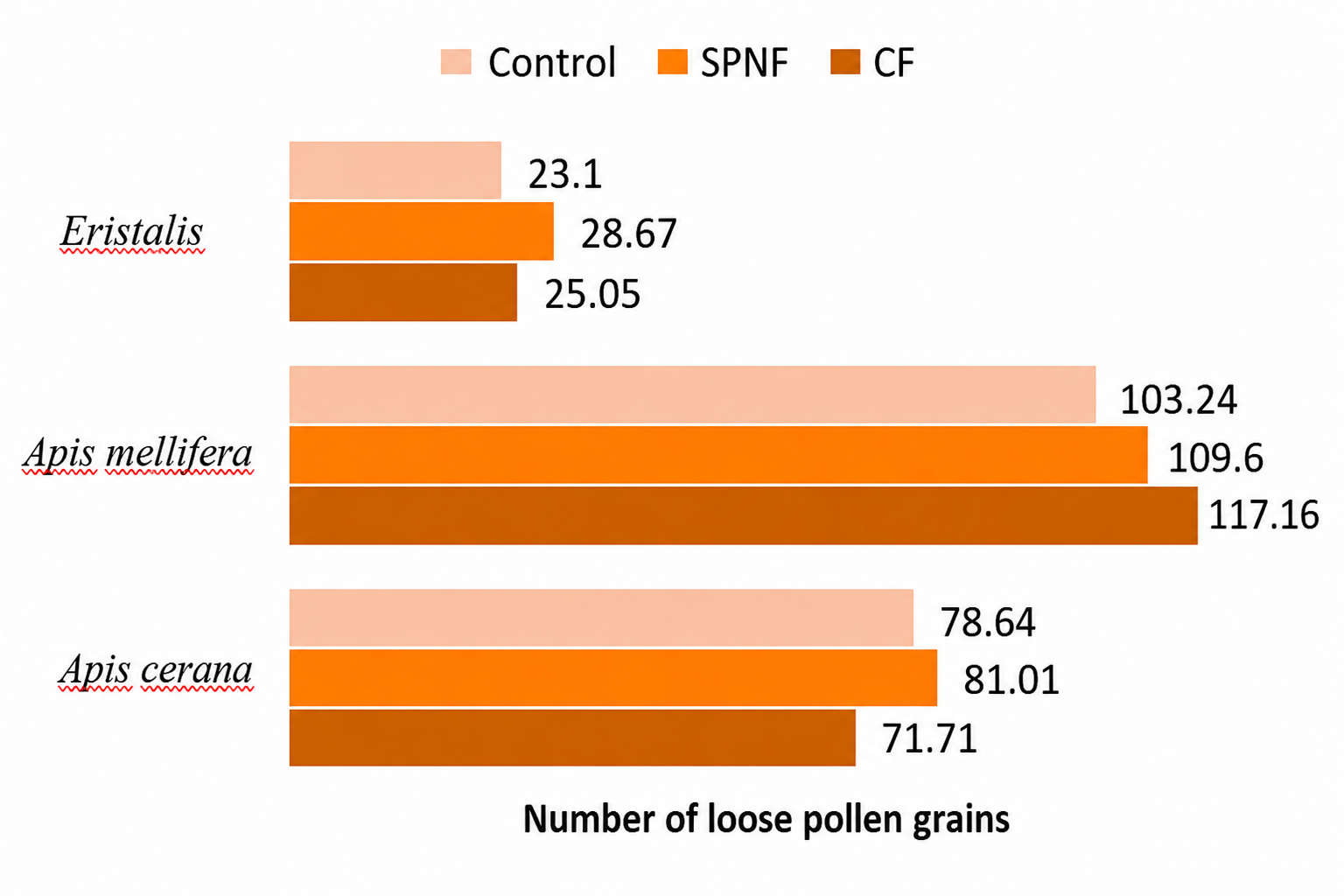
The present study was on pollinator diversity and foraging behavior of Apis mellifera Linnaeus and Apis cerana Fabricius on Chinese cabbage (Brassica rapa Linnaeus subspecies chinensis) grown under different farming systems. A total of 19 insects belonging to 16 genera under 7 families and 3 orders were recorded on Chinese cabbage. Among all insect visitors, A. mellifera (8.85 / 100 flowers) was the most dominant visitor. Significantly higher abundance was recorded in SPNF system followed by the control and CF system, respectively. The insect pollinators showed a positive correlation with temperature and a negative correlation with humidity. The average number of flowers visited by both foragers in one minute was significantly more in SPNF system followed by the control and CF system. The average time spent per flower by both foragers was significantly more in the CF system followed by the control and SPNF system. The number of loose pollen grains sticking to the body of insect pollinators recorded in SPNF system and CF system was statistically the same. Hence, it can be concluded that pollinators prefer SPNF system as compared to CF system and control. So, due to enhanced pollination in SPNF system, farmers may obtain more yields if they are consistent with the timely application of indigenous farm products.
References
[1] P. Hanson, R. Y. Yang, L. C. Chang, L. Ledesma and D. Ledesma (2009). Contents of carotenoids, ascorbic acid, minerals and total glucosinolates in leafy brassica pakchoi (Brassica rapa L. chinensis) as affected by season and variety. J. Sci. Food Agric., 89: 906-914.
[2] R. Bishnoi and A. Bhati (2017). An Overview: Zero Budget Natural Farming. Trends in Biosci., 10: 9314-9316.
[3] S. Palekar (2006). Shoonya Bandovalada Naisargika Krushi published by Swamy Anand, Agri Prakashana, Bangalore.
[4] T. H. Roultson, S. A. Smith and A. L. Brewster (2007). A comparison of pan trap and intensive net sampling techniques for documenting a bee (Hymenoptera:Apiformes) fauna. J. Kans. Entomol. Soc., 80: 179-181.
[5] H. K. Sharma, N. Bakshi, R. K. Thakur and M. Devi (2016a). Diversity and density of insect pollinators on sweet cherry (Prunus avium I.) in temperate regions of Kullu valley of Himachal Pradesh. J. Entomol. Res., 40: 123-128.
[6] J. H. Cane, R. L. Minckley and L. J. Kervin (2000). Sampling bees for pollinator community studies: pitfalls of pan-trapping. J. Kans. Entomol. Soc., 73: 225-231.
[7] R. Rader, W. Edwards, D. Westcott, S. A. Cunningham and B. G. Howlett (2011). Pollen transport differs among bees and flies in a human-modified landscape. Divers. Distrib., 17: 519-524.
[8] J. Ollerton, R. Winfree and S. Tarrant (2011). How many flowering plants are pollinated by animals? Oikos, 120: 321-326.
[9] R. Thapa (2006). Honeybees and other insect pollinators of cultivated plants: A review. J. Inst. Agric. Anim., 27: 1-23.
[10] D. L. Anderson, M. Sedgeley, J. R. T. Short and A. J. Atwood (1982). Insect pollination of Mango in northern Australia. Aust. J. Agric. Res., 33: 541-548.
[11] N. D. Skrebtsova, (1957). Amounts of pollen on body of bees. ) (In Russian), Pchelovodstvo Mosk 34: 39-42.
[12] C. Westphal, R. Bommarco, G. Carre, E. Lamborn, N. Morison, T. Petanidou, S. G. Potts et al., (2008). Measuring bee diversity in different European habitats and biogeographical regions. Ecol Monogr., 78: 653-671.
[13] T. Atmowidi, D. Buchori, S. Manuwoto, B. Suryobroto and P. Hidayat (2007). Diversity of insect pollinators in relation to seed set of mustard, Brassica rapa L. Hayati. J. Biosci., 14: 155-161.
[14] B. Bhowmik, B. Mitra and K. Bhadra (2014). Diversity of insect pollinators and their effect on the crop yield of mustard (Brassica juncea L.), NPJ-93 from southern West Bengal. Int. J. Recent Sci. Res., 5: 1207-1213.
[15] P. P. Gautam and N. Kumar (2018). Pollinator diversity and relative abundance of insect pollinators on ridge gourd (Luffa acutangula) flowers in Bihar (India). J. Entomol. Zool. Stud., 6: 1177-1181.
[16] A. K. Sharma, H. S. Dhaliwal and K. L. Kaker (1974). Insect visitors and pollinators of cauliflower seed crop bloom. Himachal Journal of Agricultural Research 2: 74-78.
[17] S. S. Thakur, S. Kumar and K. S. Verma (2004). Bloom visiting insects and their foraging behaviour on broccoli. Pest Management Economic Zool., 12: 145:151.
[18] D. P. Abrol (2007). Foraging behaviour of Apis. mellifera L. and Apiscerana F. as determined by the energetics of nectar production in different cultivar of Brassica campestris var. Toria. J Apic Sci., 51: 19-23.
[19] D. Gabriel and T. Tscharntke (2007). Insect pollinated plants benefit from organic farming. Agric Ecosyst Environ., 118: 43-48.
[20] R. Pudasaini, R. B. Thapa, N. K. Chaudhary and S. Tiwari (2015). Insect pollinators diversity of rapeseed (Brassica campestris var. toria) in Chitwan, Nepal. J. Inst. Agric. Anim. Sci., 33: 73-78.
[21] H. Chand, R. Singh and S. F. Hameed (1994). Population dynamics of insect pollinators in mustard (Brassica juncea L.). J. Entomol. Res., 18: 233-239.
[22] H. S. Devi, B. K. Sontakke, L. N. Mohaptara and J. Padhi (2011). Foraging activities of Italian bee, Apis mellifera L. on mustard under coastal conditions of Orissa. J. Plant Protec. Environ., 8: 34-38.
[23] B. Bisht and R. Tiwari (2017). Effect of plant and animal origin products on quality of honey, growth parameters and foraging behaviour of honeybee Apis mellifera L at Pantnagar, Uttrakhand-An eco-friendly and novel approach. J. Entomol. Zool. Stud., 5: 394-399
[24] H. K. Sharma, S. Katna, B. S. Rana and K. Rana (2016b). Apis cerana F. as an important natural pollinator of radish (Raphanus sativus L.) under mid-hill conditions of Himachal Pradesh. Int. J. Bio-resour. Stress Manag., 7: 1156-1160.
[25] D. P. Singh, S. C. Verma, P. Thakur and S. Kumari (2017). Impact of organic inputs and transplanting dates on insect fauna and seed production in radish (Raphanus sativus L.). J. Entomol. Zool. Stud., 5: 1651-1654
[26] M. Devi and H. K. Sharma (2017). Impact of weather on phenology and its effect on insect pollinators diversity and pollination of mustard (Brassica juncea L.) sown on different sowing dates. J. Entomol. Zool. Stud., 6: 1889-1893.
[27] H. K. Sharma and B. S. Rana (2000). Foraging behaviour of insect pollinators on pollination of cherry. In: Proceedings of the Seventh International Conference on Tropical Bees: Management and Diversity and Fifth Asian Apiculture Association conference. Chiang Mai, Thailand 19-25.
Downloads
Published
Issue
Section
License
Copyright (c) 2022 Author (s)

This work is licensed under a Creative Commons Attribution-NonCommercial-NoDerivatives 4.0 International License.
Copyright © The Author(s). This is an open access article distributed under the terms of the Creative Commons Attribution-NonCommercial-NoDerivatives 4.0 International License (CC BY-NC-ND 4.0), which permits unrestricted non-commercial use, distribution, and reproduction in any medium, provided the original author(s) and source are properly credited, and the work is not modified or adapted.