Thermal and functional properties of a biofilms composed of fruits and vegetables waste
DOI:
https://doi.org/10.31783/elsr.2022.81175182Keywords:
biofilms, biomaterials, food packaging, FTIR, TGAAbstract
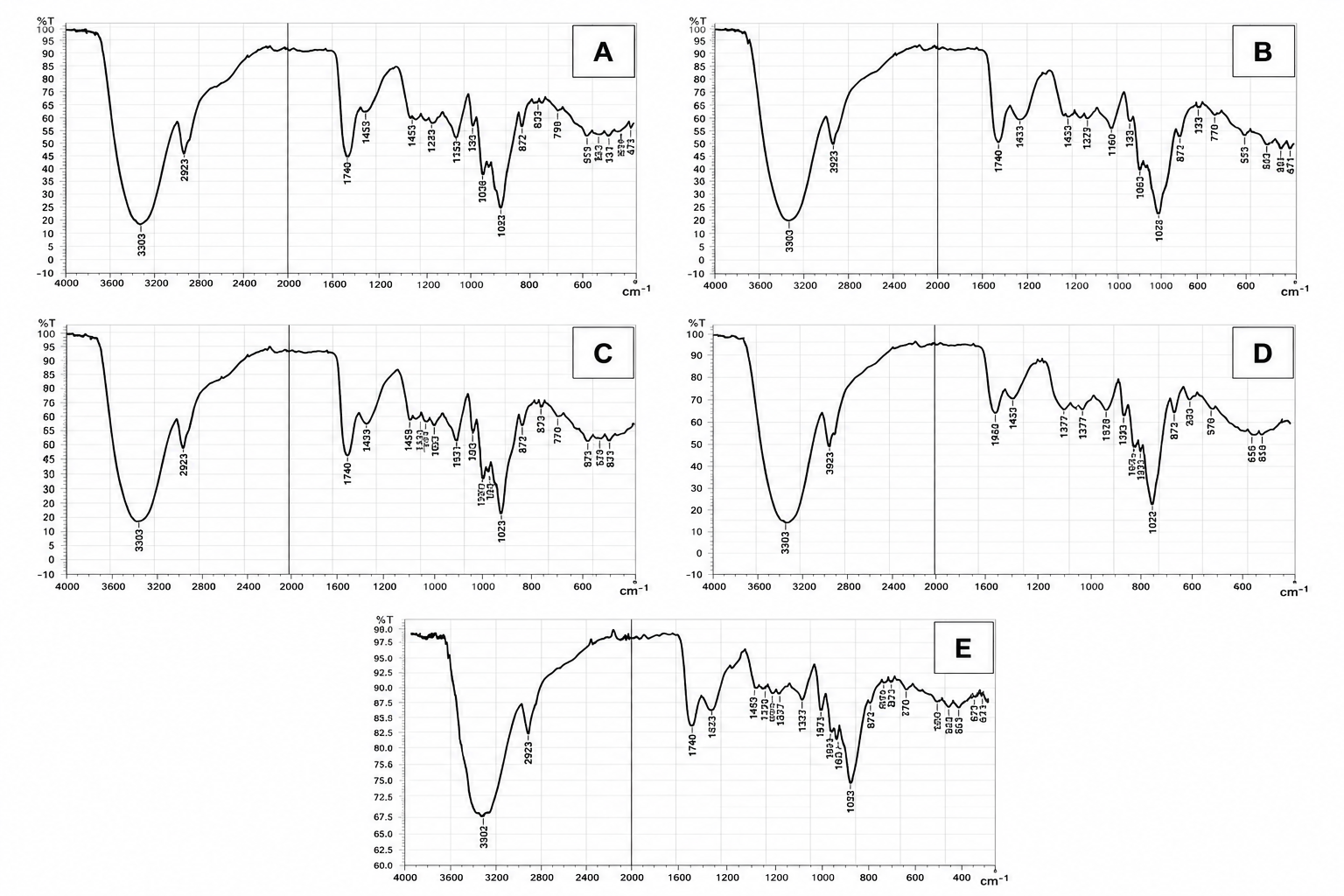
This study includes the development of biofilms from orange peel (OP), apple pomace (AP), tomato pomace (TP), and potato peel (PP). Thermogravimetric analysis (TGA), fourier transform infrared spectroscopy (FTIR), transparency, and water solubility were performed on the synthesized films. The biofilms were prepared using the casting method. The OP, AP, and TP, along with pectin and glycerol, form a flexible film at a concentration of 6%, whereas the PP forms a film at 4%. The TGA results showed that the OP film has the highest decomposition temperature, ranging from 194.5℃ to 246.92℃. The FTIR spectra of the biofilms revealed the interaction between the plasticizer and polysaccharide compounds. The pectin film (PF) had a transparency of 2.19%, while the TP film had a transparency of 7.45%, the highest among the fruit & vegetable waste (FVW) films. The lower the transparency score, the more transparent the film. The water solubility of PF film was 89%, while that of FVW-based films was lower. The usage of FVW-based biofilms and their use in food packaging would minimize plastic products, resulting in reduced pollution.
References
[1] F. Dilucia, V. Lacivita, A. Conte, and M. A. Del Nobile (2020). Sustainable use of fruit and vegetable by-products to enhance food packaging performance. Foods., 9: 857. doi:10.3390/foods9070857.
[2] N. A. Sagar, S. Pareek, S. Sharma, E. M. Yahia, and M. G. Lobo (2018). Fruit and vegetable waste: bioactive compounds, their extraction, and possible utilization. Compr. Rev. Food Sci. Food Saf., 17: 512-531.
[3] H. Kumar, K. Bhardwaj, R. Sharma, E. Nepovimova, K. Kuča, D. S. Dhanjal and R. Verma et al., (2020). Fruit and Vegetable Peels : Utilization of High Value Horticultural Waste in Novel Industrial Applications. Molecules., 25: 2812. doi: 10.3390/molecules25122812.
[4] C. H. N. de Barros, G. C. F. Cruz, W. Mayrink and L. Tasic (2018). Bio-based synthesis of silver nanoparticles from orange waste: effects of distinct biomolecule coatings on size, morphology, and antimicrobial activity. Nanotechnol. Sci. Appl., 11: 1-14.
[5] P. Berger, C. C.-Alvarado, J. D.-Soberanes, L. C. H.-Lozano, D. O.-Fraustro, M. F. M.-Ochoa, S. and L.-Domínguez (2020). Biopolymers obtained from orange waste based on a decision tree. IEEE Andescon, pp1-6. doi: 10.1109/ANDESCON50619.2020.9271999.
[6] M. S. L. Ferreira, M. C. P. Santos, T. M. A. Moro, G. J. Basto, R. M. S. Andrade, and É. C. B. A. Gonçalves (2015). Formulation and characterization of functional foods based on fruit and vegetable residue flour. J. Food Sci. Technol., 52: 822-830.
[7] C. G. Otoni, R. J. Avena-bustillos, H. M. C. Azeredo, M. V Lorevice, ,M. R. Moura, L. H. C. Mattoso and T. H. Mchugh (2017). Recent Advances on Edible Films Based on Fruits and Vegetables - A Review. Compr. Rev. Food Sci. Food Saf., 16: 1151-1169.
[8] R. Sharma, H. S. Oberoi, and G. S. Dhillon (2016). Fruit and Vegetable Processing Waste : Renewable Feed Stocks for Enzyme Production. In Agro-industrial wastes as feedstock for enzyme production (pp23-59). Academic Press.
[9] V. Bátori, M. Jabbari, D. Åkesson, P. R. Lennartsson, M. J. Taherzadeh, and A. Zamani (2017). Production of Pectin-Cellulose Biofilms : A New Approach for Citrus Waste Recycling. Int. J. Polym. Sci., doi: https://doi.org/10.1155/2017/9732329.
[10] D. Domene-López, J. C. García-Quesada, I. Martin-Gullon, and M. G. Montalbán (2019). Influence of starch composition and molecular weight on physicochemical properties of biodegradable films. Polymers, 11: 1084. doi: 10.3390/polym11071084.
[11] J. H. Han (2014). Edible Films and Coatings. In Innovations in Food Packaging (Second Edition) Elsevier Ltd.
[12] S. D. Pasini Cabello, E. A. Takara, J. Marchese, and N. A. Ochoa (2015). Influence of plasticizers in pectin films: Microstructural changes. Mater. Chem. Phys., 162: 491-497.
[13] V. Bátori, M. Jabbari, R. K. Srivastava, D. Åkesson, P. R. Lennartsson, A. Zamani and M. J. Taherzadeh (2018). Synthesis and characterization of Maleic Anhydridegrafted orange waste for potential use in biocomposites. BioRes., 13: 4986-4997.
[14] I. S. Bayer, S. Guzman-Puyol, J. A. Heredia-Guerrero, L. Ceseracciu, F. Pignatelli, R. Ruffilli and R. Cingolani (2014). Direct transformation of edible vegetable waste into bioplastics. Macromolecules., 47: 5135-5143.
[15] E. A. M. S. Almeida (2015). Synthesis and characterization of pectin derivative with antitumor property against Caco-2 colon cancer cells. Carbohydr. Polym., 115: 139-145.
[16] S. Hidayati, Zulferiyenni, U. Maulidia, W. Satyajaya, and S. Hadi (2021). Effect of glycerol concentration and carboxy methyl cellulose on biodegradable film characteristics of seaweed waste. Heliyon., 7: 07799. doi: 10.1016/j.heliyon.2021.e07799.
[17] U. Siripatrawan and B. R. Harte (2010). Physical properties and antioxidant activity of an active film from chitosan incorporated with green tea extract. Food Hydrocoll., 24: 770-775.
[18] K. K. Gaikwad, J. Y. Lee, and Y. S. Lee (2016). Development of polyvinyl alcohol and apple pomace bio-composite film with antioxidant properties for active food packaging application. J. Food Sci. Technol., 53: 1608-1619.
[19] S. Khairunnisa, Junianto, Zahidah, and I. Rostini (2018). The effect of glycerol concentration as a plasticizer on edible films made from alginate towards its physical characteristic. World Sci. News, 112: 130–141.
[20] K. Miller, C. Silcher, M. Lindner, and M. Schmid (2021). Effects of glycerol and sorbitol on optical, mechanical, and gas barrier properties of potato peel-based films. Packag. Technol. Sci., 34: 11-23.
[21] P. P. Borah, P. Das, and L. S. Badwaik (2017). Ultrasound treated potato peel and sweet lime pomace based biopolymer film development. Ultrason. Sonochem., 36: 11-19.
[22] A. E. Pavlath, A. Voisin, and G. H. Robertson (1999). Pectin-based biodegradable water insoluble films. Macromol. Symp., 140: 107-113.
[23] L. Alves, B. Medronho, F. E. Antunes, D. Topgaard, and B. Lindman (2016). Dissolution state of cellulose in aqueous systems. 2.Acidic solvents. Carbohydr. Polym., 151: 707-715.
[24] A. Schieber (2016). Side streams of plant food processing as a source of valuable compounds : selected examples. Annu. Rev. Food Sci. Technol., 28: 97-112.
[25] Sucheta, S. K. Rai, K. Chaturvedi and S. K. Yadav (2019). Evaluation of structural integrity and functionality of commercial pectin based edible films incorporated with corn flour, beetroot, orange peel, muesli and rice flour. Food Hydrocoll., 91: 127-135.
Downloads
Published
Issue
Section
License
Copyright (c) 2022 Author (s)

This work is licensed under a Creative Commons Attribution-NonCommercial-NoDerivatives 4.0 International License.
Copyright © The Author(s). This is an open access article distributed under the terms of the Creative Commons Attribution-NonCommercial-NoDerivatives 4.0 International License (CC BY-NC-ND 4.0), which permits unrestricted non-commercial use, distribution, and reproduction in any medium, provided the original author(s) and source are properly credited, and the work is not modified or adapted.