
Hornet pests of honey bees in the Indian Himalayas and a low cost trapping device for their eco-friendly management
DOI:
https://doi.org/10.31783/elsr.2022.81183194Keywords:
bee keeping, honey bees, hornet trap, Indian Himalayas, pest managementAbstract
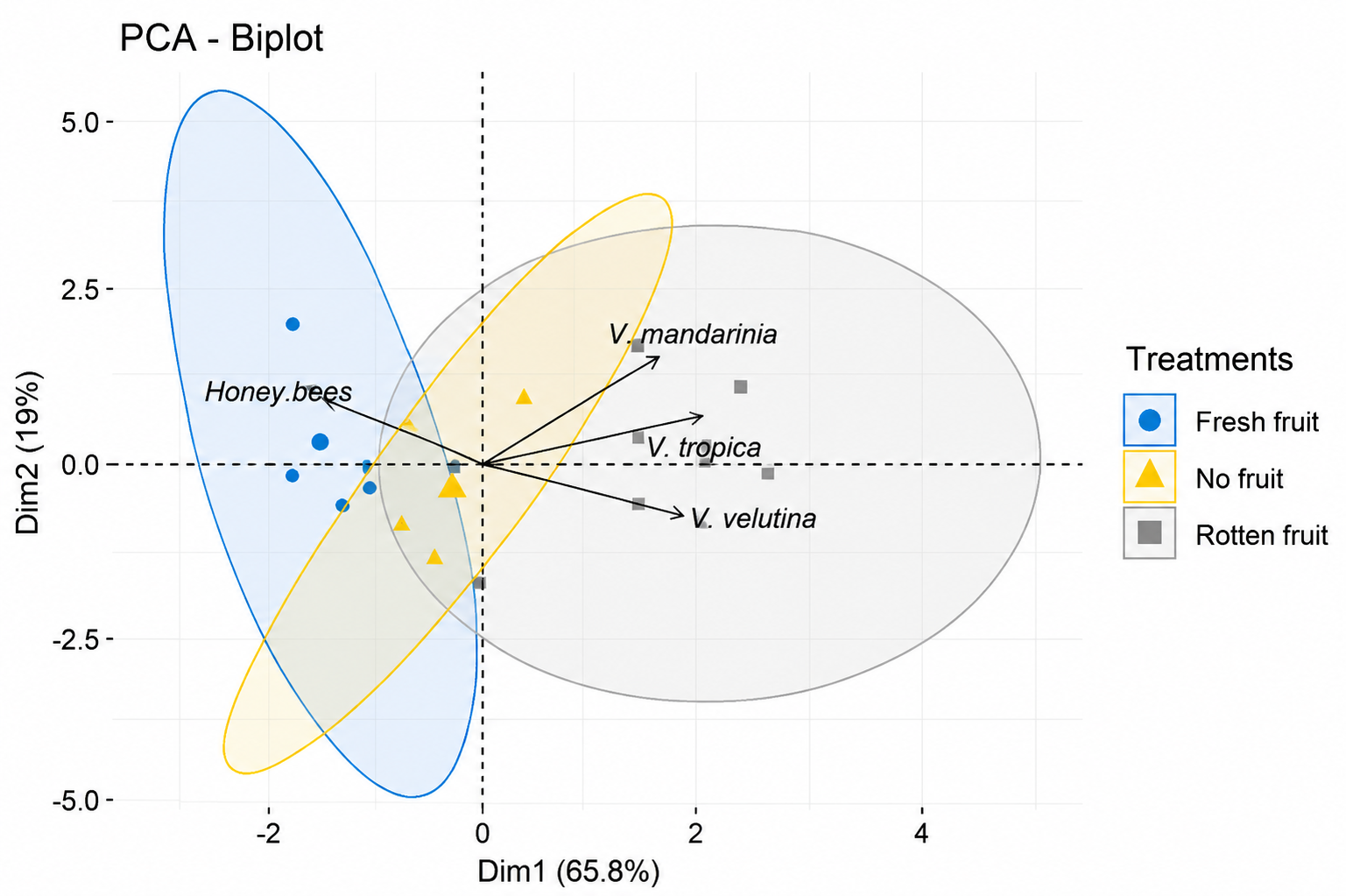
Honey bees suffer from a cosmic array of biotic and abiotic stress during their life cycle. The insect pests like wax moths and Dermestid beetles contribute immensely to the damage of bee colonies and reduction in honey yield in tropical regions of India. While, the bee colonies in temperate regions of Indian Himalayas, face an entirely different set of hitches that include predation of forager bees by three hornet species (Vespa mandarinia, Vespa velutina nigrithorax and Vespa tropica). The attacks on bee colonies by these hornet species compel the bees to desert the colony and swarm away to a new habitat thus, causing severe economic losses to bee keepers. Considering the severe setbacks enforced by hornets, a low-cost hornet trap was designed. The bait ingredients and their trapping efficiency against targeted hornet species are presented herewith. It was observed that green colored bottles attracted 34 hornets of three species in 10 days, while transparent bottles attracted only seven hornets at bait proportions of 1:2:2 (Apple cedar Vinegar: orange juice: water). Moreover, to reduce the attraction of honey bees into the trap, supplementary ingredients like rotten fruits and market honey were used, which enhanced the trapping efficiency of hornets. The benefit-cost ratio of 12.30:1 was recorded after the installation of the trap, which was significantly superior to traditional method (1.64:1) of manual swatting of hornets in the apiary. The farmers are currently trained to design and use these traps for the management of hornet pests in the Indian Himalayas.
References
[1] V. V. Kumar and N. G. Joy (2017). Honey Production and Marketing-Overview. Int. J. Eng. Manag. Res., 7: 30-42.
[2] S. Mann, R. Balakrishnan, . Y. B. Kalnar, R. K. Anurag, A. K. Dixit and R. Sharma (2020). Honey production and processing: Strategies for implementation. Technical Report. http://krishi.icar.gov.in/jspui/handle/123456789/35059.
[3] M. A. Aizen, L. A. Garibaldi, S. A. Cunningham and A. M. Klein (2008). Long-term global trends in crop yield and production reveal no current pollination shortage but increasing pollinator dependency. Curr. Biol. 18: 1572-1575.
[4] Anonymous (2019). Food and Nutrition. https://www.statista.com ; [last accessed 11 July 2020].
[5] P. L. Uniyal, P. Tiwari and E. Chaudhary (2018). Studies on floral sources, phenolic, flavonoid, proline contents and antioxidant capacity of honey from the Khirsoo area of Pauri, Uttarakhand, India. Indian J. Agric. Sci., 88: 1537-1542.
[6] F. A. Shah and T. A. Shah (1991). Vespa velutina, a serious pest of honey bees in Kashmir. Bee World. 72: 161-164.
[7] F. Requier, Q. Rome, C. Villemant and M. Henry (2020). A biodiversity-friendly method to mitigate the invasive Asian hornet’s impact on European honey bees. J. Pest Sci., 93: 1-9.
[8] D. Dazhi and W. Yunzhen (1989). A preliminary study of the biology of V. velutina auraria Smith and Vespa tropica ducalis Smith. Zool. Res., 10: 155-162.
[9] J. Yoshimoto and T. Nishida (2009). Factors affecting behavioral interactions among sap-attracted insects. Ann. Entomol. Soc. Am., 102: 201-209.
[10] C. Nuñez-Penichet, L. Osorio-Olvera, V. H. Gonzalez, M. E. Cobos, L. Jiménez, D. A. DeRaad and J. Soberon et al., (2021). Geographic potential of the world’s largest hornet, Vespa mandarinia Smith (Hymenoptera: Vespidae), worldwide and particularly in North America. Peer J., 9: e10690. doi: 10.7717/peerj.10690.
[11] G. Zhu, J. G. Illan, C. Looney and D. W. Crowder (2020). Assessing the ecological niche and invasion potential of the Asian giant hornet. Proc. Natl. Acad. Sci. U S A., 117: 24646-24648.
[12] R. Pande, N. S. A. Thakur, S. V. Ngachan, D. J. Rajkhowa (2015). First record of wax beetle, Platybolium alvearium Blair (Coleoptera: Tenebrionidae), in Eastern Himalaya: A new threat to Indian honey bee (Apis cerana fabricius) colonies. J. Entomol. Res., 39: 269-273.
[13] S. J. Martin (2004). A simulation model of biological control of social hornets (Vespinae) using mermithid nematodes. N. Z. J. Zool., 31: 241-248.
[14] M. P. Chauzat and S. J. Martin (2009). A foreigner in France: the Asian hornet. Biologist. 56: 86-91.
[15] W. R., Mason and J. T. Huber (1993). Order Hymenoptera. In (eds) H. Goulet, J. T. Huber Hymenoptera of the world: an identification guide to families. Minister of Supply and Services, Canada. 4-12.
[16] K. Seltmann (2004). An interactive key to the families of Hymenoptera and other methods of disseminating web-based information. In The 2004 ESA Annual Meeting and Exhibition. November, 2004.
[17] A. H. Smith-Pardo, J. M. Carpenter and L. Kimsey (2020). The diversity of hornets in the genus Vespa (Hymenoptera: Vespidae; Vespinae), their importance and interceptions in the United States. Insect Syst. Divers., 4: 1-27.
[18] S. Yamane (1976). Morphological and taxonomic studies on vespine larvae, with reference to the phylogeny of the subfamily Vespinae (Hymenoptera: Vespidae). Insecta Matsumurana (N.S.). 8: 1-45.
[19] J. Van der Vecht (1959). Notes on Oriental Vespinae, including some species from China and japan (Hymenoptera, Vespidae). Zool. Mededel., 36: 205-232.
[20] M. E. Archer (1993). A phylogenetic study of the species of the genus Vespa (Hymenoptera: Vespinae). Insect Syst. Evol., 24: 469-478.
[21] M. Matsuura and S. F. Sakagami (1973). A bishahmic sketch of the giant hornet, Vespa mandarinia, a serious pest for Japanese apiculture. Jour. Faa. Sci. Hokkaido Univ. Ser 4 (Zool), 19:125-162.
[22] T. Stankus (2020). Reviews of Science for Science Librarians: “Murder Hornets:” Vespa mandarinia japonica. Sci. Technol. Libr., 39: 244-252.
[23] M. E. Archer (1994). Recent rare and scarce hornets and bees (Hym., Aculeata) recorded from guernsey and herm. Entomol.'s Mon. Mag., 130: 103-104.
[24] C. K. Starr (1992). The social hornets (Hymenoptera: Vespidae) of Taiwan. Bull. Am. Mus. Nat. Sci., 3: 93-138.
[25] C. Villemant, M. Barbet-Massin, A. Perrard, F. Muller, O. Gargominy, F. Jiguet and Q. Rome (2011). Predicting the invasion risk by the alien bee hawking yellow-legged hornet Vespa velutina nigrithorax across Europe and other continents with niche models. Biol. Conserv., 144: 2142-2150.
[26] K. Tan, S. E. Radloff, J. J. Li, H. R. Hepburn, M. X. Yang, L. J. Zhang and P. Neumann, (2007). Bee-hawking by the hornet, Vespa velutina, on the honeybees Apis cerana and A. mellifera. Naturwissenschaften. 94: 469-472.
[27] M. Ono, T. Igarashi, E. Ohno and M. Sasaki (1995). Unusual thermal defence by a honeybee against mass attack by hornets. Nature, 377: 334-336.
[28] M. B. Choi, S. J. Martin and J. W. Lee (2012). Distribution, spread, and impact of the invasive hornet Vespa velutina in South Korea. J. Asia Pac. Entomol., 15: 473-477.
[29] P. G. Kumar and G. Srinivasan (2010). Taxonomic studies of hornet hornets (Hymenoptera: Vespidae) Vespa Linnaeus of India. Rec. Zool. Surv. India. 110 (Part-2): 57-80.
[30] P. Barss (1989). Renal failure and death after multiple stings in Papua New Guinea: Ecology, prevention and management of attacks by vespid hornets. Med. J. Aust., 151(11-12): 659-663.
[31] J. Bequaert (1936). The common Oriental hornets, Vespa tropica and Vespa affinis, and their colour forms. Treubia, 15: 329-351.
[32] Miyano, S. (1980). Life tables of colonies and workers in a paper hornet, Polistes Chinensis antennalis, in central Japan (Hymenoptera: Vespidae). Popul. Ecol., 22: 69-88.
[33] M. E. Archer (2008). Taxonomy, distribution and nesting biology of species of the genera Provespa Ashmead and Vespa Linnaeus (Hymenoptera, Vespidae). Entomol.'s Mon. Mag., 144: 69-101.
[34] F. Cappa, A. Cini, L. Bortolotti, J. Poidatz and R. Cervo (2021). Hornets and Honey Bees: A coevolutionary arms race between ancient adaptations and new invasive Threats. Insects 12(11):1037.
[35] C. Gill, C. Jack and A. Lucky (2020). Asian Giant Hornet Vespa mandarinia Smith (1852) (Insecta: Hymenoptera: Vespidae): ENY-574/IN1281. EDIS, 3: 5.
[36] B. Powell (2020). Asian Giant Hornet (Vespa mandarinia) and Yellow-Legged Hornet (Vespa velutina), Potential Pests of Honey Bees. Clemson (SC): Clemson Cooperative Extension, Land-Grant Press by Clemson Extension; LGP 1098. http://lgpress.clemson.edu/publication/asian-giant-hornet-vespa-mandarinia-and-yellow-legged-hornet-vespa-velutina-potential-pests-of-honey-bees/.
[37] M. K. Glaiim, H. A. Mahdi and H. A. Ibrahim (2008). Testing the efficacy of some methods recommended abroad for controlling the oriental hornet, Vespa orientalis L., attacking honey bee, Apis mellifera L., colonies in Iraq. Bull Iraq Nat Hist Mus., 10: 21-27.
[38] A. G. Belkavsky (1937). The hornet (Vespa crabro L.) as an enemy of bees. Bee World 18: 75-77.
[39] N. Bacandritsos, I. Papanastasiou, C. Saitanis and E. Roinioti (2006). Three non-toxic insect traps useful in trapping wasps enemies of honey bees. Bull. Insectology, 59:135-145.
Downloads
Published
Issue
Section
License
Copyright (c) 2022 Author (s)

This work is licensed under a Creative Commons Attribution-NonCommercial-NoDerivatives 4.0 International License.
Copyright © The Author(s). This is an open access article distributed under the terms of the Creative Commons Attribution-NonCommercial-NoDerivatives 4.0 International License (CC BY-NC-ND 4.0), which permits unrestricted non-commercial use, distribution, and reproduction in any medium, provided the original author(s) and source are properly credited, and the work is not modified or adapted.