
Phytosociological assessment of Juniperus macropoda dominated forest stands in the Gurez valley of Kashmir Himalaya, India
DOI:
https://doi.org/10.31783/elsr.2022.81195206Keywords:
altitude, conservation, forest, Himalaya, management, samplingAbstract
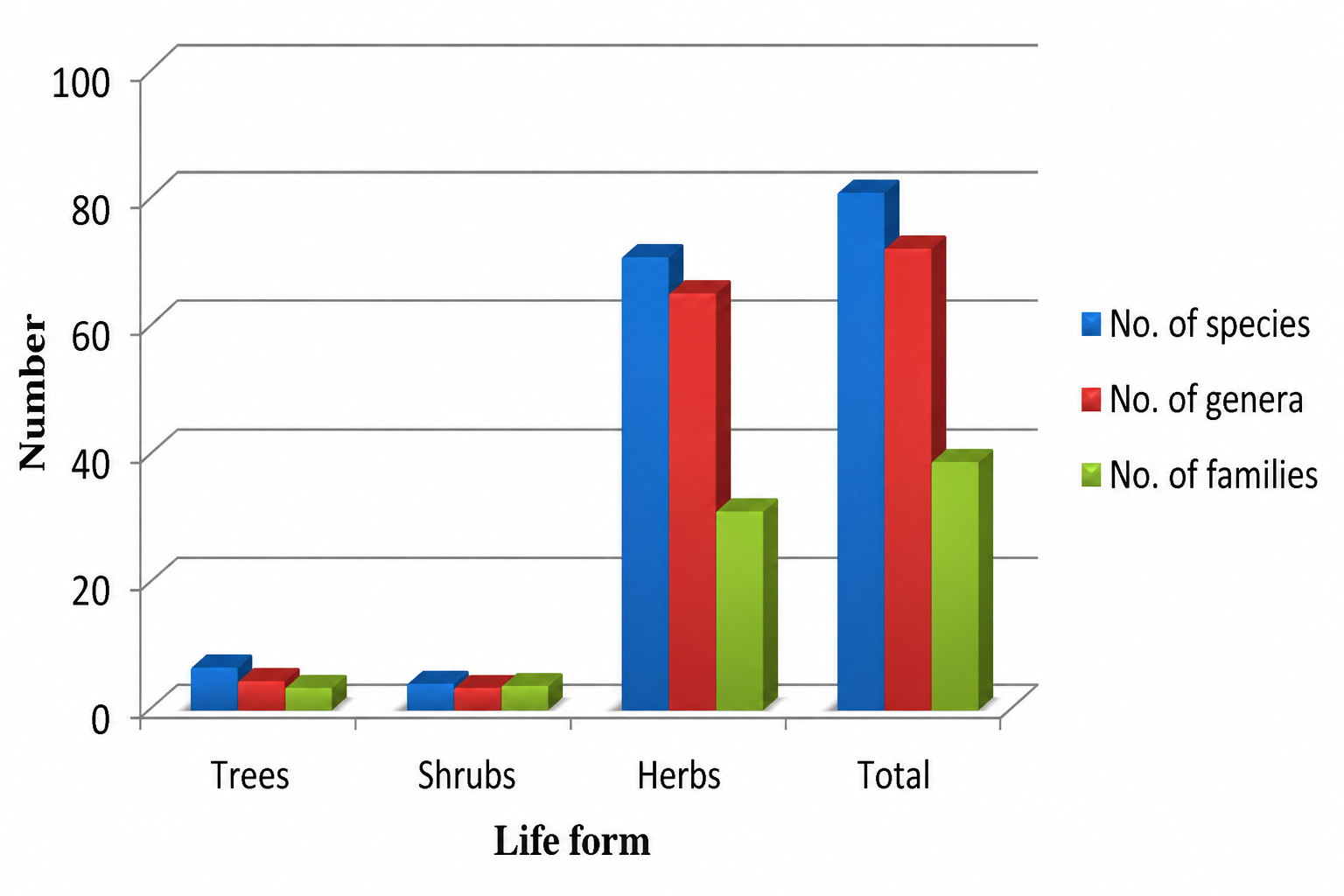
The present study entitled “Phytosociological assessment of Juniperus macropoda dominated forest stands in the Gurez valley of Kashmir Himalaya” was carried out to access the ecological status of this important species in the high-altitude landscapes of Gurez valley in Kashmir Himalaya, India. For a better understanding of these stands, the area was divided into three sites namely Kanzalwan, Dawar, and Burnai based on the standard sampling procedure. The results revealed that these three different sites harbor a total of 80 plant species representing 72 genera and belonging to 38 families. Of these reported 80 plant species, 6 species were trees, representing 4 genera under 3 families and 4 species of shrubs belonging to 4 genera from 4 families. The number of herbaceous species was 71 representing 64 genera under 31 families. Juniperus macropoda was dominant in all the sample sites with IVI of 205.57, 279.62, and 239 in Kanzalwan, Dawar, and Burnai forests respectively. Among shrubs, Rosa webbiana with IVI value of (114.5) was the dominant species followed by Hippophae rhamnoides (34.6) in Dawar only. Among the herbs, Stipa sibirica was dominant with IVI values of 20.08, 9.78, and 16.23 in Kanzalwan, Dawar, and Burnai forest stands respectively. Out of these three sites, Dawar reported the highest number of species followed by Kanzalwan and Burnai. The study is a baseline and will be of high significance in formulating conservation and sustainable management practices of this important Himalayan species.
References
[1] K. Ozkan, S. Gulsoy, R. Aerts and B. Muys (2010). Site properties for Crimean juniper (Juniperus excelsa) in semi-natural forests of South Western Anatolia, Turkey. J. Environ. Biol., 31: 97-100.
[2] H. Ahani, H. Jalilvand, N. S. M. Hosseini, K. H. Soltani, M. R. Ghaziand and H. Mohammadz (2013). Reproduction of Juniperus polycarpus in KhorasanRazavi, Iran. For. Sci. Pract., 15: 231-237.
[3] A. S. Korouri, M. Khoshnevisand M. Matinizadeh (2011). Comprehensive studies of juniper species in Iran. Publication of Pooneh, Forest range and watershed management organization of Iran, Iran. Pp554.
[4] S. Carus (2004). Increament and growth in Crimean Juniper (Juniperus excelsa Biab.) stands in Isparta-Sutculer Region of Turkey. J. Biol. Sci., 4:173-179.
[5] A. Stampoulidis, E. Milios and K. Kitikidou (2013). The regeneration of pure Juniperus excelsa stands in Prespa National Park' in Greece. Sumar List., 137: 163-171.
[6] G. Aussenac (2002). Ecology and ecophysiology of circum Mediterranean firs in the context of climate change. Ann. For. Sci., 59: 823-832.
[7] A. K. Taheri, F. F. Khosh, R. Jandi and B. S. Foumani (2012). Structure and regeneration patterns of Juniperus polycarpus in Alborzmountains. Iran. J. Basic. Appl. Sci. Res., 2: 5993-5996.
[8] Anonymous (1959). The wealth of India-raw materials. Counsil of scientific and industrial research (CSIR), New Delhi. pp306-311.
[9] D. K. Ved, G. A. Kinhal, K. R. Kumar, V. Prabhakaran, U. Ghate, R. V. Sankar and J. H. Indresha (2003). Conservation assessment and management prioritization for the medicinal plants of Jammu and Kashmir, Himachal Pradesh and Uttaranchal. Foundation for Revitalisation of Local Health Traditions, Bangalore
[10] S. Ara and A. R Naqshi (1992). Ethno botanical studies in Gurais Valley. J. Econ Taxon Bot., 17: 657-678.
[11] J. T. Curtis and R. P. McIntosh (1959). The interrelations of certain analytic and synthetic phytosociological characters. Ecology, 31: 434-455.
[12] R. Misra (1968). Ecology work book. Oxford and IBH Publishing Company, Calcutta.
[13] K. A. Kershaw (1973). Quantitative and dynamic plant ecology. Edward Arnold, London.
[14] G. Cintron and Y. S. Novelli (1984). Methods for studying mangrove structure. In: Snedaker S. C, Snedaker C. G. The mangrove ecosystem: research methods.
[15] C. E. Shanon and W. Wiener (1949). The mathematical theory of communication. Urbana, University of IIIinois Press.
[16] E. H. Simpson (1949). Measurement of diversity. Nature, 163: 688-688.
[17] J. M. Dad and Z. A. Reshi (2015). Influence of environmental and anthropogenic factors on the species distribution in alpine rangelands of Gurez valley, Kashmir, India. Trop. Ecol., 56: 335-346.
[18] P. Sharma, J. C. Rana, U. Devi, S. S. Randhawa and R. Kumar (2014). Floristic diversity and distribution pattern of plant communities along altitudinal gradient in Sangla valley, Northwest Himalaya. Sci. World J., 2014: Article ID 264878, doi: https://doi.org/10.1155/2014/264878.
[19] J. T. Zhang (2002). A study on relations of vegetation, climate and soils in Shanxi province, China. Plant Ecol., 162: 23-31.
[20] N. Parthasarathy and R. Karthikeyan (1997). Plant biodiversity inventory and conservation of two tropical dry evergreen forests on the Coromandel coast, south India. Biodivers. Conserv., 6: 1063-1083.
[21] W. F. Johnston (1971). Broadcast burning slash favors black spruce reproduction on organic soil in Minnesota. For. Chron., 47: 33-35.
[22] E. J. Chaneton and R. S. Lavado (1996). Soil nutrients and salinity after long-termgrazing exclusion in a flooding Pampa grassland. J. Range Manag., 49: 182-187.
[23] S. Gunaga, N. Rajeshwari and R. Vasudevai (2013). Tree diversity and disturbance of kaanforests: relics of a community protected climax vegetation in the central western ghats. Trop. Ecol., 54: 117-131.
[24] C. Körner (1995). Alpine plant diversity: a global survey and functional interpretations. In: F. S. Chapin & C. Körner (ed.) Arctic and alpine biodiversity: patterns, causes and ecosystem consequences. Springer-Verlag, Berlin, Heidelberg.
[25] M. C. Nautiyal, B. P. Nautiyal and V. Prakash (2004). Effect of grazing and climatic changes on alpine vegetation of Tungnath, Garhwal Himalaya, India. Environmentalist, 24: 125-134.
[26] A. Saarsalmi, E. Malkonen and S. Piirainen (2001). Effects of wood ash fertilization on forest soil chemical properties. Silva Fenn., 35: 355-368.
[27] J. S. Singh, Y. S. Rawat and O. P. Chaturvedi (1984). Replacement of oak forest with pine in the Himalaya affect the nitrogen cycle. Nature, 311: 54-56.
[28] N. Visalakshi (1995). Vegetation analysis of two tropical dry evergreen forest in southern India. Trop. Ecol., 36: 117-127.
[29] P. S. Swamy, S. M. Sundarapandian, P. Chandrasekarand and S. Chandrasekaran (2000). Plant species diversity and tree population structure of a humid tropical forest in Tamil Nadu, India. Biodivers. Conserv., 9: 1643-1669.
[30] P. Deb and R. C. Sundriyal (2011). Vegetation dynamics of an old-growth lowland tropical rainforest in North-east India: species composition and stand heterogeneity. Int. J. Biodivers. Conserv., 3: 405-430.
[31] S. P. S. Kushwahaand S. Nandy (2012). Species diversity and community structure in Sal (Shorearobusta) forests of two different rainfall regimes in West Bengal, India. Biodivers. Conserv., 21: 1215-1228.
[32] H. Knight (1975). A phytosociological analysis of species rich tropical forest on Barro-Colorado Island: Panama. Ecol. Monogr., 45: 259-289.
Downloads
Published
Issue
Section
License
Copyright (c) 2022 Author (s)

This work is licensed under a Creative Commons Attribution-NonCommercial-NoDerivatives 4.0 International License.
Copyright © The Author(s). This is an open access article distributed under the terms of the Creative Commons Attribution-NonCommercial-NoDerivatives 4.0 International License (CC BY-NC-ND 4.0), which permits unrestricted non-commercial use, distribution, and reproduction in any medium, provided the original author(s) and source are properly credited, and the work is not modified or adapted.