Engineering properties of neem (Azadirachta indica) fruit and seed for the development of depulper and decorticator
DOI:
https://doi.org/10.31783/elsr.2022.81207223Keywords:
correlation analysis, depulping, neem, physical properties, regression analysisAbstract
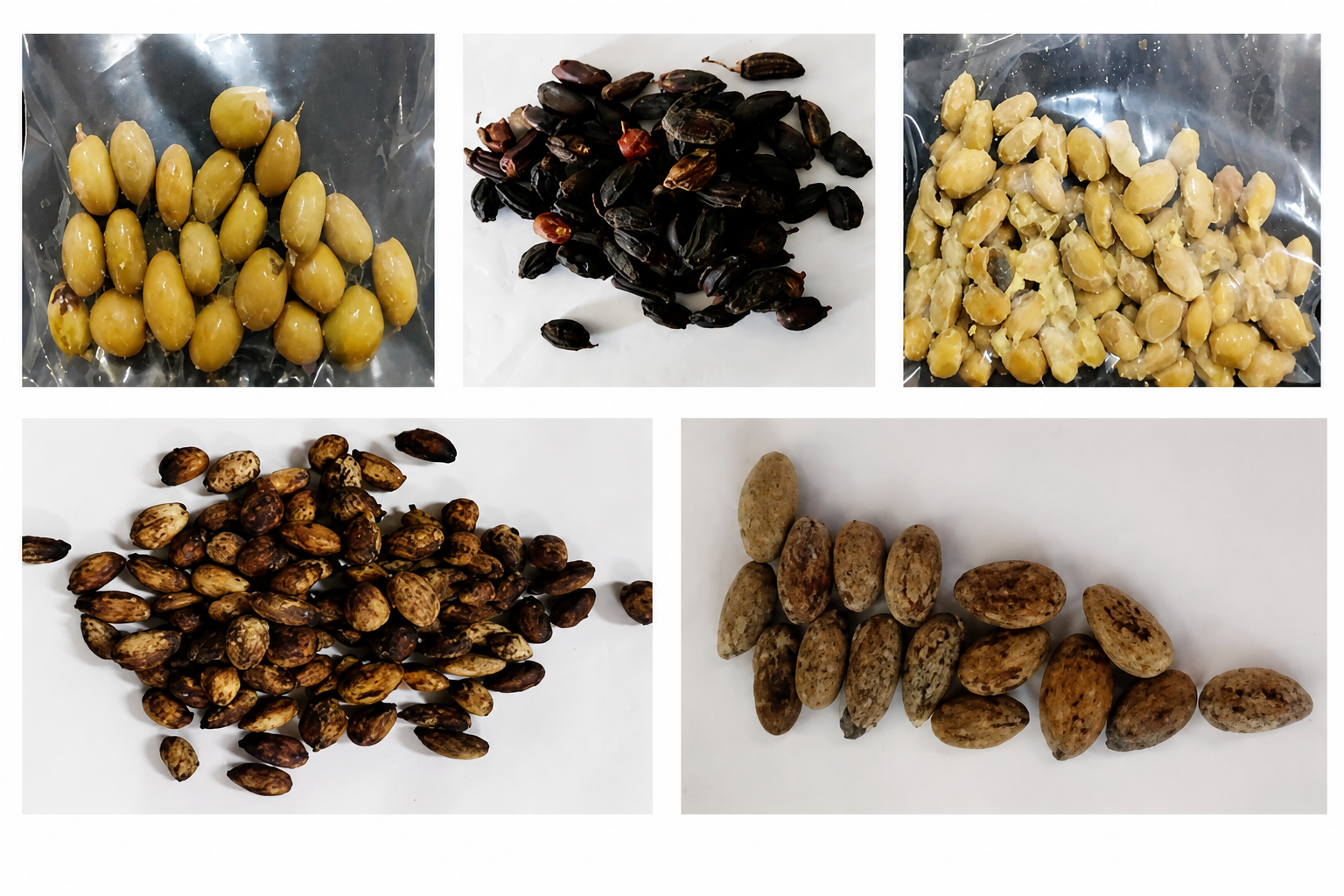
Studies had been carried out to study the engineering properties of neem fruits and seeds collected from the southern region of India at different moisture content which would be useful in studying drying characteristics, designing equipment, and developing neem fruit depulper. Engineering properties varied when moisture content varied, so for different moisture content of neem seeds study had been carried out. The moisture content, one thousand mass, mean linear axial dimensions (length, breadth and thickness), arithmetic mean diameter, geometric mean diameter, equivalent mean diameter, sphericity, surface area, volume, aspect ratio, frontal surface area, cross sectional area, shape index, bulk density, true density, porosity, angle of repose, coefficient of friction, compressive strength, terminal velocity and color value of the samples (fresh neem fruit, dry neem fruit, fresh neem seed at 30% MC, dried neem seed at 20% MC and dried seed at 10% MC) ranged between 10 to 38 %, 276.7 to 1200 g, (12.1 to 18.10, 8.452 to 12.63 and 8.15 to 12.18) mm, 9.57 to 14.30 mm, 9.41 to 14.07 mm, 28.876 to 52.77mm, 65.83 to 78.08 %, 278.10 to 621.92 mm2, 2617.874 to 8750.48 mm3, 55.29 to 70.60 %, 80.28 to 179.54 mm2, 71.87 to 160.68 mm2, 83.94 to 187.53 mm2, 157.639 to 726.36 kgm-3 , 730.14 to 929.33 kgm-3 , 21.84 to 78.40%, 30.29 to 42.80◦, 0.21 to 0.86, 39.24 to 412.02 N, 108.25 to 223.16 m/s and 3.0 to 84.1 respectively.
References
[1] F. A. Oluwole, M. B. Oumaru and A. T. Abdulrahim (2015). Traditional method of Neem seed oil extraction in North Eastern Nigeria: Challenges and prospects. Cont. J. Eng. Sci., 10: 1-8.
[2] S. H. Heroor and S. D. R. Bharadwaj (2013). Production of bio-fuel from crude neem oil and its performance. Int. J. Environ. Eng. Manag., 4: 425- 432.
[3] K. Girish and B.S. Shankara (2008). Neem-A green treasure. Electronic J. Biol., 4: 102-111.
[4] B. D. Nde, A. E. Ngu and M. I. Natang (2013). Physical properties of Neem (Azadirachtaindicaa. juss) fruits, nuts and kernels. Sky J. Food Sci., 2: 14-23.
[5] S. E. Atawodi and J. C. Atawody (2009). Azadirachta indica (Neem): a plant of multiple biological and pharmacological activities. Phytochem. Rev., 8: 601-620.
[6] R. Subapriya and S. Nagini (2005). Medicinal properties of Neem leaves: A Review. Curr. Med. Chem. Anti-Cancer Agents, 5: 149-156.
[7] S. Lokanadhan, P. Muthukrishnan and S. Jeyaraman (2012). Neem products and their agricultural applications. J. Biopest., 5: 72-76. doi: 10.1038/srep33484.
[8] N. Kaushik, B. G. Singh, U. K. Tomar, S. N. Naik, S. Vir, S. S. Bisla and K. K. Sharma et al., (2007). Regional and habitat variability in azadirachtin content of Indian neem (Azadirachta indica A. Jusieu). Curr. Sci., 92: 1400-1406.
[9] R. C. Solanki, S. N. Naik, S. Santosh, A. P. Srivastava and S. P. Singh (2017). Design, development and evaluation of Neem Depulper. Agri. Mechanization Asia, Africa Latin America., 48: 45-51.
[10] S. Dubhashi, V. Pranay, M. Singaiah, J. Satwik, V. V. L. N. Prasad and P. V. Diwan (2013). Studies on extraction and HPLC Analysis of Azadirachtin from Kernels of Neem Seeds. J. Adv. Pharm. Educ. Res., 3: 57-60.
[11] R. C. Solanki, S. N. Naik, A. P. Srivastava and S. Santosh (2011). Physical and mechanical properties of Neem fruit and seed relevant to depulping and decortication. J. Agri. Eng., 48: 52-57.
[12] M. A. Adedeji and O. K. Owolarafe (2015). Some physical properties of Neem seeds and kernels (Azadirachta indica) as a function of moisture content. Int. J. Sci. Eng. Res., 6: 812-820.
[13] R. Visvanathan, P. T. Palanisamy, L. Gothandapani and V. V. Sreenarayanan (1996). Physical properties of neem nut. J. Agric. Eng. Res., 63: 19-26.
[14] R. S. Kureel, R. Kishore and D. Dutt (2009). Neem- A tree borne oilseed, National Oilseeds and Oils Development Board (Ministry of Agriculture, Government, of India) Website: www.novodboard.com.
[15] O. P. Sidhu, Vishal Kumar, and H. M. Behl (2003). Variability in neem (Azadirachta indica) with respect to azadirachtin content. J. Agric. Food Chem., 51: 910-915.
[16] M.G. Kumar, R.J. Kumar, A. Regupathy and B. Rajasekharan (1995). Neem Update 1: 4.
[17] N. Kaushik and B.G. Singh (2002). Chemical Variability in Azadirachta indica Growing in Tamil Nadu State of India. In: Şener, B. (eds) Biodiversity. Springer, Boston, MA. doi: 10.1007/978-1-4419-9242-0_32.
[18] O. Prakash, T. N. Sharma and A. Khan (1953). Devising of Machinery for Depulping, Drying and Decortication of Neem Fruit for its oil and Cake. Scheme Report, Indian Central Oil Seed Committee, All India Coordinated Research Project on Oilseeds, ICAR, New Delhi.
[19] C. R. Mitra (1963). Neem. The Indian Central Oil Seeds Committee, Bombay.
[20]. K. Vivek, S. Mishra and R. C. Pradhan (2018). Physicochemical characterization and mass modelling of Sohiong (Prunus nepalensis L.) fruit. J. Food Meas. Charact., 12: 923-936.
[21] R. Sasikumar, M. Das and S. C. Deka (2020). Process optimization for the production of blood fruit powder by spray drying technique and its quality evaluation. J. Food Sci. Technol. 57: 2269-2282.
[22] I. H. L. Cavalcante, L. F. Cavalcante, J. M. S. Miranda and A. B. G. Martins (2012). Physical and chemical characteristics of tropical and non-conventional fruits. B. Valdez (Ed.), Food industrial processes: Methods and equipment, In Tech, Rijeka, Croatia. pp3-16.
[23] P. C. Correa, F. S. Silva, C. Jaren, P. C. A. Junior and I. Arana (2007). Physical and mechanical properties in rice processing. J. Food Eng., 79: 137-142.
[24] M. Sharifi, S. Rafiee, A. Keyhani, A. Jafari, H. Mobli, A. Rajabipour and A. Akram (2007). Some physical properties of orange (var. Tompson). Int. Agrophys., 21: 391-397.
[25] R. Gholami, A.N. Lorestani and T.F. Jalilian (2012). Determination of physical and mechanical properties of Zucchini (summer squash). Agric. Eng. Int. CIGR J., 14: 136-140.
[26] O. K. Owolarafe and H. O. Shotonde (2004). Some physical properties of fresh okra fruit. J. Food Eng., 63: 299-302.
[27] N. N. Mohsenin (1980). Physical Properties of Plant and Animal Materials. (3rd ed.). New York: Gordon and Breach.
[28] K. Sacilik, R.Öztürk and R.Keskin (2003). Some Physical Properties of Hemp Seed. Biosyst. Eng., 86: 191-198.
[29] R. Sasikumar, K. Vivek, S. Chakkaravarthi and S. C. Deka (2021). Physicochemical Characterization and Mass Modeling of Blood Fruit (Haematocarpus Validus) – An Underutilized Fruit of Northeastern India. Int. J. Fruit Sci., 21: 12-25.
[30] A. Jahanbakhshi, Y. A.-Gilandeh and T. M. Gundoshmian (2018). Determination of physical and mechanical properties of carrot in order to reduce waste during harvesting and post‐harvesting. Food Sci. Nutr., 6: 1898-1903.
[31] S. Gursoy and Emin Guzel (2010). Determination of physical properties of some agricultural grains. Res. J. Appl. Sci., Eng. Tech., 2: 492-498.
[32] D. B. Nde, C. Kapseu, D. Tenin, A. Kuitche, C. F. Abi and C. Tchiegang (2008). Variation of the physical properties of sheanut (Vitellaria Paradoxa Gaertn.) kernels during convective drying. Int. J. Food Eng., 4: 1-19.
[33] E. Altuntaş, E. Ozgoz and O. F. Taşer (2005). Some physical properties of fenugreek (Trigonellafoenum-graceum L.) seeds. J. Food Eng., 71: 37-43.
[34] O. F. Taser, E. Altuntas and E. Ozgoz (2005). Physical properties of Hungarian and common vetch seeds. J. Appl. Sci., 5: 323-326.
Downloads
Published
Issue
Section
License
Copyright (c) 2022 Author (s)

This work is licensed under a Creative Commons Attribution-NonCommercial-NoDerivatives 4.0 International License.
Copyright © The Author(s). This is an open access article distributed under the terms of the Creative Commons Attribution-NonCommercial-NoDerivatives 4.0 International License (CC BY-NC-ND 4.0), which permits unrestricted non-commercial use, distribution, and reproduction in any medium, provided the original author(s) and source are properly credited, and the work is not modified or adapted.