
Approach and prospects of landscape genetics in livestock: A review
DOI:
https://doi.org/10.31783/elsr.2023.913339Keywords:
conservation, gene flow, landscape genetics, livestock, seascape geneticsAbstract
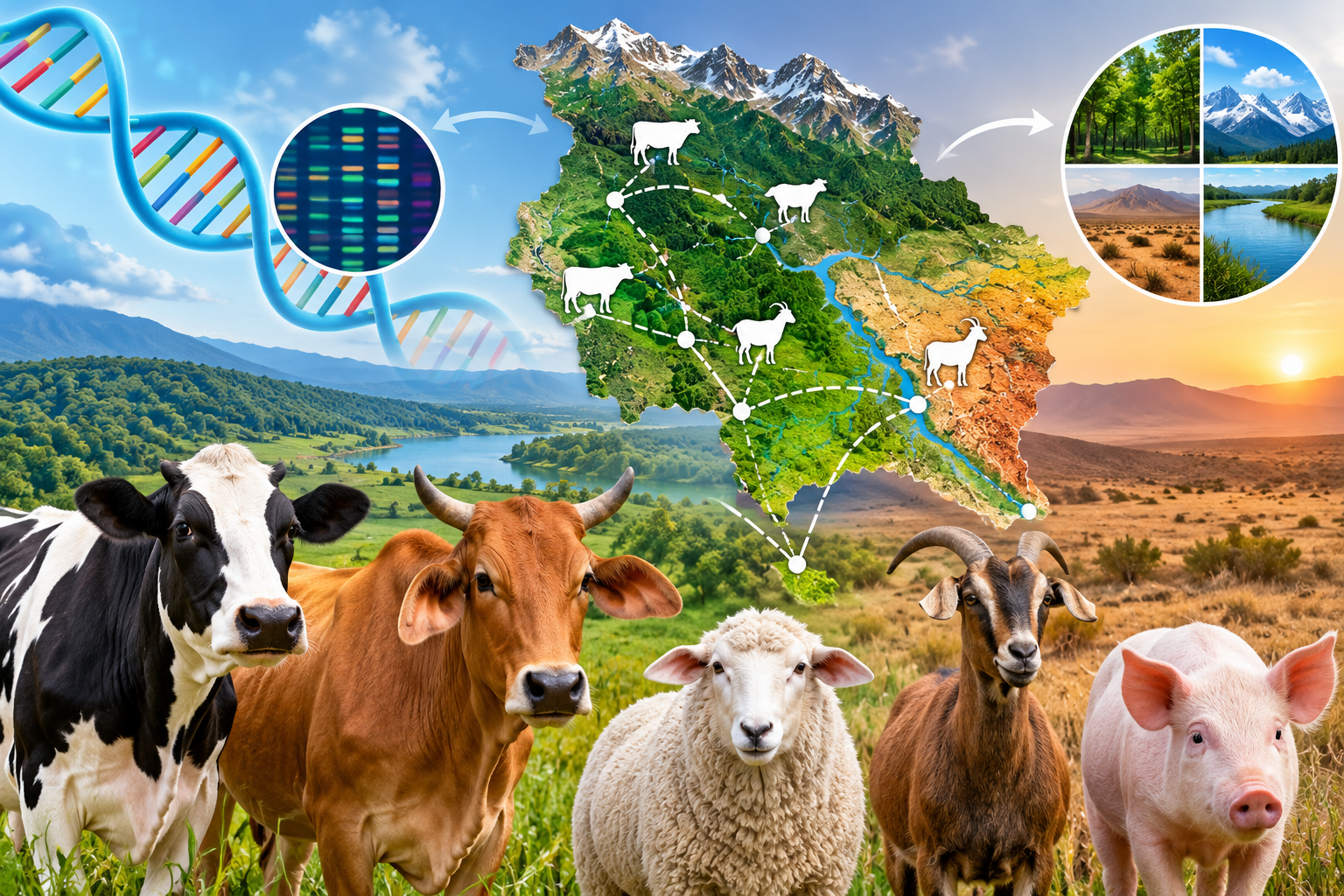
The genetic constitution is unique for each population as its composition is associated with the landscape reforms. Landscape genetics helps in understanding the structural genetic difference at population and individual levels based on gene flow in different geographical and environmental constituents. Gene flow is helpful in avoiding several adverse effects such as inbreeding, loss of heterogeneity (genetic variations), depression of population fitness, demographic problems of inbreeding and to decrease extinction risk. Livestock species are following devastating trends such as the extinction rate of biodiversity, demolition of bionetwork, and vanishing genetic diversity. This resulted adversely on livestock diversity which translates into a lack of apt reaction for future generations. Over the years, intense anthropogenic selection for highly productive cosmopolitan breeds resulted in a progressive ebb in the number of native breeds. Landscape genetics analyses are therefore very helpful in the practical conservative management of species of economic importance. In situ breed conservation can be done relevant by combining relevant information from different applied fields viz. geo-referencing, eco-climatic, epidemiological, spatial diversity at a genetic level and production aspect to strategize precedence judgments. This can be of great use to realize the genetic source of animal adaptation to the varied environmental conditions and production wise co-evolution pattern of livestock structure.
References
[1] S. Manel, M. K. Schwartz, G. Luikart and P. Taberlet (2003). Landscape genetics: combining landscape ecology and population genetics. Trends Ecol. Evol, 18: 189-197.
[2] A. Storfer, M. A. Murphy, J. S. Evans, C. S. Goldberg, S. Robinson, S. F. Spear and R. Dezzani et al., (2007). Putting the "landscape" in landscape genetics. Heredity, 98: 128-142.
[3] A. R. Wallace (1860). On the zoological geography of the Malay Archipelago. J. Proc. Linn. Soc. Zool., 4: 172-184.
[4] S. Solomon, M. Manning, M. Marquis and D. Qin (2007). Climate change 2007: the physical science basis: Working group I contribution to the fourth assessment report of the IPCC. Cambridge university press. pp 1056.
[5] Intergovernmental Panel on Climate Change. Retrieved 18 September 2021.
[6] M. A. Murphy and J. S. Evans (2011). Genetic patterns as a function of landscape process: Applications of neutral genetic markers for predictive modeling in landscape ecology. In: Drew CA, Wiersma YF, Huettmann F (eds) Predictive species and habitat modeling in landscape ecology. Springer, New York, pp161-188.
[7] G. Merriam (1984). Connectivity: a fundamental ecological characteristic of landscape pattern. J. Brandt, P. Aggerin (Eds.), Proceedings of the 1st international seminar on methodology in landscape ecological research and planning, Roskilde University, Denmark, pp5-15.
[8] B. J. Goodwin (2003). Is landscape connectivity a dependent or independent variable?. Landsc. Ecol., 18: 687-699.
[9] P. D. Taylor, L. Fahrig, K. Henein and G. Merriam (1993). Connectivity is a vital element of landscape structure. Oikos, 68: 571-573.
[10] L. S. Mills and F. W. Allendorf (1996). The one‐migrant‐per‐generation rule in conservation and management. Conserv. Biol., 10: 1509-1518.
[11] J. A. Vucetich and T. A. Waite (2003). Spatial patterns of demography and genetic processes across the species' range: null hypotheses for landscape conservation genetics. Cons. For. Genet., 4: 639-645.
[12] F. Adriaensen, J. P. Chardon, G. De Blust, E. Swinnen, S. Villalba, H. Gulinck and E. Matthysen (2003). The application of ‘least-cost’modelling as a functional landscape model. Landsc. Urban Plan., 64: 233-247.
[13] S. A. Cushman, K. S. McKelvey, J. Hayden and M. K. Schwartz (2006). Gene flow in complex landscapes: testing multiple hypotheses with causal modeling. Am. Nat., 168: 486-499.
[14] M. F. Goodchild and R. P. Haining (2004). GIS and spatial data analysis: Converging perspectives. Pap. Reg. Sci., 83: 363-385.
[15] A. Coulon, G. Guillot, J. F. Cosson, J. M. A. Angibault, S. Aulagnier, B. Cargnelutti and A. J. M. Hewison (2006). Genetic structure is influenced by landscape features: empirical evidence from a roe deer population. Mol. Ecol., 15: 1669-1679.
[16] R. L. Westemeier, J. E. Buhnerkempe, W. R. Edwards, J. D. Brawn and S. A. Simpson (1998). Parasitism of greater prairie-chicken nests by ring-necked pheasants. J. Wildl. Manage., 62: 854-863.
[17] M. Olsson and T. Madsen (2001). Promiscuity in sand lizards (Lacerta agilis) and adder snakes (Vipera berus): causes and consequences. J. Hered., 92: 190-197.
[18] M. K. Schwartz and L. S. Mills (2005). Gene flow after inbreeding leads to higher survival in deer mice. Biol. Conserv., 123: 413-420.
[19] P. Ajmone‐Marsan, J. F. Garcia and J. A. Lenstra (2010). On the origin of cattle: how aurochs became cattle and colonized the world. Evolutionary Anthropology: Issues, News, and Reviews, 19(4): 148-157.
[20] B. Chessa, F. Pereira, F. Arnaud, A. Amorim, F. Goyache, I. Mainland and R. Kao et al., (2009). Revealing the history of sheep domestication using retrovirus integrations. Science, 324: 532-536.
[21] S. Naderi, H.R. Rezaei, F. Pompanon, M. Blum, R. Negrini, H.R. Naghash and Ö. Balkız et al., (2008). The goat domestication process inferred from large-scale mitochondrial DNA analysis of wild and domestic individuals. Proc. Natl. Acad. Sci, USA, 105: 17659-17664.
[22] S. Kanginakudru, M. Metta, R. D. Jakati and J. Nagaraju (2008). Genetic evidence from Indian red jungle fowl corroborates multiple domestication of modern day chicken. BMC Evol. Biol., 8: 174, doi: 10.1186/1471-2148-8-174.
[23] G. Larson, U. Albarella, K. Dobney and P. Rowley-Conwy (2007). Current views on Sus phylogeography and pig domestication as seen through modern mtDNA studies. In A. Albarella, K. Dobney, A. Ervynck, & P. Rowley-Conwy (Eds.), Pigs and humans: 10,000 Years of interaction. Oxford: Oxford University Press. pp30-41.
[24] G. Wiener, J. Han and R. Long (2003). The yak. FAO Regional office for Asia and the Pacific.
[25] M. Pellecchia, R. Negrini, L. Colli, M. Patrini, E. Milanesi, A. Achilli and G. Bertorelle et al., (2007). The mystery of Etruscan origins: novel clues from Bos taurus mitochondrial DNA. Proc. R. Soc. B., 274: 1175-1179.
[26] C. Berthouly, D. D. Ngoc, S. Thevenon, D. Bouchel, T. N. Van, C. Danes and V. Grosbois et al., (2009). How does farmer connectivity influence livestock genetic structure? A case‐study in a Vietnamese goat population. Mol. Ecol., 18: 3980-3991.
[27] M. Bertaglia, S. Joost, J. Roosen and Econogene Consortium (2007). Identifying European marginal areas in the context of local sheep and goat breeds conservation: A geographic information system approach. Agric. Syst., 94: 657-670.
[28] C. Peter, E. M. Prinzenberg, G. Erhardt and the ECONOGENE Consortium (2005). Null allele at the OarAE129 locus and corresponding allele frequencies in German sheep breeds. Anim. Genet., 36: 71-93.
[29] L. Pariset, M. Mariotti, M. Gargani, S. Joost, R. Negrini, T. Perez and A. Valentini (2011). Genetic diversity of sheep breeds from Albania, Greece, and Italy assessed by mitochondrial DNA and nuclear polymorphisms (SNPs). Scientific World J., 11: 1641-1659.
[30] S. Joost, A. Bonin, M. W. Bruford, L. Després, C. Conord, G. Erhardt and P. Taberlet (2007). A spatial analysis method (SAM) to detect candidate loci for selection: towards a landscape genomics approach to adaptation. Mol. Ecol., 16: 3955-3969.
[31] L. Pariset, S. Joost, P. A. Marsan and A. Valentini (2009). Landscape genomics and biased FST approaches reveal single nucleotide polymorphisms under selection in goat breeds of North-East Mediterranean. BMC Genet., 10: 7. doi: 10.1186/1471-2156-10-7.
[32] M. Nagarajan (2017). Metagenomics: Perspectives, Methods, and Applications. 1st ed. London: Academic Press, Elsevier, pp1-10.
[33] M. Mishra, T. Acharyya, P. Chand, C. A. G. Santos, R. M. da Silva, C. A. C. Dos Santos and D. Kar (2022). Response of long-to short-term tidal inlet morphodynamics on the ecological ramification of Chilika lake, the tropical Ramsar wetland in India. Sci. Total Environ., 807: 150769. doi: 10.1016/j.scitotenv.2021.150769.
[34] Y. Li, X. X. Zhang, R. L. Mao, J. Yang, C. Y. Miao, Z. Li and Y. X. Qiu (2017). Ten years of landscape genomics: challenges and opportunities. Front. Plant Sci., 8: 2136. doi: 10.3389/fpls.2017.02136.
[35] D. Westphal, A. N. Mancini, and A. L. Baden (2021). Primate landscape genetics: A review and practical guide. Evol. Anthropol., 30: 171-184.
[36] E. R. Konzen, and M. I. Zucchi (2020). Landscape genetics: from classic molecular markers to genomics. In Methods in Molecular Medicine. IntechOpen. doi: 10.5772/intechopen.92022.
Downloads
Published
Issue
Section
License
Copyright (c) 2023 Author (s)

This work is licensed under a Creative Commons Attribution-NonCommercial-NoDerivatives 4.0 International License.
Copyright © The Author(s). This is an open access article distributed under the terms of the Creative Commons Attribution-NonCommercial-NoDerivatives 4.0 International License (CC BY-NC-ND 4.0), which permits unrestricted non-commercial use, distribution, and reproduction in any medium, provided the original author(s) and source are properly credited, and the work is not modified or adapted.