Exploitation of Thermomyces fungal pigment for the synthesis of silver nanoparticles for textile application
DOI:
https://doi.org/10.31783/elsr.2023.914048Keywords:
antibacterial, fungal pigment, silk fabric, silver nanoparticleAbstract
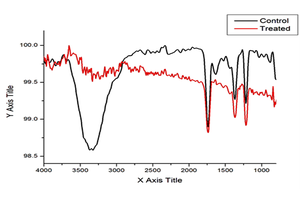
Antimicrobial fabrics have gained considerable interest for use in different fields of application. However, most of these antimicrobials have many disadvantages viz., toxicity on non-targets, environment, and low durability of finished products, etc. The study aimed to develop an eco-friendly nanoparticle that can be used both as an antimicrobial and coloring agent. Fungi are known to produce a wide spectrum of colors as secondary metabolites, and they are also capable of creating nanoparticles. Thermomyces sp. is capable of producing a yellow pigment along with the ability to synthesize silver nanoparticles. UV-Vis spectroscopy, FT-IR, and TEM were used to analyze the synthesized silver nanoparticles. The size of the silver nanoparticles was found to be between 10 and 50 nm, and nanoparticles treated cloth displayed 90% antibacterial action against Escherichia coli, Staphylococcus aureus, and Pseudomonas aeruginosa.
References
[1] S. Riaz, M. Ashraf, T. Hussain, M. T. Hussain, A. Rehman, A. Javid and K. Iqbal et al., (2018). Functional finishing and coloration of textiles with nanomaterials. Color. Technol., 134: 327-346.
[2] P. Das, S. Barua, S. Sarkar, N. Karak, P. Bhattacharyya, N. Raza and K.-H. Kim et al., (2018). Plant extract–mediated green silver nanoparticles: efficacy as soil conditioner and plant growth promoter. J. Hazard Mater., 346: 62-72.
[3] S. Prabhu and E. K. Poulose (2012). Silver nanoparticles: mechanism of antimicrobial action, synthesis, medical applications, and toxicity effects. Int. Nano Lett., 2: 32. doi: 10.1186/2228-5326-2-32.
[4] Y. Y. Loo, Y. Rukayadil, M. A. R. Nor-Khaizura, C. H. Kuan, B. W. Chieng, M. Nishibuchi and S. Radu (2018). In vitro antimicrobial activity of green synthesized silver nanoparticles against selected gram-negative foodborne pathogens. Front. Microbiol., 9: 1555. doi: 10.3389/fmicb.2018.01555.
[5] N. Durán, P. D. Marcato, M. Durán, A. Yadav, A. Gade and M. Rai (2011). Mechanistic aspects in the biogenic synthesis of extracelular metal nanoparticles by peptides, bacteria, fungi and plants. Appl. Microbiol. Biotechnol., 90: 1609-1624.
[6] D. Ballotin, S. Fulaz, M. L. Souza, P. Corio, A. G. Rodrigues, A. O .Souza and P.M. Gaspari et al., (2016). Elucidating protein involvement in the stabilization of the biogenic silver nanoparticles. Nanoscale Res. Lett., 11: 313. doi: 10.1186/s11671-016-1538-y.
[7] N. Vigneshwaran, N. M. Ashtaputre, P. V. Varadarajan, R. P. Nachane, K. M. Paralikar and R. H. Balasubramanya (2007). Biolgical synthesis of silver nanoparticles using the fungus Aspergillus flavus. Mater. Lett., 66: 1413-1418.
[8] H. Borchert, E. V. Shevchenko, A. Robert, I. Mekis, A. Kornowski, G. Grübel and H. Weller. (2005). Determination of nanocrystal sizes: a comparison of TEM, SAXS, and XRD studies of highly monodisperse CoPt3 particles. Langmuir, 21: 1931-1936.
[9] M. Moresi, A. M. Gallo and M. Petruccioli (2005). Assessment of the dyeing properties of pigments from Monascus purpureus. J. Chem. Technol. Biotechnol., 80: 1072-1079.
[10] M. A. Seif and M. M. Hiji (2016). Evaluating the effect of seams on colour fastness properties of textile fabrics. Int. J. Text. Fash. Technol., 6: 1-14.
[11] A. I. El-Batal, A. A. Hashem and N. M. Abdelbaky (2013). Gamma radiation mediated green synthesis of gold nanoparticles using fermented soybean-garlic aqueous extract and their antimicrobial activity. Springerplus, 2: 129. doi: 10.1186/2193-1801-2-129.
[12] K. Chaloupka, Y. Malam and A. M. Seifalian (2010). Nanosilver as a new generation of nanoproduct in biomedical applications. Trends Biotechnol., 28: 580-588.
[13] A. A. Taglietti, C. R. Dagostino, A. Dacarro, L. Montanaro, L. Campoccia, D. Cucca and L. Vercellino (2014). Antibiofilm activity of a monolayer of silver nanoparticles anchored to an amino-silanized glass surface. Biomaterials. 35: 1779-1788.
[14] P. Mukherjee, A. Ahmad, D. Mandal, S. Senapati, S. R. Sainkar, M. I. Khan and R. Parischa et al., (2001). Fungus mediated synthesis of silver nanoparticles and their immobilization in the mycelia matrix: a novel biological approach to nanoparticle synthesis. Nano Lett., 1: 515-519.
[15] L. R. Jaidev and G. Narasimha (2010). Fungal mediated biosynthesis of silver nanoparticles, characterization and antimicrobial activity. Colloids Surf B Biointerfaces, 81: 430-433.
[16] R. P. Metuku, S. Pabba, S. Burra, K. Gudikandula, M. S. Charya. (2014). Biosynthesis of silver nanoparticles from Schizophyllum radiatum HE 863742.1: their characterization and antimicrobial activity. 3 Biotech, 4: 227-234.
[17] S. Honary, H. Barabadi, E. Gharaei-Fathabad and F. Naghibi (2013). Green Synthesis of Silver Nanoparticles Induced by the Fungus Penicillium citrinum. Trop. J. Pharmaceut. Res., 12: 7-11.
[18] N. Soni and S. Prakash (2013). Possible mosquito control by silver nanoparticles synthesized by soil fungus (Aspergillus niger 2587). Adv. Nanopart., 2:125-132.
[19] A. Fouda and T. I. Shaheen (2017). Silver nanoparticles: biosynthesis, characterization and application on cotton fabrics. Microbiol. Res. J. Int., 20: 1-14.
[20] N. Jain, A. Bhargava, S.Majumdar, J.C. Tarafdar, J. Panwar (2011). Extracellular biosynthesis and characterization of silver nanoparticles using Aspergillus flavus NJP08: a mechanism perspective. Nano, 3: 635-641.
[21] D. S. Balaji, S. Basavaraja, R. Deshpande, D. B. Mahesh, B. K. Prabhakar and A. Venkataraman (2009). Extracellular biosynthesis of functionalized silver nanoparticles by strains of Cladosporium cladosporioides fungus. Colloids Surf. B Biointerfaces, 68: 88-92.
[22] D. Sharma, C. Gupta, S. Aggarwal and N. Nagpal (2012). Pigment extraction from fungus for textile dyeing. Indian J. Fibre Text. Res., 37: 68-73.
[23] R. Poorniammal, M. Parthiban, S. Gunasekaran, R. Murugesan and R. Thilagavathi (2013). Natural dye production from Thermomyces sp fungi for textile application. Indian J. Fibre Text. Res., 38: 276-279.
[24] R. Zhang, J.Yu, X.Guo, W.Li, Y.Xing and Y .Wang (2021). Monascus pigment‐mediated green synthesis of silver nanoparticles: Catalytic, antioxidant, and antibacterial activity. Appl. Organomet. Chem., 35:.e6120. doi: 10.1002/aoc.6120.
Downloads
Published
Issue
Section
License
Copyright (c) 2023 Author (s)

This work is licensed under a Creative Commons Attribution-NonCommercial-NoDerivatives 4.0 International License.
Copyright © The Author(s). This is an open access article distributed under the terms of the Creative Commons Attribution-NonCommercial-NoDerivatives 4.0 International License (CC BY-NC-ND 4.0), which permits unrestricted non-commercial use, distribution, and reproduction in any medium, provided the original author(s) and source are properly credited, and the work is not modified or adapted.