Ultraviolet light food processing: A mini concept
DOI:
https://doi.org/10.31783/elsr.2023.914953Keywords:
food processing, pasteurization, shelf life, ultravioletAbstract
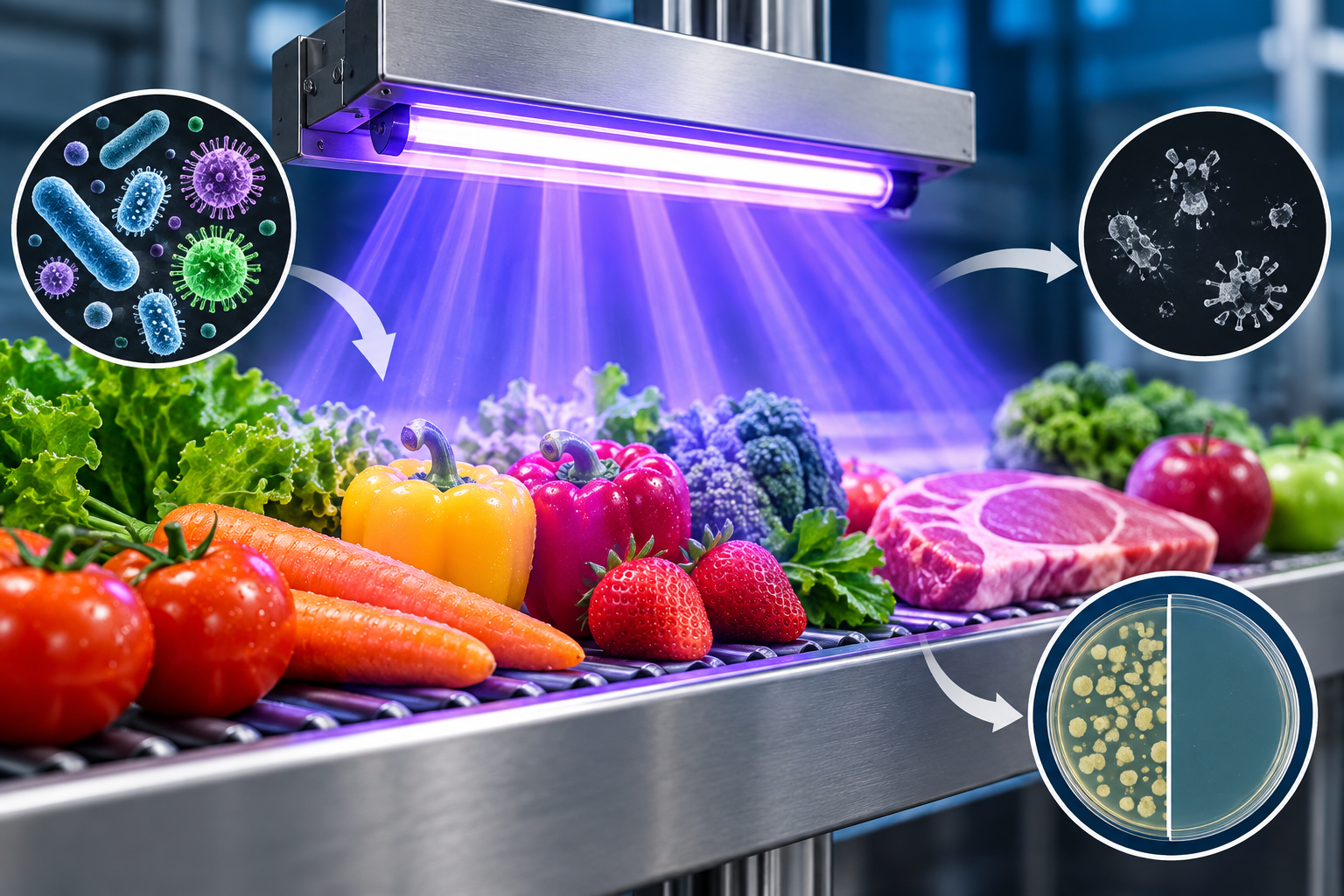
Chemical preservatives, which are added to food to increase shelf life and to guard against diseases that can spread through food borne bacteria, are drawing an increasing amount of criticism from the general public. Alternatives to present preservation methods are being sought to meet customer desires for healthier meals. In contrast to conventional heat processing, ultraviolet light has great promise in the field of food processing. Just a few of its applications include pasteurizing juices, post-lethality treating of meats, treating surfaces in touch with food and increasing the shelf life of fresh vegetables. A brief assessment of the working of UV light and its applications is done in this review. In specific this review work highlights the potential application of ultraviolet as an alternative means of preservation of food.
References
[1] S. K. Amit, M. M. Uddin, R. Rahman, S. R. Islam and M. S. Khan (2017). A review on mechanisms and commercial aspects of food preservation and processing. Agric. Food Secur., 6: 51, doi: 10.1186/s40066-017-0130-8.
[2] T. N. Koutchma, L. J. Forney and C. I. Moraru (2009). Ultraviolet light in food technology: principles and applications. CRC Press. doi: 10.1201/9780429244414.
[3] A. D. McLaren, P. Gentile, D. C. Kirk Jr. and N. A. Levin (1953). Photochemistry of proteins. XVII. Inactivation of enzymes with ultraviolet light and photolysis of the peptide bond. J. Polym. Sci., 10: 333-344.
[4] G. V. Barbosa-Canovas, D. W. Schaffner, M. D. Pierson and Q. H. Zhang (2000). Pulsed light technology. J. Food Sci., 65: 82-85.
[5] K. E. Matak, J. J. Churey, R. W. Worobo, S. S. Sumner, E. Hovingh, C. R. Hackney and M. D. Pierson (2005). Efficacy of UV light for the reduction of Listeria monocytogenes in goat's milk. J. Food Prot., 68: 2212-2216.
[6] K. Song, M. Mohseni and F. Taghipour (2019). Mechanisms investigation on bacterial inactivation through combinations of UV wavelengths. Water Res., 163: 114875. doi: 10.1016/j.watres.2019.114875.
[7] C. Adhikari and T. Koutchma (2002). Effect of UV radiation on lipids, antioxidants, and vitamins in food. Abstract of presentation at the AOAC Annual Meeting. In 93rd AOAC Annual Meeting. Montreal.
[8] K. E. Matak, S. S. Sumner, S. E. Duncan, E. Hovingh, R. W. Worobo, C. R. Hackney and M. D. Pierson (2007). Effects of ultraviolet irradiation on chemical and sensory properties of goat milk. J. Dairy Sci., 90: 3178-3186.
[9] L. C. Altic, M. T. Rowe and I. R. Grant (2007). UV light inactivation of Mycobacterium avium subsp. paratuberculosis in milk as assessed by FASTPlaqueTB phage assay and culture. Appl. Environ. Microbiol., 73: 3728-3733.
[10] M. Turtoi (2013). Ultraviolet light treatment of fresh fruits and vegetables surface: A review. J. Agroaliment. Processes Technol., 13: 325-337.
[11] S. Kulkarni and S. Karadbhajne (2015). Influence of UV light exposure on shelf life extension of fresh cut fruits. Int. J. Adv. Res., 3: 1296-1306.
[12] I. G. Paulino-Lima, K. Fujishima, J. U. Navarrete, D. Galante, F. Rodrigues, A. Azua-Bustos and L. J. Rothschild (2016). Extremely high UV-C radiation resistant microorganisms from desert environments with different manganese concentrations. J. Photochem. Photobiol. B., 163: 327-336.
[13] Z. H. Abu‐ghararah (1994). Effect of temperature on the kinetics of wastewater disinfection using ultraviolet radiation. J. Environ. Sci. Health Part A, 29: 585-603.
[14] N. G. Reed (2010). The history of ultraviolet germicidal irradiation for air disinfection. Public Health Rep., 125: 15-27.
[15] A. Allende and F. Artes (2003). Combined ultraviolet-C and modified atmosphere packaging treatments for reducing microbial growth of fresh processed lettuce. LWT-Food Sci. Technol., 36: 779-786.
[16] T. Koutchma (2009). Advances in ultraviolet light technology for non-thermal processing of liquid foods. Food and Bioprocess Technol., 2: 138-155.
Downloads
Published
Issue
Section
License
Copyright (c) 2023 Author (s)

This work is licensed under a Creative Commons Attribution-NonCommercial-NoDerivatives 4.0 International License.
Copyright © The Author(s). This is an open access article distributed under the terms of the Creative Commons Attribution-NonCommercial-NoDerivatives 4.0 International License (CC BY-NC-ND 4.0), which permits unrestricted non-commercial use, distribution, and reproduction in any medium, provided the original author(s) and source are properly credited, and the work is not modified or adapted.