Identification of suitable coloured mango (Mangifera indica L.) cultivars for Bihar conditions
DOI:
https://doi.org/10.31783/elsr.2023.915460Keywords:
canopy volume, coloured varieties, flowering intensity, mango, yieldAbstract
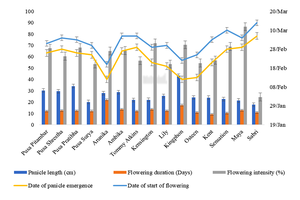
An experiment was conducted on 15 coloured mango cultivars at Bihar Agricultural University, Sabour, Bihar during the year 2020-2021 to identify suitable coloured mango cultivars for Bihar conditions. Arunika and Kingphon were found early in panicle emergence and anthesis while much delayed panicle emergence and anthesis were observed in Sabri. The maximum length of the panicle was measured in Kingphon (43.22 cm) whereas; the minimum was in Sabri (17.76 cm). The minimum flowering duration was recorded in Kent (9.20 days) with statistically at par value in Sensation, Osteen and Sabri. While the longest flowering duration was observed in Arunika (22 days). Maya was topped (86.50 %) in the list for the flowering intensity which was found statistically at par with Kensington (72.50 %). Maximum number of fruit set per panicle was counted in Tommy Atkins (21.10) which was statistically at par with Sensation (20.60). Early fruit maturity and the highest number of fruits per plant at the maturity stage were found in Pusa Pratibha. The highest fruit weight, volume, pulp percentages and pulp/stone ratio were observed in Osteen (505.71 g, 500.05 ml, 73.40% and 6.98 respectively) followed by Lily. Pusa Pitambar yielded the highest number of fruits per m3 canopy volume (2.34) with statistically at par results in Kent (1.77). The maximum TSS/Acid blend was assessed in Sensation (99.25). The total sugar content (16.48%) was found in Pusa Pratibha which was statistically at par with Pusa Surya (15.90%) and Sabri (15.47%).
References
[1] Anonymous (2020). Horticulture Statistics Division, Department of Agriculture, Co-operation and Farmers’ Welfare.
[2] M. M. Rahman, T. Ichiyanagi, T. Komiyama, S. Sato and T. Konishi (2008). Effects of anthocyanins on psychological stress-induced oxidative stress and neurotransmitter status. J. Agric. Food Chem., 56: 7545-7550.
[3] E. Skates, J. Overall, K. DeZego, M. Wilson, D. Esposito, M. A. Lila and S. Komarnytsky (2018). Berries containing anthocyanins with enhanced methylation profiles are more effective at ameliorating high fat diet-induced metabolic damage. Food Chem. Toxicol., 111: 445-453.
[4] E. Kayesh, L. Shangguan, N. K. Korir, X. Sun, N. Bilkish, Y. Zhang and J. Han et al., (2013). fruit skin color and the role of anthocyanin. Acta Physiol. Plant, 35: 2879-2890.
[5] R. Joshi, M. Kundu and C. P. Singh (2013). Morphological characters: efficient tool for identification on different mango cultivars. Environ. Ecol., 31: 385-388.
[6] S. N. Singh, S. Sengupta, M. Kundu, S. Sahay and D Kumar (2021). Phenological characterization of different mango genotype under Sabour condition. The Pharma Innov. J., 10: 2152-2156.
[7] S. Das, M. Kundu, S. Sengupta and S. Nahakpam (2023). Assessment of physio-chemical, nutritional and enzymatic activities in the bud in relation to flowering behaviours of different alternate bearing mango (Mangifera indica L.) cultivars. Commun. Soil Sci. Plant Anal., 54: 640-654.
[8] E. Jones and R. E. Hughes (1983). Foliar ascorbic acid in some angiosperms. Phytochem., 22: 2493-2499
[9] J. H. Lane and L. Eyon (1934). Determination of reducing sugars by Fehling’s solutions with methylene blue indicator. Normam Rodge, London, pp1-8
[10] S. K. Roy (1973). Simple and rapid method for estimation of total carotenoid pigments in mango. J. Food Sci. Technol., 10: 45.
[11] M. S. Gill, S. Navprem, N. Singh and P. P. S. Gill (2011). Performance of mango cultivars under sub-mountane zone of subtropics of India. Acta Hortic., 1066: 27-33.
[12] S. Ankit, M. Srivastav, A. K. Singh, A. K. Dubey and S. K. Lal (2014). Flowering attributes of parental mango genotypes. Ind. J. Hortc., 71: 458-463.
[13] H. Barua, M. A. Patwary and M. H. Rahman (2013). Performance of BARI mango (Mangifera indica L.) varieties in Chittagong region. Bangladesh J. Agric. Res., 38: 203-209.
[14] A. Kumar, S. Malik, S. Prakash, M. K. Singh, P. Chandand and B. P. Dhayani (2018). A study on the Physico-Chemical characteristics of different cultivars of mango (Mangifera indica L.) Under Western Uttar Pradesh Conditions. Progressive Agric., 18: 57-61.
[15] H. Rymbai, M. Srivastav, S. K. Singh and A. K. Singh (2016). Growth, flowering and yield attributes of full-sib (Amrapali× Sensation) hybrids of mango. Indian J. Hortic., 73: 157-164.
[16] L. Bora, A. K. Singh and C. P. Singh (2017). Characterization of mango (Mangifera indica L.) genotypes based on physio-chemical quality attributes. J. App. Nat. Sci., 9: 2199-2204.
[17] K. Kishore, H. S. Singh, R. M. Kurian, P. Srinivas and D. Samant (2015). Performance of certain mango varieties and hybrids in east coast of India. Indian J. Genet. Plant Resou., 28: 296-302.
[18] S. Haque, P. Begum, M. Khatun and S. N. Islam (2015). Total carotenoid content in some mango (Mangifera indica) varieties of Bangladesh. Int. J. Pharm. Sci. Res., 6: 4875-4878.
Downloads
Published
Issue
Section
License
Copyright (c) 2023 Author (s)

This work is licensed under a Creative Commons Attribution-NonCommercial-NoDerivatives 4.0 International License.
Copyright © The Author(s). This is an open access article distributed under the terms of the Creative Commons Attribution-NonCommercial-NoDerivatives 4.0 International License (CC BY-NC-ND 4.0), which permits unrestricted non-commercial use, distribution, and reproduction in any medium, provided the original author(s) and source are properly credited, and the work is not modified or adapted.