Production, partial purification and characterization of intracellular Azoreductase from bacterial isolates during biodecolorization of textile dye Acid Maroon V
DOI:
https://doi.org/10.31783/elsr.2023.916171Keywords:
azoreductase, bacterial cultures ED and PA, characterization, decolorizationAbstract
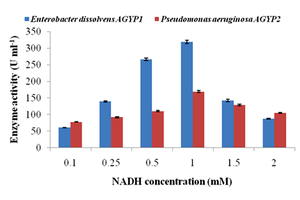
Azoreductase is an important enzyme for the reduction of the azo linkage of dye during the biodecolorization process. In the present study, the production of intracellular azoreductase from bacterial cultures Enterobacter dissolvens AGYP1 (ED) and Pseudomonas aeruginosa AGYP2 (PA) was achieved during biodecolorization of synthetic textile dye Acid Maroon V. When compared with PA, the enzyme activity of ED was 2.31 times greater. The partial purification of azoreductase revealed specific activity of the dialyzed enzyme 51.72 U mg-1 protein (ED) and 33.06 U mg-1 protein (PA). Methyl Red served as the best substrate for the azoreductase enzyme with superior activity at optimal pH 7 and temperature 30 °C. 75-80% of azoreductase enzyme activity was maintained when Mg+2 and Ca+2 were present. The azoreductase activity was considerably increased with NADH as the most suitable electron donor. The kinetic study showed consequent Michaelis-Menten constant (Km) and maximal velocity (Vmax) values of 50 μM and 2222 U ml-1 (ED) and 250 μM and 1000 U ml-1 (PA), respectively.
References
[1] S. Barathi, K. N. Aruljothi, C. Karthik and I. A. Padikasan (2020). Optimization for enhanced ecofriendly decolorization and detoxification of Reactive Blue160 textile dye by Bacillus subtilis. Biotechnol. Rep., 28: e00522. doi: 10.1016/j.btre.2020.e00522.
[2] H. Chen, J. Feng, O. Kweon, H. Xu and C. E. Cerniglia (2010). Identification and molecular characterization of a novel flavin-free NADPH preferred azoreductase encoded by azoB in Pigmentiphaga kullae K24. BMC Biochem., 11: 13. doi: 10.1186/1471-2091-11-13.
[3] Y. Patel and U. Chhaya (2019). Potential of bacteria for biological decolorization and degradation of synthetic dyes. Recent advances in biotechnology, Recent Trend in Biotechnology. Nova Science Publisher, New York, 229-258.
[4] C. O’. Neill, F. R. Hawkes, D. L. Hawkes, N. D. Lourenço, H. M. Pinheiro and W. Delée (1999). Color in textile effluents-sources, measurement, discharge consents and simulation: a review. J. Chem. Technol. Biotechnol., 74: 1009-1018.
[5] M. M. Haque, M. A. Haque, M. K. Mosharaf and P. K. Marcus (2021). Decolorization, degradation and detoxification of carcinogenic sulfonated azo dye methyl orange by newly developed biofilm consortia. Saudi J. Biol. Sci., 28: 793-804.
[6] T. Ooi, T. Shibata, R. Sato, H. Ohno, S. Kinoshita, T. L. Thuoc and S. Taguchi (2007). An azoreductase, aerobic NADH-dependent flavoprotein discovered from Bacillus sp.: functional expression and enzymatic characterization. Appl. Microbiol. Biotechnol., 75: 377-386.
[7] Y. Patel, U. Chhaya, D. M. Rudakiya and S. Joshi (2021). Biological decolorization and degradation of synthetic dyes: a green step toward sustainable environment. In Microbial rejuvenation of polluted environment, pp77-110, Springer, Singapore.
[8] J. Cong, X. Xie, Y. Liu, Y. Qin, J. Fan, Y. Fang and N. Liu et al., (2022). Biochemical characterization of a novel azo reductase named BVU5 from the bacterial flora DDMZ1: application for decolorization of azo dyes. RSC Adv., 12: 1968-1981.
[9] P. Saranraj, D. Stella and P. Sivasakthivelan (2014). Separation, purification and characterization of dye degrading enzyme azoreductase from bacterial isolates. Cent. Eur. J. Exp. Biol., 3: 19-25.
[10] J. S. Chang, C. Chou, Y. C. Lin, P. J. Lin, J. Y. Ho and T. L. Hu (2001). Kinetic characteristics of bacterial azo-dye decolorization by Pseudomonas luteola. Water Res., 35: 2841-2850.
[11] S. A. Zahran,, M. Ali-Tammam,, A. M. Hashem,, R. K. Aziz and A. E. Ali (2019). Azoreductase activity of dye-decolorizing bacteria isolated from the human gut microbiota. Sci. Rep., 9: 5508. doi: 10.1038/s41598-019-41894-8.
[12] M. Leelakriangsak and S. Borisut (2012). Characterization of the decolorizing activity of azo dyes by Bacillus subtilis azoreductase AzoR1. Songklanakarin J. Sci. Technol., 34: 509-516.
[13] R. Mazumder, J. R. Logan A. T. Mikell Jr and S. W. Hooper (1999). Characteristics and purification of an oxygen insensitive azoreductase from Caulobacter subvibrioides strain C7-D. J. Ind. Microbiol. Biotechnol., 23: 476-483.
[14] T. Zimmermann, F. Gasser, H. G. Kulla and T. Leisinger (1984). Comparison of two bacterial azoreductases acquired during adaptation to growth on azo dyes. Arch. Microbiol., 138: 37-43.
[15] Y. Patel, C. Mehta and A. Gupte (2012). Assessment of biological decolorization and degradation of sulfonated di-azo dye acid maroon V by isolated bacterial consortium EDPA. Int. Biodeter. Biodegrad., 75: 187-193.
[16] T. Zimmermann, H. G. Kulla, T. Leisinger (1982). Properties of purified orange II azoreductase, the enzyme initiating azo dye degradation by Pseudomonas KF46. European J. Biochem., 129: 197-203.
[17] J. S. Chang and T. S. Kuo (2000). Kinetics of bacterial decolorization of azo dye with Escherichia coli NO3. Bioresour. Technol., 75: 107-111.
[18] H. Chen, S. L. Hopper and C. E. Cerniglia (2005). Biochemical and molecular characterization of an azoreductase from Staphylococcus aureus, a tetrameric NADPH-dependent flavoprotein. Microbiol., 151: 1433-1441.
[19] F. Rafii, W. Franklin and C.E. Cerniglia (1990). Azoreducatase activity of anaerobic bacteria isolated from human intestinal micro flora. Appl. Environ. Microbiol., 56: 2146-2151.
[20] A. Bafana, S. S. Devi, K. Krishnamurthi and T. Chakrabarti (2007). Kinetics of decolourisation and biotransformation of direct black 38 by C. hominis and P. stutzeri. Appl. Microbiol. Biotechnol., 74: 1145-1152.
[21] A. Guadie, S. Tizazu, M. Melese, W. Guo, H. H. Ngo and S. Xia (2017). Biodecolorization of textile azo dye using Bacillus sp. strain CH12 isolated from alkaline lake. Biotechnol. Rep., 15: 92-100.
[22] S. Mendes, A. Farinha, C. G. Ramos, J. H. Leitão, C. A. Viegas and L. O. Martins (2011). Synergistic action of azoreductase and laccase leads to maximal decolourization and detoxification of model dye-containing wastewaters. Bioresour. Technol., 102: 9852-9859.
[23] S. Sandhya, K. Sarayu, B. Uma and K. Swaminathan (2008). Decolorizing kinetics of a recombinant Escherichia coli SS125 strain harboring azoreductase gene from Bacillus latrosporus RRK1. Bioresour. Technol., 99: 2187-2191.
[24] S. Pricelius, C. Held, M. Murkovic, M. Bozic, V. Kokol, A. Cavaco-Paulo and G. M. Gübitz (2007). Enzymatic reduction of azo and indigoid compounds. Appl. Microbiol. Biotechnol., 77: 321-327.
[25] A. Moutaouakkil, Y. Zeroual, F. Z. Dzayri, M. Talbi, K. Lee and M. Blaghen (2003). Purification and partial characterization of azoreductase from Enterobacter agglomerans. Arch. Biochem. Biophys., 413: 139-146.
[26] C. V. Nachiyar and G. S. Rajakumar (2005). Purification and characterization of an oxygen insensitive azoreductase from Pseudomonas aeruginosa. Enzym. Microb. Technol., 36: 503-509.
[27] Y. Bin, Z. Jiti, W. Jing, D. Cuihong, H. Hongman, S. Zhiyong and B. Yongming (2004). Expression and characteristics of the gene encoding azoreductase from Rhodobacter sphaeroides AS1. 1737. FEMS Microbiol. Lett., 236: 129-136.
[28] E. Idaka, H. Horitsu and T. Ogawa (1987). Some properties of azoreductase produced by Pseudomonas cepacia. Bull. Environ. Contam. Toxicol., 39: 982-989.
[29] Y. Nishiya and Y. Yamamoto (2007). Characterization of a NADH: dichloroindophenol oxidoreductase from Bacillus subtilis. Biosci. Biotechnol. Biochem., 71: 611-614.
[30] C. Zhang, S. Zhang, H. Diao, H. Zhao, X. Zhu, F. Lu and Z. Lu (2013). Purification and characterization of a temperature-and pH-stable laccase from the spores of Bacillus vallismortis fmb-103 and its application in the degradation of malachite green. J. Agric. Food Chem., 61: 5468-5473.
[31] R. Al-Tohamy, E. R. Kenawy, J. Sun and S. S. Ali (2020). Performance of a newly isolated salt-tolerant yeast strain Sterigmatomyces halophilus SSA-1575 for azo dye decolorization and detoxification. Front. Microbiol., 11: 1163. doi: 10.3389/fmicb.2020.01163.
[32] M. Zhao, P. F. Sun, L. N. Du, G. Wang, X. M. Jia and Y. H. Zhao (2014). Biodegradation of methyl red by Bacillus sp. strain UN2: decolorization capacity, metabolites characterization, and enzyme analysis. Environ. Sci. Pollut. Res., 21: 6136-6145.
[33] M. Lorenzo, D. Moldes, S. R. Couto and M. A. Sanromán (2005). Inhibition of laccase activity from Trametes versicolor by heavy metals and organic compounds. Chemosphere, 60: 1124-1128.
[34] S. Punj and G. H. John (2009). Purification and identification of an FMN-dependent NAD (P) H azoreductase from Enterococcus faecalis. Curr. Issues Mol. Biol., 11: 59-66.
[35] H. Chen (2006). Recent advances in azo dye degrading enzyme research. Curr. Protein Pept. Sci., 7: 101-111.
Downloads
Published
Issue
Section
License
Copyright (c) 2023 Author (s)

This work is licensed under a Creative Commons Attribution-NonCommercial-NoDerivatives 4.0 International License.
Copyright © The Author(s). This is an open access article distributed under the terms of the Creative Commons Attribution-NonCommercial-NoDerivatives 4.0 International License (CC BY-NC-ND 4.0), which permits unrestricted non-commercial use, distribution, and reproduction in any medium, provided the original author(s) and source are properly credited, and the work is not modified or adapted.